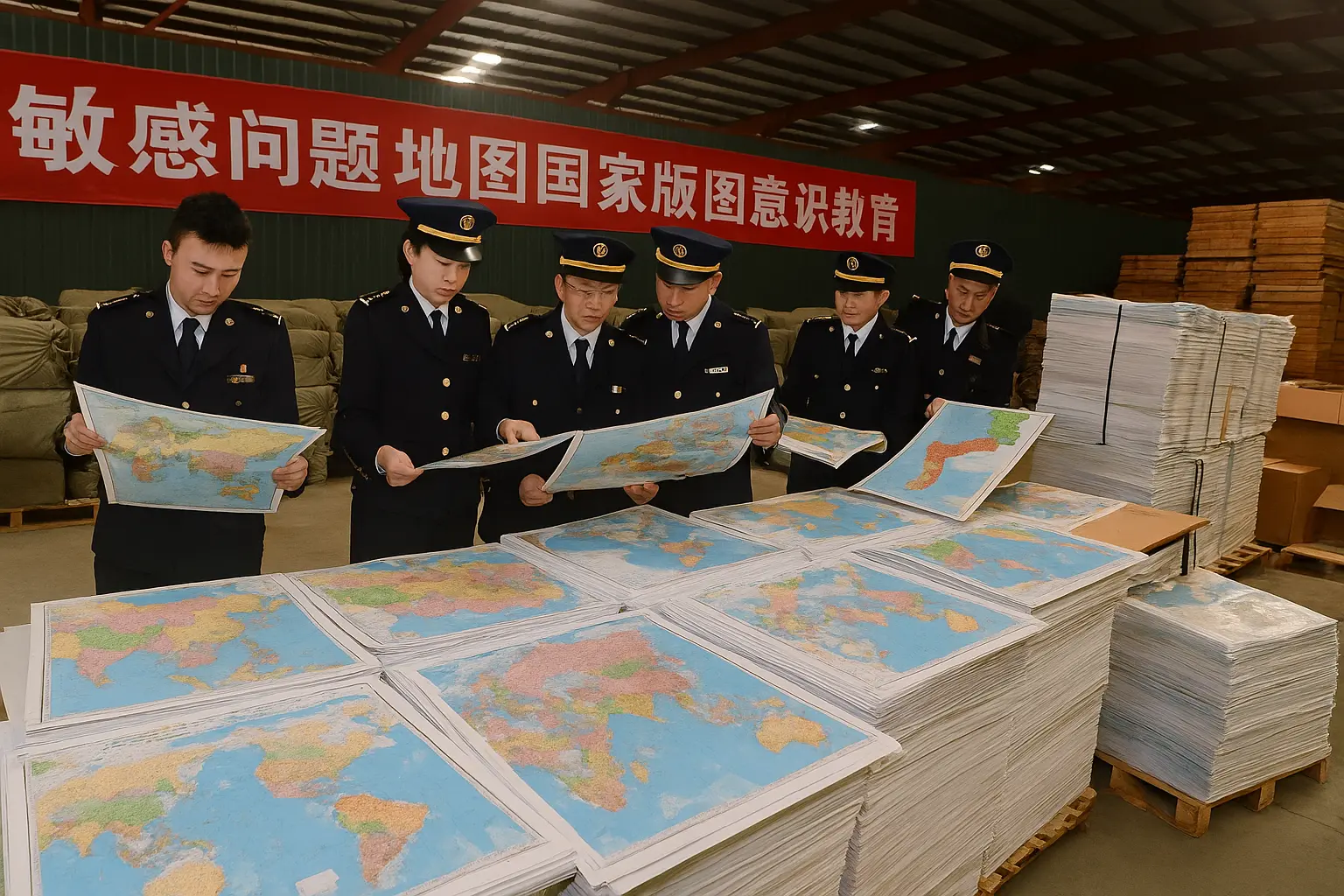
China has recently seized 60,000 maps in an export inspection, citing errors such as “mislabelling” the Taiwan region and omitting key territories. According to the Qingdao Customs authority, the confiscated maps lacked the mandatory map-review number issued by China’s Ministry of Natural Resources and contained serious deviations from the official Chinese territorial representation.
What Went Wrong in the Maps
The authorities flagged multiple violations, including:
- Labeling Taiwan in a manner inconsistent with Beijing’s “One China” policy
- Omitting islands in the South China Sea
- Excluding the nine-dash line, which China uses to assert maritime claims
- Leaving out contested features such as Diaoyu Dao (Senkaku Islands) and Chiwei Yu
According to Chinese regulation, such “problematic maps” are classified as goods that threaten national unity, sovereignty, and territorial integrity, and are strictly banned from import or export.
The Political and Symbolic Stakes
Maps are not merely geographical tools — they are powerful instruments of political messaging. China treats representation of geographic boundaries as central to its diplomatic and domestic narrative. Strict control over how Taiwan is depicted reflects its insistence that Taiwan is part of China.
In past incidents, Chinese customs have also intercepted books or publications whose maps mischaracterized China’s border claims — for example, books that labeled Taiwan as a separate “country” have been confiscated.
Trump threatens to impose additional 100% tariff on China
Such seizures are in line with Beijing’s broader effort to eliminate “incorrect maps” worldwide, reinforcing the narrative that any depiction of Taiwan as independent is invalid.
Reaction & International Implications
Internationally, such moves may draw criticism on grounds of censorship or overreach. However, from Beijing’s perspective, ensuring that exports conform to its cartographic and territorial norms is nonnegotiable.
For countries or publishers outside China, this presents a diplomatic tightrope. Many global mapping and publishing entities must navigate conflicting pressures: represent contested regions according to international conventions while avoiding triggers in major markets like China.
For Taiwan, this episode reiterates Beijing’s commitment to asserting sovereignty through nonmilitary tools — in this case, cartographic control. The map seizure can also be read as a signal: China will penalize not only military or diplomatic dissent, but even perceived symbolic or visual deviations.