Iran negotiation

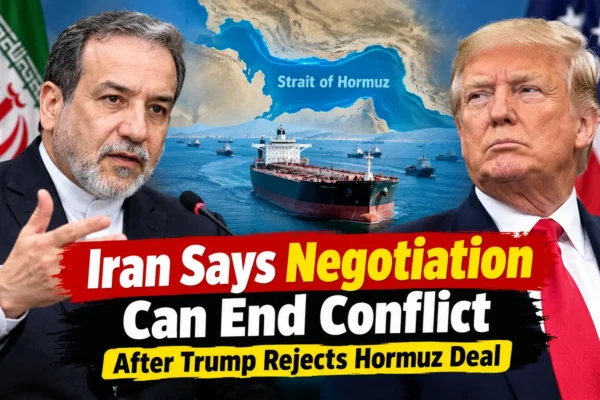
Iranian minister says only negotiation can end conflict after Trump rejects Hormuz deal

Iranian Foreign Minister Abbas Araghchi has said that only a negotiated solution can end the conflict between Iran, the United States and Israel, after President Donald Trump rejected Tehran’s latest proposal to reopen the Strait of Hormuz. Araghchi said on Sunday that Iran remained prepared for diplomacy despite Trump’s rejection of the proposal. He also said Tehran was waiting for mediators to deliver Washington’s official response before deciding its next steps. Iran had presented a seven-day roadmap through Qatari mediators during the United Nations General Assembly in New York. Under the proposal, Tehran said the Strait of Hormuz could be reopened within seven days if Washington met several conditions, including lifting its naval blockade, easing restrictions on Iranian oil sales, releasing frozen Iranian assets and observing a broader ceasefire. Iran also proposed restarting negotiations over its nuclear programme. Trump said he had rejected the proposal, arguing that the terms offered by Iran were unacceptable. US officials have also said Washington wants broader commitments from Tehran, particularly concerning Iran’s nuclear programme. The two sides therefore remain divided over the conditions required to resume negotiations. The Strait of Hormuz remains at the centre of the dispute because it is a crucial route for global energy shipments. Disruptions in the waterway have contributed to uncertainty in international oil markets and raised concerns about wider economic consequences. Despite the public disagreement, Iranian officials continue to emphasize diplomacy. Araghchi said Iran was ready for negotiations while also warning that Tehran remained prepared if fighting resumed. The United States has indicated that further talks could still take place, leaving diplomatic channels open even as tensions remain high.


Read More
Trump Xi White House meeting

Trump says he and Xi held ‘great meeting’ as Chinese leader visits White House

President Donald Trump said he and Chinese President Xi Jinping had a “great meeting” at the White House on Thursday, as the two leaders held high-level talks aimed at managing tensions between the world’s two largest economies. Xi’s visit marks his first trip to Washington in more than a decade. The meeting brought together the leaders at a time when Washington and Beijing continue to compete over trade, technology, artificial intelligence, critical minerals and security issues. Trump praised his relationship with Xi, describing it as a “truly great friendship” and saying the two countries had made progress on several issues. Trade was among the central subjects. The United States and China recently agreed to extend a fragile trade truce, helping prevent an immediate return to broader tariff tensions. The leaders are also expected to discuss agricultural purchases and market access, issues important to businesses and farmers in both countries. Artificial intelligence was another major focus. Both countries are competing for technological leadership, while officials are also discussing safeguards for increasingly powerful AI systems. Xi said the United States and China, as major AI powers, have a responsibility to develop and manage the technology responsibly. Other sensitive issues include Taiwan, Iran and the supply of critical minerals. Xi called for stronger communication between the two governments and said cooperation could help prevent confrontation between the rival powers. The White House visit included a formal arrival ceremony and a state dinner, underscoring the diplomatic importance attached to Xi’s trip. While the leaders emphasized cooperation, major differences between Washington and Beijing remain unresolved.

Read More
Trump media ban

Major US outlets boycott shared Trump coverage in protest at media ban

Major U.S. television networks have taken the unusual step of suspending shared coverage of President Donald Trump after his administration barred CNN, MS NOW and Politico from the White House. The move has created a major confrontation between the Trump administration and several of the country’s biggest news organizations. ABC, CBS, NBC, Fox News and CNN participate in the White House television pool, a system in which one network provides live video that is shared with other broadcasters. On Monday, the networks halted that pool operation after CNN was removed from its scheduled duty following the White House ban. The decision meant that major television outlets did not provide their usual shared live footage of Trump’s public events. Trump announced on September 18 that CNN, MS NOW and Politico would be barred from the White House, accusing them of publishing what he described as “fake news.” The outlets rejected the accusations and said they would continue reporting on the administration. Their journalists were subsequently denied access and had their White House credentials revoked. The three organizations have also filed a federal lawsuit against the Trump administration, arguing that the restrictions violate constitutional protections for freedom of the press and due process. The case is now part of a broader legal and political dispute over media access to the presidency. The boycott has highlighted the importance of the White House press pool, which allows television audiences and other media organizations to receive shared footage of presidential events. Print, radio and wire-service journalists have continued covering Trump’s activities despite the television pool suspension. The dispute comes amid a wider and increasingly contentious relationship between Trump’s administration and major U.S. news organizations, with questions about press access, government transparency and First Amendment protections likely to remain central to the conflict.

Read More
Germany state election

German Chancellor Merz calls state election a ‘disaster’ for his party but vows to stay on

German Chancellor Friedrich Merz has described a damaging state election result as a “disaster” for his conservative Christian Democratic Union (CDU), while insisting that he will remain in office and continue with his government’s reform plans. The setback came in Mecklenburg-Western Pomerania, where exit projections showed the CDU receiving only about 5% of the vote. That marked the party’s weakest result in a German state election since the Federal Republic was founded after the Second World War. The Alternative for Germany (AfD) emerged as the strongest party, with roughly 37% of the vote, narrowly ahead of the centre-left Social Democrats. The results also brought difficulties for the CDU in Berlin, where the party was projected to finish behind the left-wing Die Linke. The outcomes came only two weeks after the AfD secured a major victory in Saxony-Anhalt, adding to pressure on Merz and his government. Merz acknowledged the seriousness of the result but rejected suggestions that he should step aside. He said Germany’s economic and political challenges made reforms more necessary rather than less urgent. His government has been pursuing measures involving economic growth, pensions, taxation and reducing bureaucracy. The chancellor also defended his position as CDU leader and said he intended to continue serving as Germany’s chancellor. The election results are likely to fuel debate inside the CDU over its political strategy and response to the growing strength of the AfD. For Merz, the immediate challenge will be maintaining support within his party and coalition while delivering on promised reforms amid voter dissatisfaction and increasing political competition.

Read More
Canada EU associate member

EU chief backs plan for Canada to become ‘associate member’

European Commission President Ursula von der Leyen has proposed opening the door for Canada to become the European Union’s first “associate member,” marking a significant step toward closer ties between Ottawa and Brussels. Speaking during her annual State of the European Union address in Strasbourg on September 16, von der Leyen directly addressed Canadian Prime Minister Mark Carney, who was attending the speech. She said the EU wanted to take its relationship with Canada to the “highest level possible.” The proposal would build on the existing Canada-European Union Comprehensive Economic and Trade Agreement, known as CETA. Von der Leyen described the next stage as an “Alliance for the Future,” with cooperation potentially covering advanced manufacturing, artificial intelligence, critical minerals, energy, batteries, defence production, cybersecurity, quantum technology and Arctic projects. For Canada, the initiative comes as Ottawa seeks to diversify its economic and strategic relationships. Canada remains highly dependent on trade with the United States, while recent tensions with Washington have encouraged the government to strengthen connections with European partners. Carney has previously described his goal as creating a “unique alliance” with the EU. However, the proposed associate-member status is still undefined. EU treaties currently do not contain a formal category called “associate membership,” meaning negotiations would be required to establish what rights and obligations Canada would have. Questions could include access to parts of the EU single market, participation in European programmes and whether Canada would have any role in EU decision-making. The proposal is therefore an opening for deeper cooperation rather than an immediate change in Canada’s status. Further discussions are expected as Canada and the EU prepare for closer economic, technological and security cooperation.

Read More
Russia strikes train near Poland border

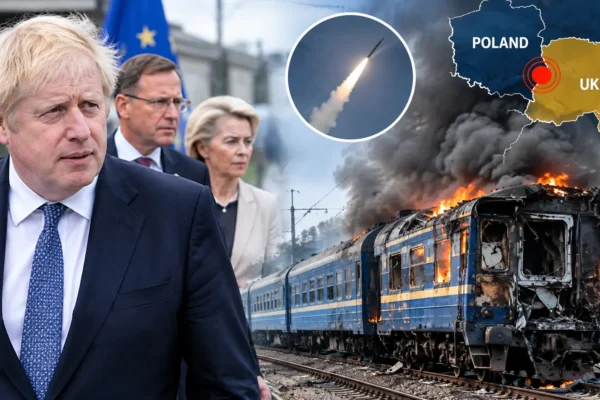
Russia struck train near Poland border shortly after Boris Johnson and top European officials passed through

Russia struck a train near Poland’s border shortly after former British Prime Minister Boris Johnson and senior European officials had traveled through the area, raising fresh concerns about the security of transport routes close to Ukraine’s western frontier. The incident occurred amid heightened tensions across the region as Russia continues its military campaign against Ukraine. The railway network in western Ukraine remains strategically important, carrying passengers, humanitarian supplies and other essential goods while also serving as a key connection to neighboring European countries. The timing of the strike has attracted particular attention because Johnson and other European figures had recently passed through the region. However, the reported proximity in timing does not by itself establish that the train was deliberately targeted because of their presence. Ukrainian authorities are expected to investigate the circumstances and assess whether the railway infrastructure was specifically targeted. Western Ukraine has generally been viewed as safer than areas closer to the front line, but Russian missile and drone attacks have increasingly reached infrastructure far from the main battlefield. Railway facilities have previously been targeted because of their importance to Ukraine’s military and civilian logistics. The incident also highlights the continuing risks faced by European officials visiting Ukraine. International leaders have regularly traveled by rail because of security and logistical considerations, particularly when visiting Kyiv and other Ukrainian cities. European governments are closely monitoring developments as Russia continues to strike Ukrainian infrastructure. Any evidence that a foreign delegation’s movements were intentionally targeted could significantly increase diplomatic tensions. For Ukraine, protecting railway connections remains a major priority as the country depends heavily on its rail system during wartime. The latest strike is likely to renew discussions about air-defense coverage, infrastructure protection and the security of international visitors traveling through the country

Read More
25th anniversary of 9/11

US marks 25th anniversary of 9/11 with tribute to victims of attacks

The United States is marking the 25th anniversary of the September 11, 2001, terrorist attacks with ceremonies honoring the nearly 3,000 people who lost their lives and remembering one of the darkest days in the nation’s modern history. Memorial events are being held at key locations connected to the attacks, including New York City, the Pentagon and Shanksville, Pennsylvania. Families of victims, survivors, first responders and government officials are gathering to pay tribute and reflect on the lasting impact of September 11. In New York, the names of those killed in the attacks are being read during a solemn ceremony at the 9/11 Memorial and Museum. Moments of silence mark the times when the hijacked planes struck the World Trade Center towers and when the towers collapsed. The anniversary also highlights the extraordinary courage of firefighters, police officers, emergency workers and ordinary citizens who responded to the attacks. Many first responders later died or suffered serious illnesses linked to their work at Ground Zero and other disaster sites. Twenty-five years later, the attacks continue to influence American society, national security and foreign policy. The events led to major changes in airport security, intelligence operations and counterterrorism policies, as well as the long wars that followed in Afghanistan and Iraq. For younger Americans who were born after 2001, the anniversary provides an opportunity to learn about an event they did not personally experience. Schools, museums and memorial organizations are preserving firsthand accounts from survivors and families so that the history is not forgotten. As the United States observes the 25th anniversary, the central message remains one of remembrance, resilience and unity. Families continue to mourn their loved ones, while the nation honors those who died and recognizes the lasting sacrifices made in the aftermath of the attacks.

Read More
Germany Merz AfD

Germany’s Merz attacks AfD in stormy debate after far-right election win

German Chancellor Friedrich Merz launched a fierce attack on the far-right Alternative for Germany (AfD) during a stormy parliamentary debate on Wednesday, just days after the party secured a major election victory in the eastern state of Saxony-Anhalt. The confrontation between Merz and AfD co-leader Alice Weidel came during a heated Bundestag debate marked by repeated interruptions and angry exchanges. Weidel opened the debate by accusing Merz’s coalition government of “total failure” and argued that voters had demanded a major political change. Merz responded forcefully, describing the AfD as a “destructive force” and insisting that the party would struggle to win an outright majority in Germany with its current policies. His comments followed the AfD’s strong performance in Saxony-Anhalt, where it won almost 44% of the vote, while Merz’s conservative CDU suffered a major setback. One of the main points of Merz’s attack was the AfD’s policy of “remigration,” which refers to plans involving the removal of certain migrants from Germany. Merz accused the party of promoting policies that could amount to ethnic cleansing and warned that aggressive migration policies could damage industries that depend heavily on migrant workers, including healthcare, hospitality and skilled trades. Merz also criticized the AfD’s position on Russia and Ukraine, arguing that its foreign-policy approach could harm German interests. The AfD, meanwhile, has continued to oppose Germany’s support for Ukraine and has called for closer relations with Moscow. The election result has intensified pressure on Merz and his coalition. Despite the AfD’s victory, mainstream German parties continue to maintain a political “firewall” against cooperation with the far-right party. The confrontation highlights Germany’s growing political divide as the AfD gains support and Merz faces increasing pressure to respond to voters’ concerns over migration, the economy and government performance.

Read More
Israeli strikes in southern Lebanon

Israeli strikes in southern Lebanese village kill 12

Israeli strikes in a village in southern Lebanon have reportedly killed 12 people, adding to growing concerns over renewed violence along the Israel-Lebanon border. The strikes caused casualties and damage in the area, according to reports, as tensions between Israel and armed groups in the region remain high. Southern Lebanon has repeatedly been affected by cross-border hostilities, with civilians facing the greatest risks as fighting intensifies. Villages and towns near the border have experienced airstrikes, shelling and displacement during periods of heightened conflict. The latest strikes have raised fears that continued military action could further destabilize the region and increase pressure on already vulnerable communities. Emergency responders and local authorities have been working to assess the damage and assist those affected. The incident comes amid wider regional tensions involving Israel and several armed groups. Any escalation in southern Lebanon could have broader consequences, particularly if attacks and retaliatory strikes increase across the border. Lebanese officials and local communities have called for greater protection of civilians and efforts to prevent further escalation. International organizations have also repeatedly warned about the humanitarian consequences of continued violence in densely populated areas. The deaths underline the risks faced by civilians living in conflict zones, where military operations can result in significant loss of life and destruction of homes and infrastructure. As the situation develops, attention is focused on whether the latest violence will remain localized or contribute to a wider escalation between Israel and forces operating in southern Lebanon. Further developments are expected as authorities continue to investigate the circumstances surrounding the strikes and assess the full extent of the casualties and damage.

Read More
US envoys meet Putin

US envoys meet Putin in Moscow for Ukraine talks

US envoys Steve Witkoff and Jared Kushner have met Russian President Vladimir Putin in Moscow as Washington seeks to revive diplomatic efforts aimed at ending the war in Ukraine. The high-level meeting took place at the Kremlin on Saturday, with the American delegation carrying a new proposal intended to help bring the conflict to an end. Putin described the situation in Ukraine as difficult but praised US President Donald Trump’s efforts to find a settlement. Trump has said the two envoys were carrying a proposal to end the war, although the details of the plan have not been publicly released. The Moscow meeting comes as fighting between Russia and Ukraine continues, with both sides carrying out long-range drone and missile attacks. Despite the renewed diplomatic activity, major disagreements remain over territory, security guarantees and Ukraine’s future relationship with NATO. Russia has maintained its demand that Ukraine give up territory in four regions claimed by Moscow and abandon its NATO ambitions. Ukraine has rejected such conditions and has repeatedly opposed surrendering territory captured or occupied during the war. As a temporary goodwill measure surrounding the talks, Russia announced a three-day pause in strikes against Kyiv. Ukrainian President Volodymyr Zelenskyy also said Ukraine would refrain from striking Moscow through Monday. The limited pause is intended to create safer conditions for the diplomatic discussions, rather than representing a broader ceasefire. Witkoff and Kushner are expected to travel to Kyiv after their Moscow meetings. It will be their first visit to the Ukrainian capital during this peace effort, giving them an opportunity to hear directly from Ukrainian officials. The latest diplomatic push offers a possible opening for negotiations, but significant obstacles remain. Whether the US proposal can narrow the gap between Moscow and Kyiv could determine whether the renewed talks lead to meaningful progress toward peace.

Read More