Trump Pakistan Iran talks

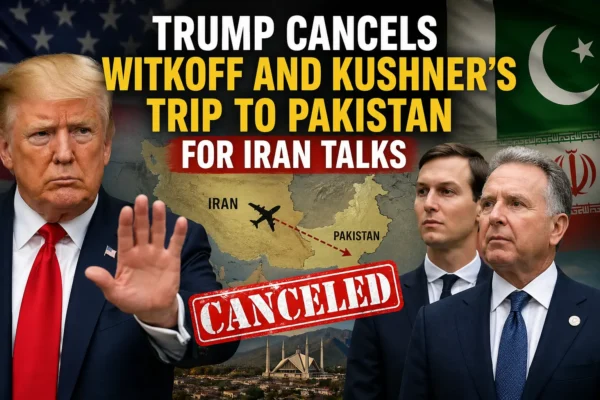
Trump cancels Witkoff and Kushner’s trip to Pakistan for Iran talks

President Donald Trump has canceled a planned trip by envoys Steve Witkoff and Jared Kushner to Pakistan for discussions linked to the ongoing conflict with Iran, creating fresh uncertainty around diplomatic efforts in the region. The delegation had been expected to travel to Islamabad for indirect negotiations involving Iranian officials and Pakistani intermediaries. Trump said he saw little value in sending negotiators on a lengthy trip when progress appeared limited. In public remarks, he argued the United States held stronger leverage and said Iran could make contact directly if it wanted serious talks. Reports also cited Trump’s frustration with what he described as confusion inside Iran’s leadership structure. The cancellation is being viewed as a setback for hopes of a diplomatic breakthrough after weeks of rising tensions. Pakistan had emerged as a possible neutral venue because of its working ties with both Washington and Tehran. Iranian Foreign Minister Abbas Araghchi was already in Islamabad meeting Pakistani leaders, though Tehran reportedly denied that direct U.S.-Iran talks were formally scheduled. The wider crisis continues to affect global markets, particularly energy prices and shipping routes through the Strait of Hormuz. Any delay in negotiations could prolong instability and keep investors cautious. Analysts say future talks may still happen through phone diplomacy, regional mediators, or a different host country. For now, the decision highlights how fragile the current ceasefire and negotiation process remains. While Trump insists talks are still possible, canceling the Pakistan mission signals that a quick resolution is far from certain.

Read More
UK relations

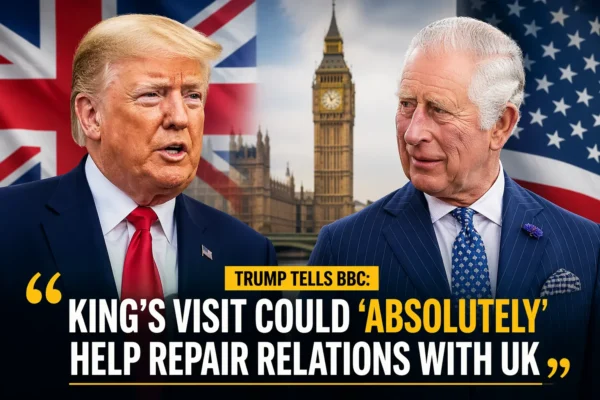
Trump tells BBC that King’s visit could ‘absolutely’ help repair relations with UK

Former U.S. President Donald Trump has said that a future visit hosted by King Charles could “absolutely” help repair relations between the United States and the United Kingdom. Speaking in an interview with the BBC, Trump suggested that the long-standing alliance between the two nations remains strong, but personal diplomacy and symbolic gestures can play an important role in strengthening ties after periods of tension. Trump’s remarks come at a time when UK-US relations are being closely watched over issues including trade, defense cooperation, and global security challenges. He indicated that the British monarchy continues to hold significant soft power and international influence, making a royal visit a meaningful opportunity to reset the tone between leaders. The former president has previously spoken positively about the Royal Family and his past state visits to Britain during his presidency. Trump noted that relations between countries often depend not only on formal negotiations but also on personal respect and public goodwill. A meeting involving King Charles, he argued, could create a more positive atmosphere and encourage closer cooperation. Political analysts say royal diplomacy has historically been used to reinforce Britain’s relationships with major allies. While the monarchy does not set government policy, royal visits often carry symbolic weight and can help smooth political tensions. Trump’s comments highlight how ceremonial events may still influence international relations in practical ways. The United Kingdom remains one of America’s closest partners, with deep economic ties, intelligence sharing, and military cooperation through NATO and other alliances. Any move aimed at improving political chemistry between leaders would likely be welcomed on both sides of the Atlantic. Although no official visit has been announced, Trump’s statement has already sparked discussion about the potential role of King Charles in future diplomacy. As both countries navigate changing global dynamics, gestures of unity and tradition may help preserve one of the world’s most important strategic partnerships. Whether symbolic or substantive, Trump’s comments underline the enduring importance of the special relationship between Washington and London, and how royal engagement could once again become part of that diplomatic story.

Read More
Iran warns response to Israel Lebanon attacks

Iran warns it will respond if Israeli attacks on Lebanon don’t stop immediately

Iran has issued a stark warning that it will respond if Israeli military attacks on Lebanon do not stop immediately, raising fears of a broader regional escalation. The warning comes amid an intensifying Israeli campaign targeting Hezbollah positions across Lebanon, including airstrikes on Beirut, the Bekaa Valley, and southern regions. According to recent reports, Israeli strikes have caused significant casualties and widespread destruction, with hundreds killed and critical infrastructure damaged. Lebanese authorities have condemned the attacks as violations of sovereignty, while calling on international actors to intervene and prevent further escalation. Tehran has positioned itself as a key backer of Hezbollah and has made clear that continued Israeli operations in Lebanon could trigger direct or indirect retaliation. Iranian officials have warned that ongoing attacks risk undermining fragile diplomatic arrangements, including a recently announced ceasefire involving the United States and Iran. Iran has even threatened to withdraw from the ceasefire framework entirely if Israeli operations persist. The situation is further complicated by conflicting interpretations of the ceasefire. While some mediators suggested it could extend to Lebanon, both Israel and the United States have clarified that the agreement does not cover Israeli actions against Hezbollah. This ambiguity has fueled tensions and increased the likelihood of miscalculation. In a dramatic move highlighting the stakes, Iran has also taken steps such as disrupting shipping routes in the Strait of Hormuz, linking these actions directly to Israeli strikes in Lebanon. Such measures threaten global energy supplies and underscore how quickly the conflict could expand beyond the immediate battlefield. Israeli leadership, meanwhile, has signaled readiness to continue military operations, describing the current pause in wider hostilities as temporary and conditional. Overall, Iran’s warning reflects a rapidly deteriorating security environment in the Middle East, where ongoing Israeli attacks in Lebanon risk triggering a wider confrontation involving multiple regional powers.

Read More
Ukraine ex-energy minister detained

Ukraine’s ex-energy minister detained while attempting to leave country

Former officials in Ukraine are facing increasing legal scrutiny as authorities detained a former energy minister while he was allegedly attempting to leave the country. According to investigators, the detention took place at a border crossing checkpoint after law enforcement agencies flagged the individual in connection with an ongoing corruption probe linked to energy sector contracts signed during his tenure. Officials from the State Border Guard Service of Ukraine confirmed that the suspect was stopped during routine exit procedures. The detention was coordinated with anti-corruption authorities, who had previously issued legal notices requiring the former minister’s cooperation in the investigation. Sources suggest the case involves suspected abuse of power, financial mismanagement, and possible irregularities in procurement deals related to national energy infrastructure projects. The arrest marks another high-profile case in Ukraine’s broader anti-corruption campaign, which has intensified since the country began implementing governance reforms tied to European integration goals. Prosecutors stated that the investigation remains ongoing and that additional charges could be filed depending on the results of forensic financial audits and witness testimony. The former minister has not publicly commented on the allegations, though his legal representatives reportedly deny wrongdoing and claim the detention is politically motivated. The incident has generated political debate in Kyiv, with opposition figures calling for transparency and due process, while government officials emphasize that no individual is above the law. Analysts note that corruption cases involving senior officials are closely watched by international partners, particularly as Ukraine seeks continued financial and military support amid ongoing geopolitical tensions. If formally charged and convicted, the former minister could face significant prison time and asset confiscation under Ukrainian anti-corruption legislation. Authorities say further updates will be released as the investigation progresses.

Read More
Russian attack

Thousands without power in Kyiv after massive Russian attack

Thousands of residents in Kyiv were left without electricity after a massive Russian attack targeted critical infrastructure across Ukraine, once again plunging the capital into emergency conditions. Ukrainian officials said the overnight assault involved a combination of missiles and drones aimed primarily at energy facilities, worsening an already fragile power supply as winter conditions strain the national grid. Kyiv’s mayor confirmed that large sections of the city experienced blackouts following the strikes, with emergency crews working throughout the day to restore electricity and heating. While air defense systems intercepted a significant number of incoming threats, several projectiles managed to penetrate defenses, causing damage to substations and transmission lines. Authorities warned that rolling outages could continue as repairs remain ongoing. The attack also disrupted water supply and mobile communications in some districts, highlighting the cascading impact of strikes on civilian infrastructure. Hospitals, metro stations, and critical services were switched to backup generators to maintain operations. Residents were urged to conserve electricity once supply is restored and to prepare for potential further outages. Ukrainian energy officials described the assault as one of the most severe attacks on Kyiv’s power network in recent months. They said Russia appears to be renewing its strategy of targeting energy systems to weaken civilian morale and economic stability. Similar strikes were reported in several other regions, compounding pressure on the national energy system. President Volodymyr Zelensky condemned the attack, calling it a deliberate act of terror against civilians. He reiterated appeals to Western allies for additional air defense systems and faster delivery of energy support equipment. According to government estimates, repeated attacks have already destroyed or damaged a significant portion of Ukraine’s energy infrastructure since the start of the war. Despite the disruption, city officials emphasized that Kyiv remains functional and resilient. Repair teams, supported by international partners, continue to work around the clock to stabilize the grid. For many residents, however, the latest Kyiv power outage after Russian attack is a stark reminder that the conflict’s impact is felt far beyond the front lines, directly affecting daily life in the capital.

Read More
Brain drain

Brain Drain in India: For Every 1 Foreign Student, 25 Indians Study Abroad | NITI Aayog

India is witnessing a growing brain drain, especially in the field of higher education. According to NITI Aayog, for every one foreign student studying in India, nearly 25 Indian students go abroad for education. This stark imbalance highlights a serious challenge for India’s education system and its long-term economic growth. Understanding Brain Drain in India Brain drain refers to the migration of educated, skilled, and talented individuals from their home country to other nations in search of better education, improved career opportunities, higher income, and a better quality of life. In the Indian context, this phenomenon is most visible in higher education, where a growing number of students choose to pursue undergraduate, postgraduate, and research programs abroad. Every year, lakhs of Indian students move to countries such as the United States, Canada, the United Kingdom, Australia, and Germany. While many initially go for education, a significant proportion later settle overseas due to attractive job prospects, advanced research ecosystems, and favorable immigration policies. As a result, India experiences a continuous loss of highly skilled human capital, including future scientists, engineers, doctors, and entrepreneurs. Recent observations by NITI Aayog confirm that brain drain in India is no longer just a theoretical concern—it is a measurable and growing reality. The widening gap between Indian students going abroad and foreign students coming to India highlights structural challenges in the domestic education system. If left unaddressed, this trend could weaken India’s innovation capacity, slow economic growth, and reduce its global competitiveness in the long term. Key Findings Highlighted by NITI Aayog Why Are Indian Students Going Abroad? 1. Better Quality of Education Many foreign universities offer advanced research facilities, updated curricula, and global exposure that attract Indian students. 2. Strong Career Opportunities Countries like the US, Canada, and the UK provide post-study work visas and long-term employment options, making them more appealing. 3. Limited Research Infrastructure in India While India has top institutions like IITs and IISc, overall research funding, innovation support, and global collaboration remain limited in many universities. 4. International Exposure Foreign education provides multicultural exposure, global networks, and better recognition in international job markets. Economic Impact of Brain Drain The economic impact of brain drain on India is both significant and long-term. Every year, Indian families spend thousands of crores of rupees on foreign education, covering tuition fees, accommodation, living expenses, and other related costs. This massive outflow of money could otherwise be invested in strengthening India’s own higher education system, improving research infrastructure, and creating world-class universities within the country. Beyond financial loss, the permanent settlement of Indian students abroad leads to a serious loss of human capital. When talented students choose to build their careers overseas, India loses skilled professionals such as engineers, doctors, scientists, and management experts. Additionally, the country misses out on future researchers and innovators who could have contributed to technological advancement, scientific discovery, and industrial growth. Brain drain also reduces the number of potential entrepreneurs and leaders who could have created jobs, launched startups, and driven economic development within India. Over time, this talent loss directly impacts economic growth, innovation capacity, and India’s global competitiveness. Without effective policy intervention, the continued migration of skilled youth may weaken India’s ambition to become a knowledge-driven and innovation-led economy. Why India Attracts Fewer Foreign Students Despite having rich culture, affordable education, and growing universities, India struggles to attract international students due to: What Can Be Done to Reduce Brain Drain? Strengthening Higher Education India must invest more in world-class universities, research centers, and faculty development. Internationalisation of Education Introducing more global collaborations, exchange programs, and international-standard courses can help. Attracting Foreign Students Simpler visa policies, scholarships, English-taught programs, and better campus facilities can make India a global education hub. Creating Opportunities at Home High-quality jobs, innovation ecosystems, and startup support can encourage students to return after studying abroad. Conclusion The fact that 25 Indian students go abroad for every one foreign student coming to India is a wake-up call. As NITI Aayog highlights, brain drain is real and growing. To turn this challenge into an opportunity, India must reform its higher education system, improve research infrastructure, and position itself as a global education destination. India’s youth is its greatest strength. Retaining and attracting talent is no longer optional—it is essential for the country’s future.

Read More
US social media screening

US could ask foreign tourists for five-year social media history before entry

The United States is considering a stricter vetting policy that would require foreign tourists to disclose up to five years of their social media history before being allowed to enter the country. The proposal, which has resurfaced amid broader discussions on national security and immigration control, reflects Washington’s increasing reliance on digital footprints to assess potential risks posed by visitors. Under the proposed measure, applicants for various categories of U.S. visas would need to provide usernames used across major social media platforms over a multi-year period. Officials argue that reviewing publicly available posts and interactions could help authorities identify security threats, extremist affiliations, or misleading information in visa applications. While the idea has been floated in earlier policy discussions in past administrations, recent reports suggest that such digital scrutiny might be expanded and applied more uniformly to a wider pool of travelers. Supporters of the measure claim that social media has become one of the most revealing indicators of an individual’s views, intentions, and associations. They argue that the U.S. cannot afford to overlook a space where radicalization and illicit activity often occur. According to proponents, many countries already review online activity to a limited extent, and the U.S. must adopt stronger tools to protect its borders in an increasingly digital world. However, privacy advocates and civil liberties groups warn that the proposal could create significant concerns for millions of travelers. Requiring a detailed record of social media handles, they argue, could lead to intrusive monitoring, misinterpretation of content, and a chilling effect on free expression. Critics also express worry that travelers could be unfairly denied entry based on satire, political comments, or posts taken out of context. There are also concerns about data security. Collecting such large amounts of personal information would require robust safeguards to prevent misuse or unauthorized access. International travelers may fear that their digital identities could become part of permanent government files, affecting future travel or even employment opportunities. Travel industry representatives caution that such rules could discourage tourism, especially from countries whose citizens already face extensive screening. They argue that additional layers of digital vetting may slow down visa processing, create bureaucratic backlogs, and make the U.S. less attractive as a travel destination. Despite ongoing debate, the proposal reflects a broader global trend in which governments increasingly view social media as a crucial part of identity verification and risk assessment. Whether the United States ultimately implements such a rule remains uncertain, but the discussion signals a future where digital footprints may become as important as passports at international borders. Former EU top diplomat Mogherini accused in fraud investigation WabsTalk Spoken English and Public Speaking Institute

Read More
Trump threatens China

Trump threatens to impose additional 100% tariff on China

Former U.S. President Donald Trump has issued a fresh warning to China, vowing to impose an additional 100% tariff on Chinese imports if the United States does not achieve what he calls “fair and reciprocal trade.” The declaration, made during a campaign rally in Michigan, marks the latest escalation in Trump’s long-standing criticism of China’s trade practices, intellectual property theft, and currency manipulation. Trump accused China of taking advantage of the U.S. economy for decades, claiming that the country’s export-driven growth came at the expense of American workers and manufacturers. “China has been ripping us off for years,” he said, adding that if Beijing does not agree to “real trade fairness,” his administration would double the existing tariffs. During his first term, Trump’s administration had already imposed hundreds of billions of dollars’ worth of tariffs on Chinese goods, sparking a prolonged trade war between the two global powers. That conflict disrupted global supply chains and raised costs for both businesses and consumers. However, Trump argued that his hardline stance was necessary to force China to renegotiate unfair trade deals. Economic analysts suggest that Trump’s new proposal could have significant consequences for the global economy if enacted. A 100% tariff would likely hit industries such as electronics, automobiles, textiles, and consumer goods, many of which rely heavily on Chinese manufacturing. Experts warn that such a move could further strain U.S.-China relations and potentially trigger retaliatory measures from Beijing. Chinese officials have so far refrained from direct response, but state media outlets have criticized Trump’s remarks as “economic blackmail.” The Chinese government has repeatedly urged Washington to resolve trade differences through dialogue rather than confrontation. Meanwhile, Trump’s supporters argue that his strong stance on China is necessary to protect American jobs and reduce dependency on foreign imports. They claim that a tougher trade policy could help revive domestic manufacturing and promote economic self-reliance. However, critics fear that escalating tariffs could backfire by raising consumer prices and provoking inflation at home. Economists also note that previous tariffs imposed during Trump’s presidency led to retaliatory duties on American exports, particularly affecting farmers and small businesses. As the U.S. presidential election nears, Trump’s remarks highlight his intent to make China policy a central campaign issue. His threats signal a potential return to aggressive economic nationalism, emphasizing his promise to put “America First” in trade negotiations. Whether such policies will ultimately strengthen or destabilize the global economy remains a deeply debated question.

Read More

How to Learn English in a Month: A Complete Guide

Learning English in just one month may seem challenging, but with the right approach, consistency, and dedication, you can significantly improve your fluency. Follow this step-by-step guide to start speaking, understanding, and writing in English in just 30 days! Week 1: Build the Foundation 🔹 Learn Basic Words & Sentences 🔹 Improve Pronunciation 🔹 Practice Speaking Daily 🔹 Use English Learning Apps📱 Apps to Download: Week 2: Improve Listening & Speaking Skills 🔹 Watch English Movies & Shows (with Subtitles) 🔹 Listen to English Podcasts🎧 Best Beginner Podcasts: 🔹 Start Thinking in English 🔹 Practice with a Partner Week 3: Improve Grammar & Writing 🔹 Learn Basic Grammar Rules 🔹 Start Writing Daily✍ Practice Writing Simple Sentences: 🔹 Read Short English Stories📖 Best Websites for Reading: 🔹 Join English-Speaking Groups Week 4: Speak Confidently & Fluently 🔹 Challenge Yourself to Speak for 5 Minutes Daily 🔹 Avoid Translating from Your Native Language 🔹 Take an Online English Test📊 Free Tests: 🔹 Final Step: Keep Practicing! Bonus Tips for Quick Learning ✅ Surround Yourself with English – Change your phone settings to English.✅ Use Sticky Notes – Label objects in your house with English words.✅ Speak Without Fear – Don’t worry about mistakes, just keep talking.✅ Stay Consistent – Practice for at least 2 hours daily.

Read More