
Afham

Trump legal action on BBC

Trump says he will take legal action against BBC over Panorama edit

Donald Trump has announced that he will pursue legal action against the BBC, accusing the broadcaster of defamation after what he describes as a deceptive and damaging edit of his January 6, 2021 speech in a recent Panorama documentary. Speaking aboard Air Force One, Trump confirmed that he intends to file the lawsuit “sometime next week,” adding that he is seeking between $1 billion and $5 billion in compensation. His lawyer, Alejandro Brito, previously sent the BBC a letter demanding a full retraction, a public apology, and significant financial damages. The controversy centers on the Panorama episode titled “Trump: A Second Chance?”, which aired shortly before the 2024 U.S. election. The documentary used excerpts from Trump’s January 6 speech, but critics say the program spliced together lines from different parts of the address, making it appear as though Trump called on supporters to “fight like hell” as they moved toward the Capitol. In reality, the statements were made nearly an hour apart, and key segments in which Trump urged protesters to remain peaceful were omitted. These editorial choices prompted accusations that the documentary created a misleading narrative about Trump’s intentions on the day of the Capitol riot. Following the outcry, the BBC issued an apology, with its chair Samir Shah describing the edit as an “error of judgment.” The broadcaster also confirmed that it would not rebroadcast the documentary in its existing form. However, despite acknowledging the editing mistake, the BBC rejected Trump’s request for damages, arguing that there is no legal basis for a defamation claim of the scale he is pursuing. Trump has remained firm in his stance, insisting that he feels an “obligation” to proceed with the lawsuit. He argues that media organizations should be held accountable when they distort or manipulate his words. He publicly described the Panorama edit as a “corrupt” example of fake news designed to misrepresent his message and influence public perception. The fallout from the incident has already been significant. Two high-profile BBC executives—Director-General Tim Davie and News Chief Deborah Turness—have resigned amid the ongoing scandal, reflecting both internal and external pressure over the handling of the documentary. Despite Trump’s determination, legal experts have expressed skepticism about the viability of the lawsuit. Questions have been raised regarding the statute of limitations under UK defamation law, as well as the complexities of pursuing such a claim in U.S. courts. Nevertheless, Trump continues to frame the dispute as part of his broader battle against what he views as longstanding media bias, reinforcing his narrative that major news outlets frequently distort his rhetoric. This planned lawsuit is the latest escalation in Trump’s ongoing clash with mainstream media organizations and underscores his intent to confront those he believes have misrepresented him.


Read More
Trump government shutdown

Trump celebrates as Democrats face fallout from end of shutdown

Former President Donald Trump has declared victory following the abrupt end of the U.S. government shutdown, framing the outcome as a political setback for Democrats and a reaffirmation of his influence over national politics. The shutdown, which lasted 12 days, ended after Congress passed a bipartisan funding measure to keep the government open through the fiscal year. However, the political repercussions have begun to surface, with Democrats facing internal divisions and criticism over how they managed the crisis. Trump, speaking at a rally in Ohio, described the resolution as proof that Democrats had “no strategy, no leadership, and no message.” He argued that the party’s failure to secure any significant policy wins during the shutdown demonstrated what he called “a complete collapse of the radical left’s agenda.” Supporters at the rally cheered as Trump claimed the standoff had strengthened his image as a dealmaker capable of pressuring opponents to concede. Inside the Democratic Party, frustration has reportedly grown among lawmakers and strategists. Progressives criticized party leaders for agreeing to reopen the government without achieving key objectives, such as expanded funding for social programs or immigration reforms. Moderate Democrats, meanwhile, have urged a shift toward pragmatic negotiation rather than confrontation, fearing that prolonged shutdowns could alienate independent voters ahead of the next election cycle. Political analysts suggest the episode could deepen the divide between progressive and centrist factions within the Democratic Party. Several commentators noted that while Republicans also faced public backlash during the early days of the shutdown, the resolution’s outcome has allowed Trump to reshape the narrative, portraying himself as the figure who brought Washington back to order. The White House has capitalized on the moment, releasing statements crediting Trump with “restoring stability and accountability.” Administration officials have emphasized that the president’s stance during negotiations reflected his broader campaign promise to protect taxpayers from what he calls “reckless Democratic spending.” On Capitol Hill, some Democrats have attempted to downplay the perceived loss, insisting that reopening the government was necessary to protect federal workers and prevent further economic disruption. Yet, privately, aides acknowledge that the episode has left the party searching for a clearer messaging strategy. As Trump continues to dominate headlines and shape the post-shutdown political narrative, Democrats are now turning their focus toward repairing internal unity and preparing for upcoming budget debates. The shutdown’s end may have restored government operations, but it also reignited questions about leadership, strategy, and the shifting balance of power in Washington.

Read More
Jeffrey Epstein documents

Epstein alleged that Trump ‘spent hours’ with one of his victims, as thousands of documents released

Thousands of pages of newly unsealed court documents related to the late financier Jeffrey Epstein have revealed fresh details about his network of associates and alleged interactions with powerful figures, including former U.S. President Donald Trump. The files, which stem from a long-running civil case against Epstein’s associate Ghislaine Maxwell, include depositions, witness statements, and correspondence that shed light on the scale of Epstein’s operations and the alleged involvement of several high-profile individuals. Among the revelations, one of Epstein’s alleged victims claimed that Trump had “spent hours” with her at Epstein’s Palm Beach residence. The woman, whose identity remains confidential in the documents, did not accuse Trump of sexual misconduct but described his presence at gatherings organized by Epstein in the early 2000s. The allegations add to the growing scrutiny surrounding Epstein’s connections with influential figures from politics, business, and entertainment. Trump has repeatedly denied any wrongdoing or inappropriate relationship with Epstein or his associates. He has acknowledged knowing Epstein “like everybody in Palm Beach,” but insisted he was “not a fan” of the financier and severed ties with him long before his 2019 arrest. Epstein, who was charged with sex trafficking of minors, died in jail that same year in what was officially ruled a suicide. The newly released files also mention other prominent names, including Prince Andrew, Bill Clinton, and several former officials and celebrities. While the documents contain numerous allegations, much of the material remains unverified or based on witness testimony, and no additional criminal charges have been filed as a result of the disclosures. Legal experts say the release of these records underscores the far-reaching nature of Epstein’s influence and the need for continued transparency. Victims’ advocates have welcomed the disclosures, saying they help expose the scale of Epstein’s alleged abuse and the systems that enabled it to persist for years. The Epstein case continues to be one of the most controversial scandals involving sexual exploitation, wealth, and power. As investigators and journalists sift through the newly unsealed evidence, questions remain about who else may have known about or participated in Epstein’s activities—and whether justice can ever be fully served for his victims.

Read More
Super Typhoon Philippines

Super typhoon makes landfall in Philippines as nearly a million evacuated

A powerful super typhoon has made landfall in the Philippines, bringing destructive winds, torrential rain, and widespread flooding that have forced the evacuation of nearly a million people across several provinces. The storm, one of the most intense to hit the country in recent years, made landfall early Sunday on the eastern coast of Samar Island, packing sustained winds exceeding 250 km/h (155 mph) and gusts reaching up to 300 km/h (186 mph). According to the Philippine Atmospheric, Geophysical and Astronomical Services Administration (PAGASA), the storm—named Typhoon Sanro—is moving west-northwest across the Visayas region, with authorities warning of “catastrophic damage” in its path. Entire coastal towns have been submerged as storm surges up to 4 meters high battered low-lying communities. The government has suspended all flights and maritime operations, and electricity has been cut in several provinces as a precaution. The National Disaster Risk Reduction and Management Council (NDRRMC) reported that around 960,000 residents were evacuated from coastal and landslide-prone areas ahead of the storm. Emergency shelters and schools are now being used to house displaced families, though officials fear overcrowding could lead to further health risks. In Tacloban City, memories of Typhoon Haiyan (Yolanda)—which devastated the area in 2013—have resurfaced, prompting many residents to evacuate early. Philippine President Ferdinand Marcos Jr. has ordered all government agencies to be on “maximum alert,” emphasizing that the priority is saving lives. Military and coast guard units have been deployed for rescue and relief operations, while the Department of Social Welfare has pre-positioned food packs, water, and medical supplies across affected regions. Meteorologists warn that the super typhoon’s strength is comparable to Haiyan, one of the deadliest tropical cyclones in recorded history. The combination of violent winds and torrential rains has already caused landslides in parts of Eastern Samar and Leyte, blocking key roads and isolating some rural communities. Floodwaters are also rising rapidly in the Bicol region, where rivers have overflowed due to nonstop rainfall. Experts say the Philippines, located along the Pacific “Typhoon Belt,” faces increasing storm intensity due to climate change, which is warming ocean temperatures and fueling stronger cyclones. The country typically experiences about 20 tropical storms each year, but the frequency of super typhoons has been rising. Authorities warn that even after the storm moves westward, heavy rainfall could continue for days, triggering flash floods and landslides in the mountainous interior. Rescue efforts are expected to expand as weather conditions improve, but early reports suggest widespread agricultural damage and infrastructure destruction. The full extent of the devastation from the super typhoon in the Philippines is still unfolding, with officials bracing for potentially severe humanitarian and economic impacts.

Read More
Elon Musk’s $1 trn pay deal

Elon Musk’s $1tn pay deal approved by Tesla shareholders

At Tesla’s annual shareholders meeting in Austin, Texas, more than 75% of shareholders voted in favour of a new compensation plan for Elon Musk. The package, potentially worth up to around $1 trillion, would be the largest corporate CEO compensation award ever if all performance conditions are achieved. The deal is structured largely as stock-based incentives rather than a fixed salary, linking Musk’s potential earnings to Tesla’s long-term performance. If successful, Musk’s ownership stake in Tesla could increase from roughly 13% to about 25%, further cementing his control over the company. Key Performance Conditions The massive payout depends on Tesla achieving a series of ambitious goals over the coming years. These include reaching a market capitalization of about $8.5 trillion, delivering 20 million vehicles annually, and deploying 1 million robotaxis alongside selling 1 million humanoid robots, such as Tesla’s “Optimus” models. Additionally, Tesla must record sustained annual profits in the hundreds of billions of dollars and Musk must remain as CEO for a defined period while guiding the company through these milestones. Why Supporters Backed It Supporters argue that Musk is the driving force behind Tesla’s transformation from an electric carmaker to a broader AI and robotics powerhouse. They believe the plan aligns Musk’s personal incentives with Tesla’s long-term growth rather than short-term profit. For many investors, the potential benefits justify the risk. Musk’s proven record with Tesla, SpaceX, and other ventures gives confidence that he can push the company toward extraordinary achievements in automation, energy, and self-driving technology. Why It’s Controversial Despite the strong vote in favour, the deal has attracted significant criticism. The sheer scale of the potential payout—$1 trillion—has been labelled excessive by critics who question its fairness and impact on corporate governance. Some institutional investors and governance experts warned that such a plan could dilute shareholder value and place too much power in the hands of a single individual. Sceptics also argue that achieving all the performance targets is unlikely. Tesla faces mounting challenges, including intensifying EV competition, slowing demand, supply chain risks, and regulatory scrutiny. Entrusting so much influence to one figure raises concerns about oversight and succession planning. What This Means Going Forward If Musk meets all conditions, he could become the first person in history to receive a corporate payout of this magnitude, potentially making him the world’s first trillionaire. For Tesla, it represents a daring bet on future dominance across multiple sectors—EVs, robotics, and AI. The vote signals strong investor faith in Musk’s leadership and Tesla’s long-term vision. Yet, it also sets towering expectations that may prove difficult to meet. The outcome will define not only Musk’s personal wealth but also Tesla’s position in the global technology landscape. Read this also Inside Gaza, BBC sees total devastation after two years of war Bottom line: Tesla shareholders have handed Musk a colossal opportunity—and an equally colossal challenge. The $1 trillion plan embodies both Tesla’s ambition and the immense risks that come with placing so much of its future in one man’s hands.

Read More
Gaza devastation

Inside Gaza, BBC sees total devastation after two years of war

Two years after the war between Israel and Hamas began, the Gaza Strip has been reduced to ruins, with once-thriving neighborhoods now resembling ghost towns. A BBC team granted rare access to the territory describes a landscape of total devastation — homes flattened, hospitals barely functioning, and thousands of displaced families struggling to survive amid the wreckage. Entire districts that were once crowded with markets, schools, and apartment blocks now lie in rubble. In northern Gaza, what used to be Gaza City’s commercial heart is now a sea of collapsed concrete and twisted metal. The BBC crew reported seeing children playing amid debris, their laughter echoing in streets that have no running water, electricity, or sanitation. “It’s like time stopped here,” one resident told reporters. “We are alive, but everything around us is dead.” The humanitarian situation remains dire. The United Nations estimates that more than 1.7 million people — nearly 80 percent of Gaza’s population — are still displaced. Many live in makeshift shelters or tents built from scrap metal and plastic sheets. Food shortages are chronic, with aid deliveries continuing to face restrictions at border crossings. Hospitals, already crippled by years of blockade, are overwhelmed. Doctors work without adequate supplies, and power cuts force surgeries to be done under flashlights. The BBC also visited Al-Shifa Hospital in Gaza City, once the territory’s largest medical facility. Its corridors are dark, lined with patients on stretchers, while generators rumble outside. “We’ve lost colleagues, we’ve lost equipment, and we’re losing patients we could have saved,” said one exhausted doctor. Israel’s government maintains that its military operations were aimed at dismantling Hamas’s military infrastructure, following the deadly attacks that triggered the war in 2023. Officials say rebuilding can only begin once Hamas’s influence is completely removed. However, international aid agencies argue that ordinary civilians have borne the brunt of the destruction, with entire families wiped out and public infrastructure obliterated. Despite calls from global powers for a long-term ceasefire and reconstruction plan, progress has been painfully slow. Many foreign donors remain hesitant to fund rebuilding projects without assurances of stability. Meanwhile, Gazans face another winter with little shelter and minimal hope. At the Rafah crossing on the Egyptian border, crowds gather daily, hoping for rare permits to leave. “We just want to live somewhere safe,” said a young mother holding her child. “We have nothing left here.” Two years on, the BBC’s report paints a bleak picture: a territory trapped between the ruins of war and the uncertainty of peace. For Gaza’s people, survival has become the only measure of victory.

Read More
tower collapse in rome

Worker dies after partial collapse of medieval tower in Rome

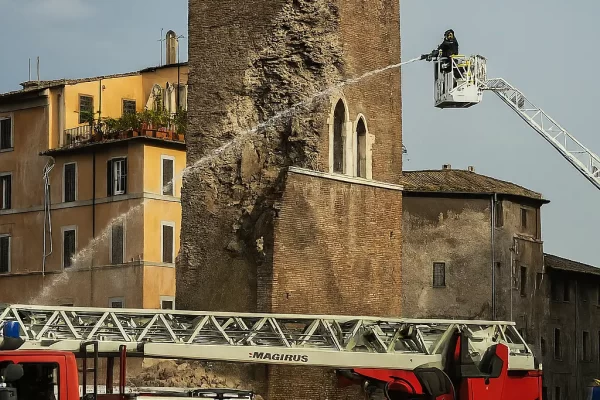
A construction worker has died after a partial collapse of a medieval tower in central Rome, Italian authorities confirmed on Tuesday. The tragic incident occurred at the historic Torre Accursi, a centuries-old structure undergoing restoration near Piazza Venezia, one of the capital’s busiest and most visited areas. According to emergency services, part of the upper section of the tower gave way around midday, sending debris cascading onto the scaffolding below where several workers were operating. Rescue teams rushed to the scene within minutes, including firefighters, police, and paramedics. One worker, a 42-year-old Italian man, was found trapped under rubble and pronounced dead at the scene. Two other workers sustained minor injuries and were taken to nearby hospitals for treatment. The area around the tower has since been cordoned off as authorities investigate the cause of the collapse. Early reports suggest structural instability in a section of the ancient masonry may have triggered the failure, though officials have not ruled out the possibility of errors related to the ongoing restoration work. Engineers and heritage experts from the Italian Ministry of Culture have joined the investigation to assess the extent of the damage and the safety of adjacent buildings. The Torre Accursi, dating back to the 13th century, is one of several medieval towers that once dotted the skyline of Rome. The structure had been under restoration for several months as part of a broader city initiative to preserve historical landmarks that have suffered from decades of wear, pollution, and neglect. The project aimed to reinforce the tower’s foundations and repair cracks that had developed in its stone walls. Rome’s mayor, Roberto Gualtieri, expressed his condolences to the victim’s family and called for a thorough investigation. “This is a terrible tragedy that should never have happened,” he said. “Our thoughts are with the worker’s loved ones, and we will ensure full accountability for what occurred.” The collapse has sparked renewed debate about the safety of restoration projects on Italy’s vast array of ancient and medieval buildings. Preservation experts have long warned that balancing conservation with modern construction standards poses significant challenges. The incident also comes amid broader concerns over workplace safety in Italy, where fatal accidents on construction sites remain a recurring issue despite recent reforms. As the investigation continues, authorities have suspended all work at the site. The Ministry of Culture stated that the tower’s stability will be closely monitored before any restoration efforts resume. Meanwhile, tributes have poured in for the victim, remembered by colleagues as a skilled and dedicated craftsman who had spent years working on historic restoration projects across Rome.

Read More
tequila bats Mexico

Why tequila depends on Mexico’s bats

equila, Mexico’s most famous spirit, owes much of its existence to an unlikely ally — bats. Specifically, the lesser long-nosed bat and the Mexican long-tongued bat play a vital role in pollinating the blue agave plants from which tequila is made. These nocturnal creatures help sustain the delicate balance of the agave ecosystem, making them essential to the drink’s future. Blue agave plants take around seven to ten years to mature before they can be harvested for tequila production. During this time, the plants produce tall flowering stalks called quiotes, which can reach up to six meters in height. Most agave farmers traditionally cut these stalks off to preserve the plant’s sugar concentration, ensuring a sweeter heart, or piña, for distillation. However, when the flowering stalks are removed, bats lose their primary source of nectar, disrupting their feeding habits and reducing the chance for natural pollination. The relationship between bats and agave is a classic example of mutualism in nature. As bats feed on the nectar of agave flowers, they transfer pollen from one plant to another, promoting genetic diversity and resilience within the species. Without bat pollination, agave plants would become more genetically uniform, making them vulnerable to pests, diseases, and climate stress — all of which could threaten tequila production. In recent years, conservationists and tequila producers have begun to recognize the importance of protecting bats and encouraging natural pollination. Initiatives like the “Bat-Friendly Tequila” and “Bat-Friendly Mezcal” programs allow some agave plants in each field to bloom naturally, providing food for bats and ensuring genetic variation. Farmers who participate in these programs label their bottles with a special bat-friendly certification, signaling to consumers that their tequila supports wildlife conservation. These sustainable practices not only protect bat populations but also safeguard the long-term future of tequila. Encouraging biodiversity helps agave plants adapt to environmental changes, including drought and shifting weather patterns linked to climate change. Jamaicans reveal devastation as hurricane causes floods, power cuts and splits city in two The story of tequila and bats is a reminder that even the world’s most celebrated products rely on natural relationships to survive. Every sip of tequila is connected to the nighttime flight of bats across Mexico’s agave fields. Protecting these pollinators is not only a matter of preserving wildlife — it’s also essential for maintaining the flavor, quality, and cultural heritage of one of Mexico’s most iconic spirits.

Read More
Jamaica

Jamaicans reveal devastation as hurricane causes floods, power cuts and splits city in two

Jamaica is reeling from the aftermath of the catastrophic Hurricane Melissa, which tore through the island earlier this week, leaving a trail of destruction described by residents as “the worst in living memory.” The Category Five storm battered the island with sustained winds of over 250 km/h, torrential rains, and massive storm surges that inundated coastal areas and crippled infrastructure. The capital, Kingston, has been left partially cut off after severe flooding and landslides split the city in two, isolating several districts from the main road network. Entire neighborhoods were submerged under several feet of water, forcing thousands of residents to seek refuge in emergency shelters. According to Jamaica’s Office of Disaster Preparedness and Emergency Management, more than 80% of the island’s households lost power during the height of the storm, while communication networks collapsed under widespread outages. Residents shared harrowing accounts of how the hurricane transformed once-bustling streets into rivers overnight. “It was like the sea came for us,” said one survivor from Port Royal, recalling how waves crashed through coastal defenses. In the hills overlooking the city, homes were swept away by mudslides, while downed trees and power lines made rescue operations perilous. Authorities have confirmed at least 27 deaths, though officials warn that the number may rise as search-and-rescue teams reach the most remote areas. Hospitals have been overwhelmed with the injured, and emergency crews continue to battle blocked roads and damaged bridges. Prime Minister Andrew Holness declared a national state of emergency, urging international partners for immediate assistance. “Our nation is facing one of the darkest moments in its modern history,” he said in a televised address. “But Jamaica will rebuild, stronger and united.” Airports remain closed, and the main seaport in Kingston sustained heavy damage, disrupting food and fuel supplies. Power company officials estimate it could take several weeks before electricity is fully restored across the island. Water systems have also been compromised, raising fears of disease outbreaks as residents rely on contaminated floodwaters. International aid has begun to arrive, with relief teams from neighboring Caribbean nations and the United States assisting local authorities in distributing food, clean water, and medical supplies. Despite the destruction, scenes of resilience have emerged across the island. Volunteers and community groups are working tirelessly to clear debris, support displaced families, and restore a sense of hope amid the ruins. As Jamaica begins its long recovery, experts warn that the record-breaking intensity of Hurricane Melissa highlights the growing threat of climate change to the Caribbean. For many Jamaicans, however, survival and rebuilding their shattered communities remain the immediate priority.

Read More
Jamaica life-threatening storm

Jamaica in path of ‘life-threatening’ category five Hurricane Melissa

Jamaica is bracing for the full force of Hurricane Melissa, now an extremely dangerous Category 5 storm, as it barrels through the Caribbean with devastating winds and torrential rain. The U.S. National Hurricane Center (NHC) has warned that the storm poses a “life-threatening threat” to the island, bringing the potential for catastrophic damage, flooding, and storm surges. Melissa, with sustained winds exceeding 260 kilometers per hour (160 mph), is the strongest hurricane to form in the Atlantic this season. The hurricane’s eye was located just 150 kilometers southeast of Kingston on Tuesday afternoon, moving northwest at around 20 kilometers per hour. Meteorologists say the storm’s outer bands have already begun lashing Jamaica’s southern coast with heavy rainfall and fierce winds. Authorities have issued evacuation orders for low-lying and coastal areas, including parts of St. Catherine, Clarendon, and St. Elizabeth parishes. Shelters have been opened across the island, and the government has mobilized emergency services, soldiers, and medical personnel in preparation for the storm’s landfall, expected late Tuesday night or early Wednesday morning. Prime Minister Andrew Holness has urged citizens to take the warnings seriously, emphasizing that this hurricane could cause “unprecedented destruction” if residents do not act swiftly. “We are facing a dangerous and unpredictable system. Everyone must move to safety and avoid taking risks,” Holness said during a national address. Meteorologists predict that Melissa could drop up to 600 millimeters (24 inches) of rain in some areas, leading to flash floods and landslides, particularly in mountainous regions. Coastal communities face the risk of storm surges up to 5 meters (16 feet) high, capable of inundating entire neighborhoods and cutting off access to vital infrastructure. Airports across the island have suspended operations, and airlines have canceled flights in and out of Jamaica. The national power company has warned of possible widespread outages as high winds threaten to topple electricity poles and damage transmission lines. After passing Jamaica, Hurricane Melissa is projected to continue northwest toward the Cayman Islands and western Cuba, though slight changes in its path could alter its trajectory. The NHC continues to monitor the storm closely, warning nearby nations to remain vigilant.

Read More