
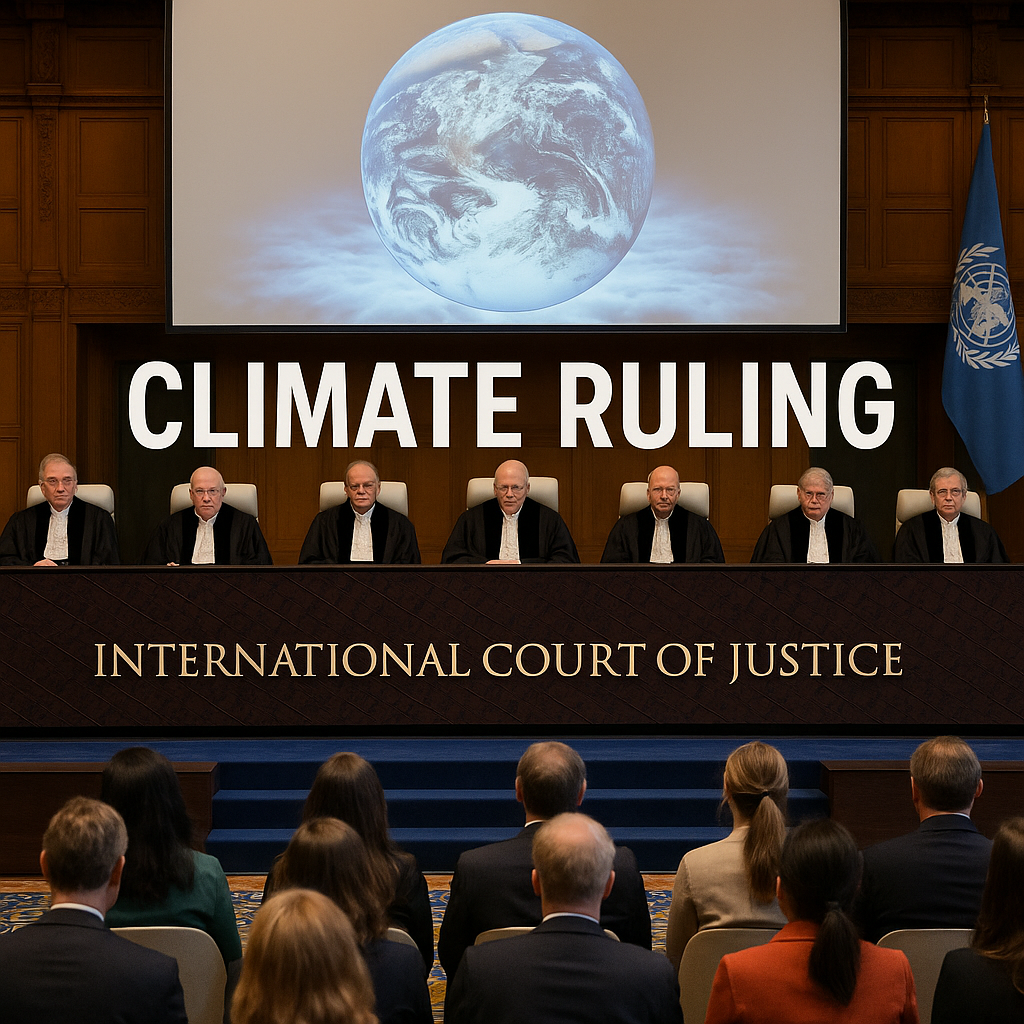
The International Court of Justice (ICJ) has issued a landmark advisory opinion addressing the obligations of states under international law to combat climate change. This ruling comes amid growing global pressure for accountability and action on the climate crisis, and is seen as a pivotal moment in the intersection of environmental and international law.
Requested by the United Nations General Assembly and supported by a coalition of small island nations and vulnerable states, the ICJ ruling provides legal clarity on whether countries are acting in accordance with their responsibilities to protect the environment and uphold human rights in the face of climate change. Although advisory in nature and not legally binding, ICJ opinions carry significant moral and political weight, often influencing national courts, international agreements, and diplomatic negotiations.
In its ruling, the Court affirmed that states have obligations to prevent significant environmental harm, both to their own populations and to other nations. It emphasized the duty of all nations—especially industrialized ones—to reduce greenhouse gas emissions, transition to renewable energy, and provide financial and technical support to developing countries disproportionately affected by climate impacts. The ruling also highlighted the connection between climate change and fundamental human rights, including the right to life, health, and a healthy environment.
Legal experts have hailed the decision as a major step forward in using international legal frameworks to address climate injustice. It reinforces the idea that failure to act on climate change could constitute a breach of international obligations, potentially opening the door to future litigation or sanctions in other legal venues.
While the ICJ cannot enforce compliance, its ruling adds momentum to global efforts like the Paris Agreement and provides a powerful tool for climate activists and vulnerable nations to demand stronger action. It marks a historic moment where law, justice, and environmental stewardship converge on the world stage, pushing the boundaries of how international institutions can be leveraged to safeguard the planet for future generations. WabsTalk