
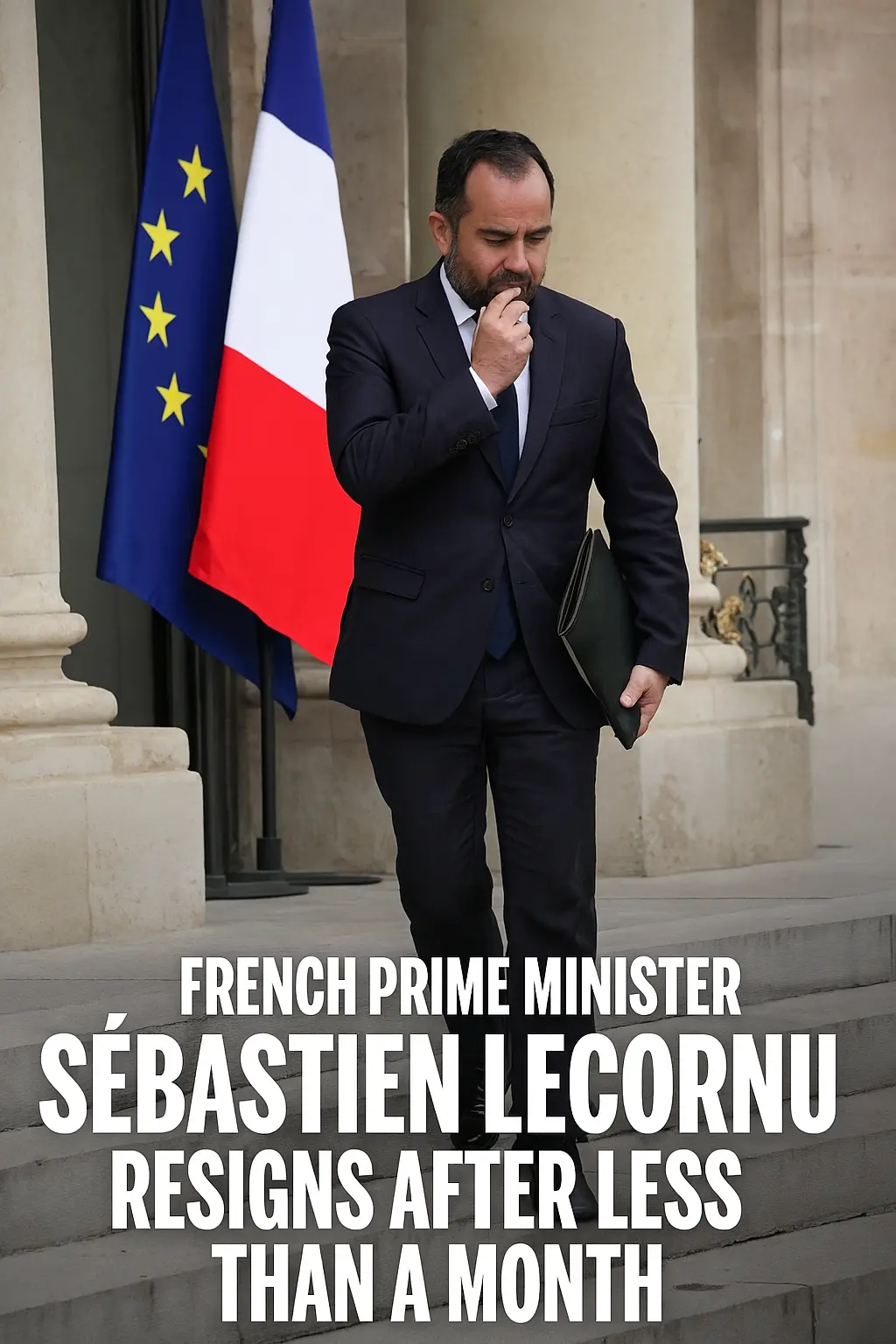
In a stunning political development, French Prime Minister Sébastien Lecornu has resigned from office less than a month after assuming power, plunging France into renewed political uncertainty. The Élysée Palace confirmed Lecornu’s resignation on Monday, citing “irreconcilable differences” within the cabinet and mounting pressure from both the opposition and members of President Emmanuel Macron’s party.
Lecornu, 38, was appointed Prime Minister in early September, succeeding Gabriel Attal in what was seen as an effort by President Macron to bring stability and fresh energy to his centrist government. However, his brief tenure was marked by growing tensions over economic reforms, social unrest, and divisions within the ruling coalition. His resignation underscores the deepening challenges facing Macron’s administration as it struggles to maintain political control amid declining approval ratings.
According to French media reports, Lecornu’s decision came after several high-level disputes over budgetary priorities and France’s energy policy. He reportedly clashed with key ministers over spending cuts and green transition targets, which drew criticism from trade unions and environmental groups alike. The controversy intensified after a wave of protests erupted in Paris and other major cities last week, demanding better living conditions and opposing austerity measures.
Political analysts say Lecornu’s departure could further weaken Macron’s ability to govern effectively. With parliamentary elections looming in 2026, the president faces mounting pressure to reassert authority and restore public confidence. “This resignation reflects a government in disarray,” said political analyst Jean-Pierre Moreau. “Macron’s attempt to project renewal through Lecornu has backfired, leaving him scrambling for a credible replacement.”
In a brief statement outside the Hôtel de Matignon, Lecornu thanked the president and his cabinet colleagues but hinted at frustration with the constraints of the role. “I have served France with loyalty and conviction,” he said. “But under the current circumstances, it is impossible to pursue the agenda that our citizens were promised.”
President Macron is expected to appoint a new prime minister within days, with several names already circulating in French political circles. Interior Minister Gérald Darmanin and former Prime Minister Élisabeth Borne are rumored contenders, though no official announcement has been made.
The resignation marks yet another blow to Macron’s leadership as France grapples with economic stagnation, labor unrest, and widespread voter disillusionment. Many observers view Lecornu’s abrupt exit as symptomatic of a broader crisis within the French political establishment—one that could shape the country’s trajectory for years to come.