
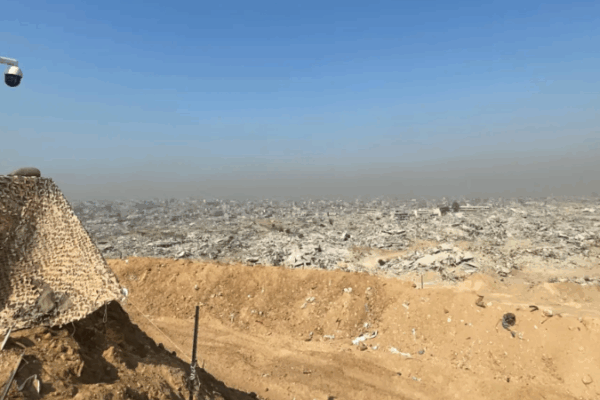
Gaza devastation

Inside Gaza, BBC sees total devastation after two years of war

Two years after the war between Israel and Hamas began, the Gaza Strip has been reduced to ruins, with once-thriving neighborhoods now resembling ghost towns. A BBC team granted rare access to the territory describes a landscape of total devastation — homes flattened, hospitals barely functioning, and thousands of displaced families struggling to survive amid the wreckage. Entire districts that were once crowded with markets, schools, and apartment blocks now lie in rubble. In northern Gaza, what used to be Gaza City’s commercial heart is now a sea of collapsed concrete and twisted metal. The BBC crew reported seeing children playing amid debris, their laughter echoing in streets that have no running water, electricity, or sanitation. “It’s like time stopped here,” one resident told reporters. “We are alive, but everything around us is dead.” The humanitarian situation remains dire. The United Nations estimates that more than 1.7 million people — nearly 80 percent of Gaza’s population — are still displaced. Many live in makeshift shelters or tents built from scrap metal and plastic sheets. Food shortages are chronic, with aid deliveries continuing to face restrictions at border crossings. Hospitals, already crippled by years of blockade, are overwhelmed. Doctors work without adequate supplies, and power cuts force surgeries to be done under flashlights. The BBC also visited Al-Shifa Hospital in Gaza City, once the territory’s largest medical facility. Its corridors are dark, lined with patients on stretchers, while generators rumble outside. “We’ve lost colleagues, we’ve lost equipment, and we’re losing patients we could have saved,” said one exhausted doctor. Israel’s government maintains that its military operations were aimed at dismantling Hamas’s military infrastructure, following the deadly attacks that triggered the war in 2023. Officials say rebuilding can only begin once Hamas’s influence is completely removed. However, international aid agencies argue that ordinary civilians have borne the brunt of the destruction, with entire families wiped out and public infrastructure obliterated. Despite calls from global powers for a long-term ceasefire and reconstruction plan, progress has been painfully slow. Many foreign donors remain hesitant to fund rebuilding projects without assurances of stability. Meanwhile, Gazans face another winter with little shelter and minimal hope. At the Rafah crossing on the Egyptian border, crowds gather daily, hoping for rare permits to leave. “We just want to live somewhere safe,” said a young mother holding her child. “We have nothing left here.” Two years on, the BBC’s report paints a bleak picture: a territory trapped between the ruins of war and the uncertainty of peace. For Gaza’s people, survival has become the only measure of victory.

Read More
Famine in Gaza City

Famine confirmed in Gaza City is ‘failure of humanity’, UN chief says

The United Nations has confirmed that famine is now taking hold in Gaza City, with Secretary-General António Guterres calling it a “failure of humanity” and an urgent wake-up call for the international community. The declaration follows weeks of mounting evidence of widespread hunger, collapsing food systems, and mass displacement in the war-torn territory. According to the UN’s latest food security assessment, more than half of Gaza’s population is experiencing catastrophic levels of food insecurity. In Gaza City, the devastation is most acute, with children and vulnerable groups facing the brunt of starvation. Humanitarian organizations report that many families have gone days without food, relying on unsafe water and whatever scraps they can find for survival. Guterres described the situation as both “entirely preventable” and “man-made,” stressing that aid convoys have faced repeated blockages, delays, and security risks. “This famine in Gaza City is not the result of drought or natural disaster—it is the result of relentless conflict, restrictions, and a breakdown in basic humanitarian law,” he said during a press briefing in New York. Aid agencies have long warned that Gaza was on the brink of famine due to continued military operations, damaged infrastructure, and restricted access to life-saving supplies. The confirmation by the UN’s Integrated Food Security Phase Classification (IPC) means the crisis has reached the most severe level on its scale, indicating extreme hunger and high mortality rates. The World Food Programme (WFP) has called for immediate and unrestricted humanitarian access, while UNICEF has warned of irreversible consequences for children, including stunted growth, disease, and death. “Children are paying the highest price of this war,” said Catherine Russell, UNICEF’s Executive Director. International reaction has been swift but divided. Some world leaders have urged for an immediate humanitarian ceasefire to allow aid deliveries, while others maintain that security conditions must be addressed first. Human rights groups argue that political disagreements cannot justify the starvation of civilians. Meanwhile, health officials in Gaza City report that hospitals are overwhelmed with malnourished patients, many of whom arrive too late to receive effective treatment. Medical supplies remain critically low, compounding the crisis and increasing preventable deaths. The famine declaration underscores the urgent need for coordinated international action. The UN chief reiterated his call for an immediate ceasefire, safe humanitarian corridors, and accountability for those obstructing aid. “History will judge us harshly if we fail to act,” Guterres warned. As famine grips Gaza City, the world faces a defining moral test: whether to prioritize political agendas or the survival of millions trapped in an unfolding humanitarian catastrophe.

Read More