
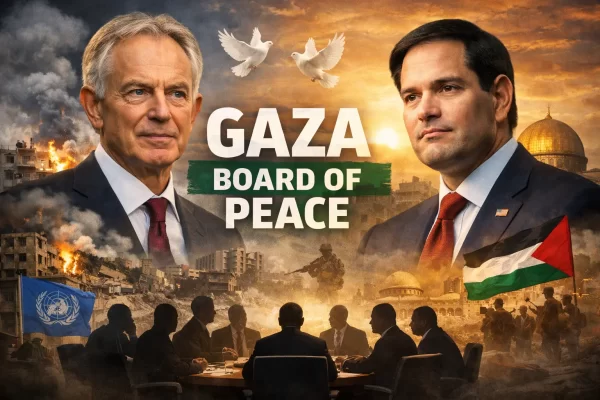
Gaza Board of Peace

Blair and Rubio among names on Gaza ‘Board of Peace’

Former UK prime minister Tony Blair and US senator Marco Rubio are among a list of prominent international figures reportedly associated with a proposed “Gaza Board of Peace,” an initiative aimed at shaping a post-war political and security framework for the Palestinian territory. The concept of a Gaza Board of Peace has emerged amid intense international debate over how Gaza should be governed and rebuilt once active hostilities subside. According to officials familiar with the discussions, the proposed body would bring together senior political figures, security experts, and regional stakeholders to oversee stabilization, humanitarian coordination, and the early stages of reconstruction, while also advising on longer-term governance arrangements. Tony Blair’s name has drawn particular attention given his previous role as the Middle East Quartet’s special envoy, a position that placed him at the center of diplomatic efforts following earlier rounds of conflict. Supporters argue that his experience navigating complex regional politics could lend credibility and institutional memory to the initiative. Critics, however, contend that past diplomatic frameworks failed to deliver lasting solutions and question whether familiar figures can produce different outcomes. Marco Rubio’s inclusion signals continued US interest in shaping the post-conflict order in Gaza. As a senior Republican voice on foreign policy, Rubio has consistently emphasized Israel’s security concerns while also calling for measures to prevent Gaza from becoming a persistent source of regional instability. His reported involvement suggests that any Gaza Board of Peace would seek bipartisan visibility in Washington, particularly as debates intensify over aid, security guarantees, and regional alliances. Proponents of the Gaza Board of Peace describe it as a temporary mechanism designed to avoid a power vacuum and prevent the re-emergence of militant control. They stress that the body would not replace Palestinian self-governance but instead act as a bridge toward a more stable and internationally supported administration. Skeptics remain wary, warning that externally driven governance models risk lacking local legitimacy. As discussions continue, the proposed Gaza Board of Peace underscores the scale of diplomatic maneuvering underway as the international community searches for a viable path forward in Gaza.
Read More
Gaza devastation

Inside Gaza, BBC sees total devastation after two years of war

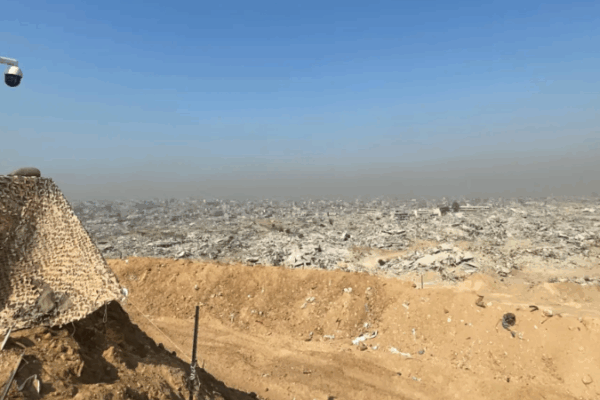
Two years after the war between Israel and Hamas began, the Gaza Strip has been reduced to ruins, with once-thriving neighborhoods now resembling ghost towns. A BBC team granted rare access to the territory describes a landscape of total devastation — homes flattened, hospitals barely functioning, and thousands of displaced families struggling to survive amid the wreckage. Entire districts that were once crowded with markets, schools, and apartment blocks now lie in rubble. In northern Gaza, what used to be Gaza City’s commercial heart is now a sea of collapsed concrete and twisted metal. The BBC crew reported seeing children playing amid debris, their laughter echoing in streets that have no running water, electricity, or sanitation. “It’s like time stopped here,” one resident told reporters. “We are alive, but everything around us is dead.” The humanitarian situation remains dire. The United Nations estimates that more than 1.7 million people — nearly 80 percent of Gaza’s population — are still displaced. Many live in makeshift shelters or tents built from scrap metal and plastic sheets. Food shortages are chronic, with aid deliveries continuing to face restrictions at border crossings. Hospitals, already crippled by years of blockade, are overwhelmed. Doctors work without adequate supplies, and power cuts force surgeries to be done under flashlights. The BBC also visited Al-Shifa Hospital in Gaza City, once the territory’s largest medical facility. Its corridors are dark, lined with patients on stretchers, while generators rumble outside. “We’ve lost colleagues, we’ve lost equipment, and we’re losing patients we could have saved,” said one exhausted doctor. Israel’s government maintains that its military operations were aimed at dismantling Hamas’s military infrastructure, following the deadly attacks that triggered the war in 2023. Officials say rebuilding can only begin once Hamas’s influence is completely removed. However, international aid agencies argue that ordinary civilians have borne the brunt of the destruction, with entire families wiped out and public infrastructure obliterated. Despite calls from global powers for a long-term ceasefire and reconstruction plan, progress has been painfully slow. Many foreign donors remain hesitant to fund rebuilding projects without assurances of stability. Meanwhile, Gazans face another winter with little shelter and minimal hope. At the Rafah crossing on the Egyptian border, crowds gather daily, hoping for rare permits to leave. “We just want to live somewhere safe,” said a young mother holding her child. “We have nothing left here.” Two years on, the BBC’s report paints a bleak picture: a territory trapped between the ruins of war and the uncertainty of peace. For Gaza’s people, survival has become the only measure of victory.

Read More