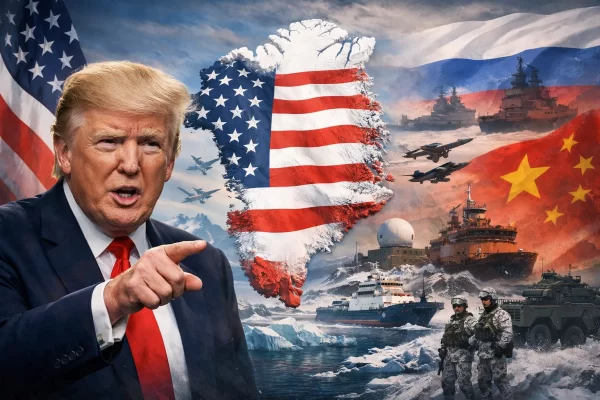
Trump Greenland negotiations

Trump wants ‘immediate negotiations’ to acquire Greenland but insists he ‘won’t use force’

Former US President Donald Trump has renewed his controversial interest in Greenland, calling for “immediate negotiations” to acquire the strategically vital Arctic island while insisting that the United States would not use military force to achieve the goal. The remarks have reignited international debate over sovereignty, security, and the future balance of power in the Arctic region. Trump framed his position as a matter of national and global security, arguing that Greenland’s location and natural resources make it critical at a time of rising competition among major powers. He stressed that his approach would rely on diplomacy and economic engagement rather than coercion, saying that negotiations could bring mutual benefits to both the United States and Greenland’s population. According to Trump, closer ties would lead to investment, infrastructure development, and enhanced security cooperation. Greenland, an autonomous territory within the Kingdom of Denmark, has repeatedly rejected the idea of being sold or transferred to another country. Danish officials have reaffirmed that Greenland is not for sale, while Greenlandic leaders have emphasized the island’s right to self-determination. Trump’s latest comments nevertheless place renewed pressure on Copenhagen and Nuuk, particularly as Arctic shipping routes open and interest in rare earth minerals intensifies. Analysts note that Trump’s insistence on non-forceful methods appears designed to soften criticism that his proposal undermines international norms. However, critics argue that even pushing for acquisition risks destabilizing relations with allies and sets a troubling precedent. Supporters counter that strategic realities require bold thinking and that negotiations do not automatically imply an outcome. The episode highlights the growing geopolitical importance of the Arctic, where climate change, security concerns, and resource competition intersect. Whether Trump’s call for talks gains traction or fades as diplomatic resistance hardens, the renewed focus on Greenland underscores how Arctic politics are moving closer to the center of global strategic discussions.
Read More
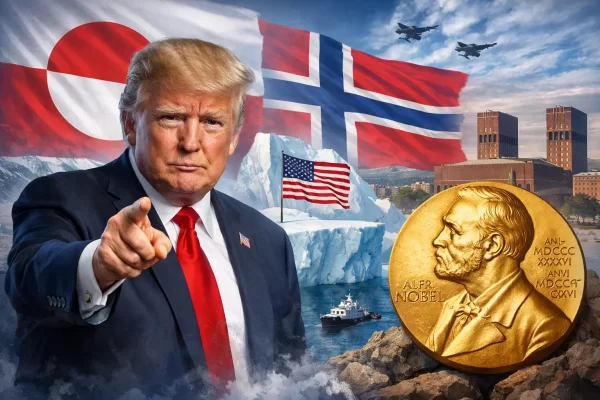
Trump Greenland Nobel Prize

Trump ties Greenland demands to Nobel Prize in message to Norway leader

Donald Trump has once again placed Greenland at the centre of global debate, this time linking US ambitions over the Arctic island to the Nobel Peace Prize in a message reportedly sent to Norway’s leader. The unusual communication has drawn sharp reactions across Europe, reviving tensions over sovereignty, diplomacy, and Trump’s unconventional approach to foreign policy. According to officials familiar with the matter, Trump argued that US control or decisive influence over Greenland would strengthen global security, reduce great-power rivalry in the Arctic, and contribute to long-term peace. He framed these claims within the context of Norway’s role as host of the Nobel Peace Prize, suggesting that such a geopolitical achievement would merit consideration for the prestigious award. The message was described as direct and characteristically provocative, reflecting Trump’s long-standing view of himself as a dealmaker capable of reshaping international order. The Trump Greenland Nobel Prize narrative has unsettled Nordic leaders, particularly Denmark, which retains sovereignty over Greenland. Danish officials have repeatedly stressed that Greenland is not for sale and that its future must be decided by its own people. Norwegian sources, meanwhile, emphasised that the Nobel Committee operates independently and does not consider political lobbying or territorial proposals when awarding the prize. Greenland’s strategic value has increased significantly in recent years due to climate change, melting ice, and expanded access to shipping routes and natural resources. Both China and Russia have stepped up Arctic engagement, a trend Trump has often cited as justification for stronger US involvement. Critics, however, argue that tying territorial ambitions to a peace prize undermines diplomatic norms and risks inflaming regional tensions rather than easing them. Political analysts note that Trump has previously linked his diplomatic initiatives to Nobel recognition, pointing to Middle East agreements and relations with North Korea. In this case, the Greenland remarks appear aimed at reinforcing his image as a leader willing to challenge traditional boundaries of diplomacy. As reactions continue, the episode underscores how Greenland remains a flashpoint in Arctic geopolitics—and how Trump continues to blend personal legacy with international strategy.

Read More
European military personnel in Greenland

European military personnel arrive in Greenland as Trump says US needs island

European military personnel have arrived in Greenland amid rising geopolitical tension after former US President Donald Trump reiterated claims that the United States needs control of the strategically located Arctic island. The deployment, involving forces from several European nations, is being framed as a defensive and cooperative measure aimed at reinforcing security and stability in the High North. Greenland, an autonomous territory of Denmark, has long been viewed as critical due to its position between North America and Europe, its proximity to Arctic shipping routes, and its growing importance in missile defense and surveillance systems. European officials say the presence of military personnel is intended to strengthen joint training, intelligence sharing, and preparedness in response to increasing activity by global powers in the Arctic region. Trump’s renewed remarks have reignited debate over Greenland’s strategic value. He has argued that US control of the island would be essential to counter the influence of Russia and China, both of which have expanded their Arctic ambitions in recent years. While Washington already maintains a military presence at Pituffik Space Base, formerly Thule Air Base, Trump’s comments suggest a far broader vision for American involvement. European leaders, however, have stressed respect for Greenlandic self-rule and Danish sovereignty. They argue that enhanced European military cooperation on the island demonstrates a collective commitment to security without undermining political autonomy. Danish authorities have welcomed allied support, noting that the Arctic is becoming an increasingly contested space as climate change opens new sea lanes and access to natural resources. For Greenland’s government, the situation highlights the delicate balance between security interests and self-determination. Local officials have emphasized that decisions about the island’s future must involve Greenlanders themselves, not be dictated by external powers. As great power competition intensifies in the Arctic, the arrival of European military personnel in Greenland underscores how the island has become a focal point of global strategic calculations, with implications far beyond the frozen north.

Read More
US ownership of Greenland

Trump says US needs to ‘own’ Greenland to prevent Russia and China from taking it

Former US President Donald Trump has once again reignited controversy by arguing that the United States needs to “own” Greenland in order to prevent Russia and China from expanding their influence in the Arctic. Speaking during a campaign-style appearance, Trump framed Greenland as a strategic necessity, claiming its location and resources make it vital to US national security in an increasingly competitive global environment. Trump said the Arctic is becoming a new frontline of great-power rivalry, with Russia strengthening its military presence in the region and China seeking greater access through economic and scientific initiatives. In this context, he argued that US ownership of Greenland would provide Washington with a decisive advantage, ensuring control over critical shipping routes, natural resources, and missile defense positioning. According to Trump, failing to act could allow rival powers to gain a foothold that would threaten long-term American interests. WABSTALK Greenland, an autonomous territory within the Kingdom of Denmark, has previously rejected any notion of being sold, and Danish leaders have described such proposals as unrealistic. However, Trump has maintained that the issue is not about real estate, but about geopolitics. He portrayed Greenland as central to Arctic security, highlighting its proximity to North America and its importance in monitoring activities in the North Atlantic and Arctic regions. The comments have drawn mixed reactions. Supporters say Trump is raising legitimate concerns about Arctic competition and the need for the US to think strategically about future threats. Critics, however, argue that the rhetoric oversimplifies complex diplomatic relationships and risks straining ties with key allies, particularly Denmark and other NATO partners. Despite the backlash, Trump’s remarks underscore how the Arctic has moved from a peripheral concern to a major strategic priority. As climate change opens new sea lanes and access to resources, competition among major powers is intensifying. Whether or not US ownership of Greenland is realistic, the debate reflects broader anxieties about maintaining influence in a rapidly changing global landscape. Trump says US will ‘run’ Venezuela until ‘safe transition can take place’

Read More