
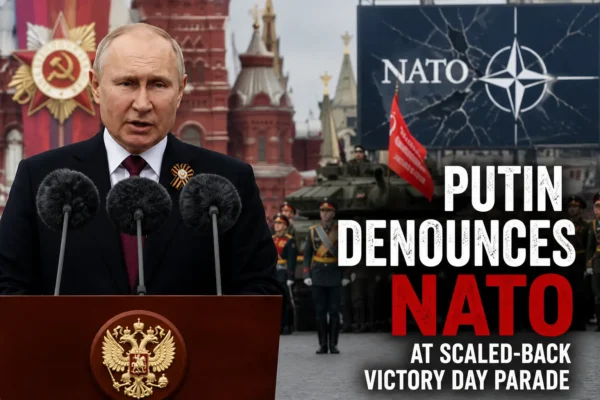
Putin denounces NATO at Victory Day parade

Putin denounces Nato at scaled-back Victory Day parade

Russian President Vladimir Putin used a scaled-back Victory Day parade in Moscow to deliver a sharp criticism of NATO, accusing the alliance of fueling global instability and escalating tensions near Russia’s borders. Speaking during the annual May 9 celebrations marking the Soviet Union’s victory over Nazi Germany in World War II, Putin said the West was attempting to “rewrite history” and weaken Russia through military pressure and sanctions. This year’s parade appeared smaller than previous editions, with fewer military vehicles and limited public participation. Analysts linked the reduced scale to ongoing military commitments and economic pressures caused by the war in Ukraine. Despite the toned-down event, the Kremlin sought to project strength and national unity through patriotic speeches, flyovers, and displays of military symbolism. Putin praised Russian troops fighting in Ukraine, describing them as defenders of the nation and heirs to the sacrifices made during World War II. He also repeated claims that NATO expansion threatens Russian security, a narrative Moscow has consistently used since the beginning of the conflict. Western leaders, however, reject those accusations and argue that Russia’s invasion of Ukraine is the main cause of instability in Europe. Several foreign allies attended the ceremony, though attendance from international leaders was noticeably lower than in previous years. Security across Moscow remained extremely tight amid fears of potential drone attacks and sabotage attempts. Victory Day remains one of Russia’s most important national holidays, blending remembrance of wartime sacrifice with displays of political and military power. This year’s event highlighted both Russia’s efforts to maintain a strong image on the global stage and the growing strains caused by its confrontation with the West.

Read More
Trump Nato troops Afghanistan remarks

Trump remarks about Nato troops in Afghanistan are ‘insulting’, says Starmer

UK Labour leader Sir Keir Starmer has condemned remarks by former US president Donald Trump about Nato troops in Afghanistan, describing them as “insulting” and disrespectful to allied forces who served and died alongside American soldiers during the conflict. Starmer said Trump’s comments undermined the sacrifices made by British and other Nato personnel over two decades of operations in Afghanistan. He stressed that the mission was conducted collectively, under Nato command, and involved shared decision-making and shared risk. “British troops stood shoulder to shoulder with US forces,” Starmer said. “Any suggestion that allied contributions were secondary or unworthy is deeply offensive to the families of those who lost their lives.” Trump, who has repeatedly criticised the Afghanistan war and the chaotic withdrawal in 2021, has in recent remarks questioned the value of Nato involvement and accused allies of failing to meet their responsibilities. While Trump did not single out the UK by name, his broader comments about allied performance prompted a strong reaction in London. The UK lost 457 service personnel during the Afghanistan campaign, making it the second-largest contributor of troops after the United States. British forces played key roles in combat operations, training Afghan security forces, and reconstruction efforts, particularly in Helmand province. Starmer said it was legitimate to debate the political decisions that led to the war and the manner of the withdrawal, but argued that criticism should never be directed at the troops themselves. He warned that dismissive rhetoric risked damaging trust within Nato at a time of heightened global insecurity. The comments also drew criticism from senior military figures and veterans’ groups, who said allied unity was essential for the credibility of the alliance. With Trump campaigning for a return to the White House and questioning long-standing US security commitments, the row is likely to fuel further debate in Europe about the future of Nato and the reliability of US leadership within the alliance.

Read More