
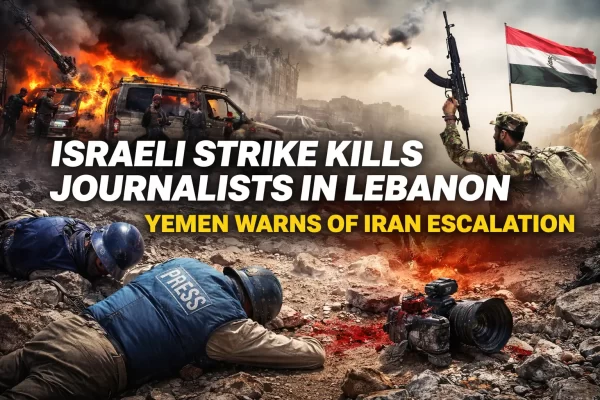
Israeli strike Lebanon journalists

Israeli strike kills journalists in Lebanon, as Yemen says Iran ‘dragging country into war’

An Israeli airstrike in southern Lebanon has killed three journalists, intensifying global concern over the safety of media workers in conflict zones and raising fears of a wider regional war. The victims included reporters and a cameraman from Lebanese outlets, who were covering ongoing hostilities between Israel and Hezbollah when their vehicle was struck. Israel stated that the strike targeted one individual it accused of being linked to Hezbollah intelligence, though it did not provide evidence and did not address the deaths of the other journalists. Lebanese authorities strongly condemned the attack, calling it a violation of international law and protections afforded to journalists in war zones. The incident comes amid a sharp escalation in the broader Middle East conflict, particularly following joint U.S.-Israeli strikes on Iran. Journalists have increasingly found themselves in harm’s way, with multiple fatalities reported across Lebanon, Gaza, and Iran since the conflict intensified. Meanwhile, tensions have expanded beyond Lebanon. Yemen’s Houthi movement, aligned with Iran, has warned that continued attacks could drag the region deeper into war. Officials signaled readiness to intervene militarily, accusing external powers of escalating the conflict and destabilizing the region. In parallel developments, missile and drone attacks across the Gulf, along with strikes on infrastructure and military bases, indicate that the conflict is no longer contained to a single front. Analysts warn that involvement from additional regional actors could transform the situation into a full-scale multi-country war. The killing of journalists has added urgency to calls from international organizations for accountability and protection of civilians. As the conflict widens, the risks to media personnel—and the broader civilian population—continue to grow.

Read More
Palestinian officials

Palestinians say new Israeli measures in West Bank amount to de facto annexation

Palestinian officials and civil society groups say a series of new Israeli measures in the occupied West Bank amount to de facto annexation, warning that recent actions are permanently reshaping the territory’s political and geographic reality. The measures include expanded settlement activity, tighter military controls, and administrative changes that critics argue undermine any future Palestinian state. According to Palestinian authorities, Israel has accelerated approval of new housing units in Jewish settlements while simultaneously restricting Palestinian construction and land access. Large areas of the West Bank have reportedly been redesignated as closed military zones or nature reserves, limiting Palestinian movement and agricultural use. Palestinians say these steps consolidate Israeli control without a formal declaration of annexation. Recent changes in governance have intensified concerns. Israeli officials have transferred additional administrative powers over the West Bank from the military to civilian authorities, a move Palestinians argue blurs the line between occupation and sovereignty. Human rights groups say this shift signals a long-term strategy to integrate the territory into Israel while denying Palestinians equal rights. The Israeli government maintains that its actions are driven by security needs and legal considerations, rejecting claims of annexation. Israeli officials argue that settlement expansion is limited and that final borders should be determined through negotiations. However, peace talks have been stalled for years, and Palestinians say facts on the ground are making a negotiated solution increasingly unrealistic. International reaction has been cautious but critical. Several governments have expressed concern that Israeli policies threaten the viability of a two-state solution. Palestinian leaders warn that continued settlement growth and land reclassification could lead to increased instability and resentment in the region. As tensions rise, Palestinians say the cumulative effect of these measures is clear: even without formal legislation, Israel is entrenching permanent control over large parts of the West Bank, fundamentally altering the prospects for peace. WABS TALK EU adds Iran’s Revolutionary Guards to terrorist list.

Read More
Gaza devastation

Inside Gaza, BBC sees total devastation after two years of war

Two years after the war between Israel and Hamas began, the Gaza Strip has been reduced to ruins, with once-thriving neighborhoods now resembling ghost towns. A BBC team granted rare access to the territory describes a landscape of total devastation — homes flattened, hospitals barely functioning, and thousands of displaced families struggling to survive amid the wreckage. Entire districts that were once crowded with markets, schools, and apartment blocks now lie in rubble. In northern Gaza, what used to be Gaza City’s commercial heart is now a sea of collapsed concrete and twisted metal. The BBC crew reported seeing children playing amid debris, their laughter echoing in streets that have no running water, electricity, or sanitation. “It’s like time stopped here,” one resident told reporters. “We are alive, but everything around us is dead.” The humanitarian situation remains dire. The United Nations estimates that more than 1.7 million people — nearly 80 percent of Gaza’s population — are still displaced. Many live in makeshift shelters or tents built from scrap metal and plastic sheets. Food shortages are chronic, with aid deliveries continuing to face restrictions at border crossings. Hospitals, already crippled by years of blockade, are overwhelmed. Doctors work without adequate supplies, and power cuts force surgeries to be done under flashlights. The BBC also visited Al-Shifa Hospital in Gaza City, once the territory’s largest medical facility. Its corridors are dark, lined with patients on stretchers, while generators rumble outside. “We’ve lost colleagues, we’ve lost equipment, and we’re losing patients we could have saved,” said one exhausted doctor. Israel’s government maintains that its military operations were aimed at dismantling Hamas’s military infrastructure, following the deadly attacks that triggered the war in 2023. Officials say rebuilding can only begin once Hamas’s influence is completely removed. However, international aid agencies argue that ordinary civilians have borne the brunt of the destruction, with entire families wiped out and public infrastructure obliterated. Despite calls from global powers for a long-term ceasefire and reconstruction plan, progress has been painfully slow. Many foreign donors remain hesitant to fund rebuilding projects without assurances of stability. Meanwhile, Gazans face another winter with little shelter and minimal hope. At the Rafah crossing on the Egyptian border, crowds gather daily, hoping for rare permits to leave. “We just want to live somewhere safe,” said a young mother holding her child. “We have nothing left here.” Two years on, the BBC’s report paints a bleak picture: a territory trapped between the ruins of war and the uncertainty of peace. For Gaza’s people, survival has become the only measure of victory.

Read More
Trump’s Gaza peace plan.

Leaders in Middle East and Europe welcome Trump’s Gaza peace plan

U.S. President Donald Trump’s recently unveiled Gaza peace plan has drawn cautious but notable support from both Middle Eastern and European leaders, marking what some analysts see as a potential turning point in efforts to stabilize the region. The plan, announced in Washington earlier this week, proposes a multi-stage roadmap to end hostilities, address humanitarian needs, and lay the groundwork for a negotiated political settlement. At the core of Trump’s Gaza peace plan is a ceasefire agreement brokered with the support of Egypt and Qatar, two nations that have long acted as intermediaries between Israel and Palestinian groups. Trump emphasized that the deal is designed to stop cycles of violence and redirect resources toward reconstruction and economic development. “This plan gives hope to the people of Gaza and ensures security for Israel,” Trump declared during his speech. In the Middle East, reactions were cautiously optimistic. Egyptian President Abdel Fattah el-Sisi praised the initiative, noting that Egypt has consistently sought stability along its border with Gaza. Qatar’s Emir Sheikh Tamim bin Hamad Al Thani echoed this sentiment, saying that the plan could open doors for renewed trust and cooperation if both sides commit. Even Jordan, often critical of U.S. approaches to the conflict, welcomed what it described as “a step that acknowledges humanitarian realities.” European leaders also offered measured endorsements. French President Emmanuel Macron said the proposal “creates a framework that Europe can support in pursuit of long-term peace.” German Chancellor Olaf Scholz highlighted the humanitarian provisions, including billions of dollars in aid and reconstruction funding, calling them “essential to building durable stability.” The European Union signaled readiness to mobilize financial support if the plan gains traction on the ground. While the plan has been met with diplomatic approval, challenges remain. Palestinian factions, including Hamas and Islamic Jihad, have voiced skepticism, warning that past agreements collapsed due to lack of enforcement and trust. Israel’s leadership has cautiously welcomed the plan, though some right-wing members of its government have expressed concerns about potential concessions. Analysts note that Trump’s Gaza peace plan stands out for placing equal emphasis on humanitarian aid and security guarantees. By involving key regional powers and securing at least tentative European backing, the proposal could achieve broader legitimacy than previous U.S. efforts. However, much will depend on implementation, particularly the ability of all parties to maintain a ceasefire in the face of provocations. As negotiations move forward, the international community is expected to play a critical role in monitoring, financing, and enforcing agreements. For now, Trump has succeeded in rallying a diverse set of allies behind a vision that, if realized, could alter the trajectory of one of the world’s most intractable conflicts.

Read More
Italian solidarity with Palestinians

Clashes break out as Italians strike demanding action over Gaza

Italy witnessed widespread unrest as thousands of demonstrators took to the streets demanding urgent government action over the escalating crisis in Gaza. What began as a coordinated strike soon turned violent when protesters clashed with police in several major cities, highlighting the growing tensions within Italian society over foreign policy and humanitarian concerns. The nationwide strike, organized by unions, student groups, and pro-Palestinian activists, aimed to pressure the Italian government into taking a firmer stance on Israel’s military actions in Gaza. Demonstrators carried banners calling for an immediate ceasefire, an end to arms sales, and increased humanitarian support for Palestinian civilians. Many also criticized the European Union for what they perceive as inaction in the face of the worsening conflict. In Rome, thousands gathered near government buildings, chanting slogans and waving Palestinian flags. Police in riot gear attempted to disperse the crowds when protesters blocked major roads, leading to scuffles. Several individuals were detained, and local reports suggest that both officers and demonstrators sustained injuries. Similar scenes were reported in Milan, Naples, and Bologna, where strikes brought public transport to a halt and disrupted daily life. Union leaders have defended the strike, arguing that Italian workers and students are standing in solidarity with Gaza’s civilians, who continue to face bombardments and shortages of food, water, and medicine. “This is not only a foreign issue,” said one organizer. “It is about basic human rights and our moral responsibility as Europeans.” The Italian government has so far expressed “concern” over the violence in Gaza but has avoided committing to stronger measures such as sanctions or halting arms exports. Prime Ministerial officials urged protesters to remain peaceful while emphasizing that diplomatic solutions should be pursued at the EU and UN levels. However, critics argue that this cautious stance only fuels public anger and alienation. The clashes come amid growing international pressure on Western governments to act decisively. Human rights groups have repeatedly called for Italy and other EU nations to suspend military cooperation with Israel until civilian safety is guaranteed. At the same time, divisions within Italy itself are widening, with some political factions supporting Israel’s right to defend itself, while others side firmly with the Palestinian cause. As the situation in Gaza deteriorates further, it remains to be seen whether Italy’s government will adjust its policy or continue to tread a middle ground. For many Italians who joined the strike, the message was clear: silence is no longer an option. Trump adds $100,000 fee for skilled worker visa applicants

Read More
Famine in Gaza City

Famine confirmed in Gaza City is ‘failure of humanity’, UN chief says

The United Nations has confirmed that famine is now taking hold in Gaza City, with Secretary-General António Guterres calling it a “failure of humanity” and an urgent wake-up call for the international community. The declaration follows weeks of mounting evidence of widespread hunger, collapsing food systems, and mass displacement in the war-torn territory. According to the UN’s latest food security assessment, more than half of Gaza’s population is experiencing catastrophic levels of food insecurity. In Gaza City, the devastation is most acute, with children and vulnerable groups facing the brunt of starvation. Humanitarian organizations report that many families have gone days without food, relying on unsafe water and whatever scraps they can find for survival. Guterres described the situation as both “entirely preventable” and “man-made,” stressing that aid convoys have faced repeated blockages, delays, and security risks. “This famine in Gaza City is not the result of drought or natural disaster—it is the result of relentless conflict, restrictions, and a breakdown in basic humanitarian law,” he said during a press briefing in New York. Aid agencies have long warned that Gaza was on the brink of famine due to continued military operations, damaged infrastructure, and restricted access to life-saving supplies. The confirmation by the UN’s Integrated Food Security Phase Classification (IPC) means the crisis has reached the most severe level on its scale, indicating extreme hunger and high mortality rates. The World Food Programme (WFP) has called for immediate and unrestricted humanitarian access, while UNICEF has warned of irreversible consequences for children, including stunted growth, disease, and death. “Children are paying the highest price of this war,” said Catherine Russell, UNICEF’s Executive Director. International reaction has been swift but divided. Some world leaders have urged for an immediate humanitarian ceasefire to allow aid deliveries, while others maintain that security conditions must be addressed first. Human rights groups argue that political disagreements cannot justify the starvation of civilians. Meanwhile, health officials in Gaza City report that hospitals are overwhelmed with malnourished patients, many of whom arrive too late to receive effective treatment. Medical supplies remain critically low, compounding the crisis and increasing preventable deaths. The famine declaration underscores the urgent need for coordinated international action. The UN chief reiterated his call for an immediate ceasefire, safe humanitarian corridors, and accountability for those obstructing aid. “History will judge us harshly if we fail to act,” Guterres warned. As famine grips Gaza City, the world faces a defining moral test: whether to prioritize political agendas or the survival of millions trapped in an unfolding humanitarian catastrophe.

Read More