
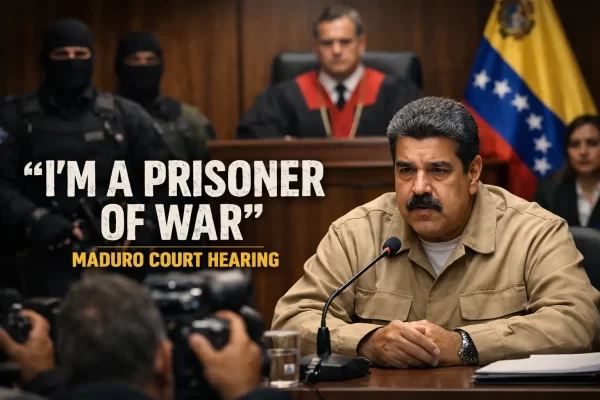
Maduro court hearing

‘I’m a prisoner of war’ – In the room for Maduro’s dramatic court hearing

Venezuela’s political tensions reached a dramatic peak as President Nicolás Maduro appeared before a court in a hearing that quickly became a stage for defiance, symbolism, and international messaging. Declaring “I’m a prisoner of war,” Maduro framed the proceedings not as a legal process but as part of a broader geopolitical confrontation, casting himself as a target of foreign pressure rather than a defendant subject to judicial scrutiny. Inside the courtroom, the atmosphere was tightly controlled. Security was heavy, access was restricted, and the audience was carefully selected, underscoring the sensitivity of the moment. Maduro, composed yet combative, used his remarks to reinforce a narrative long central to his leadership: that Venezuela is under siege from external forces seeking regime change. His words were clearly aimed beyond the room, intended for supporters at home and observers abroad. The Maduro court hearing unfolded against a backdrop of economic strain, sanctions, and ongoing disputes over legitimacy and governance. For critics, the spectacle reinforced concerns about the independence of Venezuela’s judiciary and the blurring of lines between political power and legal institutions. For supporters, Maduro’s rhetoric reaffirmed his image as a leader resisting what he describes as imperial interference. Observers noted that the hearing was less about legal arguments and more about political positioning. Maduro’s “prisoner of war” statement echoed past claims that sanctions and diplomatic isolation amount to collective punishment, a theme frequently invoked by his government to rally domestic backing and justify hardline policies. International reaction has been cautious but attentive. The courtroom drama is likely to influence ongoing negotiations, sanctions discussions, and regional diplomacy. Whether the hearing marks a turning point or merely another chapter in Venezuela’s prolonged crisis remains unclear. What is certain is that the Maduro court hearing was designed to be seen and remembered—not just as a legal event, but as a political message crafted for a global audience.
Read More
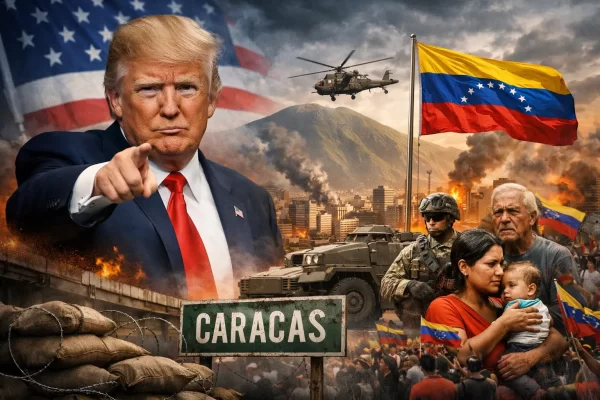
Trump Venezuela transition

Trump says US will ‘run’ Venezuela until ‘safe transition can take place’

Donald Trump has said the United States will “run” Venezuela until a “safe transition can take place,” marking one of his most forceful statements yet on the future of the crisis-hit South American nation. Speaking at a campaign-style event, Trump framed the comments as part of a broader strategy to restore stability, democracy, and economic order in Venezuela, which has been mired in political turmoil, sanctions, and economic collapse for years. Trump accused Venezuela’s current leadership of destroying the country’s economy, driving millions to flee, and turning the nation into what he described as a hub for crime and instability that affects the wider region. He argued that US involvement would be temporary and focused on overseeing a transition that ensures free elections, institutional reform, and the return of basic governance. According to Trump, the objective would be to hand control back to Venezuelans once conditions are deemed secure and democratic norms restored. The remarks immediately sparked controversy, with critics saying they suggest an unprecedented level of direct US control over another sovereign nation. Opponents argue that such language risks escalating tensions in Latin America and could revive memories of past US interventions in the region. They also warn that any perception of foreign rule could undermine the legitimacy of a future Venezuelan government. Supporters, however, say Trump’s comments reflect frustration with years of failed diplomatic efforts and sanctions that have not dislodged entrenched leadership or improved living conditions. They argue that a managed transition, backed by international partners, could help stabilize the country, revive oil production, and stem migration flows that have affected neighboring states and the United States. Venezuela remains one of the world’s most complex political crises, with deep divisions at home and competing interests abroad. Trump’s statement signals that, if returned to office, he may pursue a far more assertive approach, reshaping US policy toward Venezuela and potentially redefining Washington’s role in the region during any future transition.

Read More