
Trump Iran

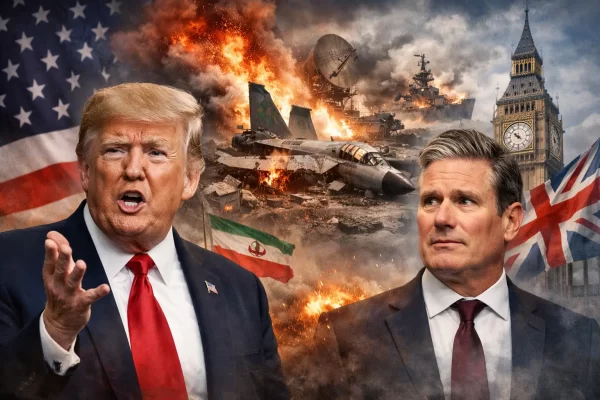
Trump says ‘everything’s been knocked out in Iran’ as he criticises UK and Starmer

US President Donald Trump claimed on Tuesday that US-Israeli military operations have inflicted “virtually everything … knocked out” of Iran’s defence capabilities, asserting that Iran’s navy, air force, radar and air-defence systems have been disabled amid escalating conflict in the Middle East. Trump made the remarks in the Oval Office during a press session with German Chancellor Friedrich Merz, defending the strikes as necessary to pre-empt what he described as an imminent threat from Iran. He denied that Israel had forced the United States into war, insisting that he acted to prevent a potentially planned Iranian attack on the United States. Trump admitted uncertainty about Iran’s post-conflict leadership and acknowledged the absence of a clear “day-after” plan. Trump’s comments came amid soaring tensions with European allies, particularly the UK. He openly criticised UK Prime Minister Sir Keir Starmer, saying he was “not happy with the UK” and that Starmer was “not Winston Churchill” for initially resisting US requests to use British military bases in support of offensive operations against Iran. Trump said Starmer had been “very uncooperative” and lamented that the “special relationship” between the US and UK was “not what it was,” highlighting London’s hesitancy over involvement and legal concerns. Starmer later allowed limited UK base use for defensive strikes against Iranian missile infrastructure but stopped short of broader offensive participation. The diplomatic spat underscores the growing strain between Washington and London as the Middle East conflict deepens. While Trump’s narrative emphasises military success, critics question both the legality and strategic planning of the campaign, and allies like Starmer have insisted on adherence to international law and careful strategic considerations.

Read More
European military personnel in Greenland

European military personnel arrive in Greenland as Trump says US needs island

European military personnel have arrived in Greenland amid rising geopolitical tension after former US President Donald Trump reiterated claims that the United States needs control of the strategically located Arctic island. The deployment, involving forces from several European nations, is being framed as a defensive and cooperative measure aimed at reinforcing security and stability in the High North. Greenland, an autonomous territory of Denmark, has long been viewed as critical due to its position between North America and Europe, its proximity to Arctic shipping routes, and its growing importance in missile defense and surveillance systems. European officials say the presence of military personnel is intended to strengthen joint training, intelligence sharing, and preparedness in response to increasing activity by global powers in the Arctic region. Trump’s renewed remarks have reignited debate over Greenland’s strategic value. He has argued that US control of the island would be essential to counter the influence of Russia and China, both of which have expanded their Arctic ambitions in recent years. While Washington already maintains a military presence at Pituffik Space Base, formerly Thule Air Base, Trump’s comments suggest a far broader vision for American involvement. European leaders, however, have stressed respect for Greenlandic self-rule and Danish sovereignty. They argue that enhanced European military cooperation on the island demonstrates a collective commitment to security without undermining political autonomy. Danish authorities have welcomed allied support, noting that the Arctic is becoming an increasingly contested space as climate change opens new sea lanes and access to natural resources. For Greenland’s government, the situation highlights the delicate balance between security interests and self-determination. Local officials have emphasized that decisions about the island’s future must involve Greenlanders themselves, not be dictated by external powers. As great power competition intensifies in the Arctic, the arrival of European military personnel in Greenland underscores how the island has become a focal point of global strategic calculations, with implications far beyond the frozen north.

Read More