
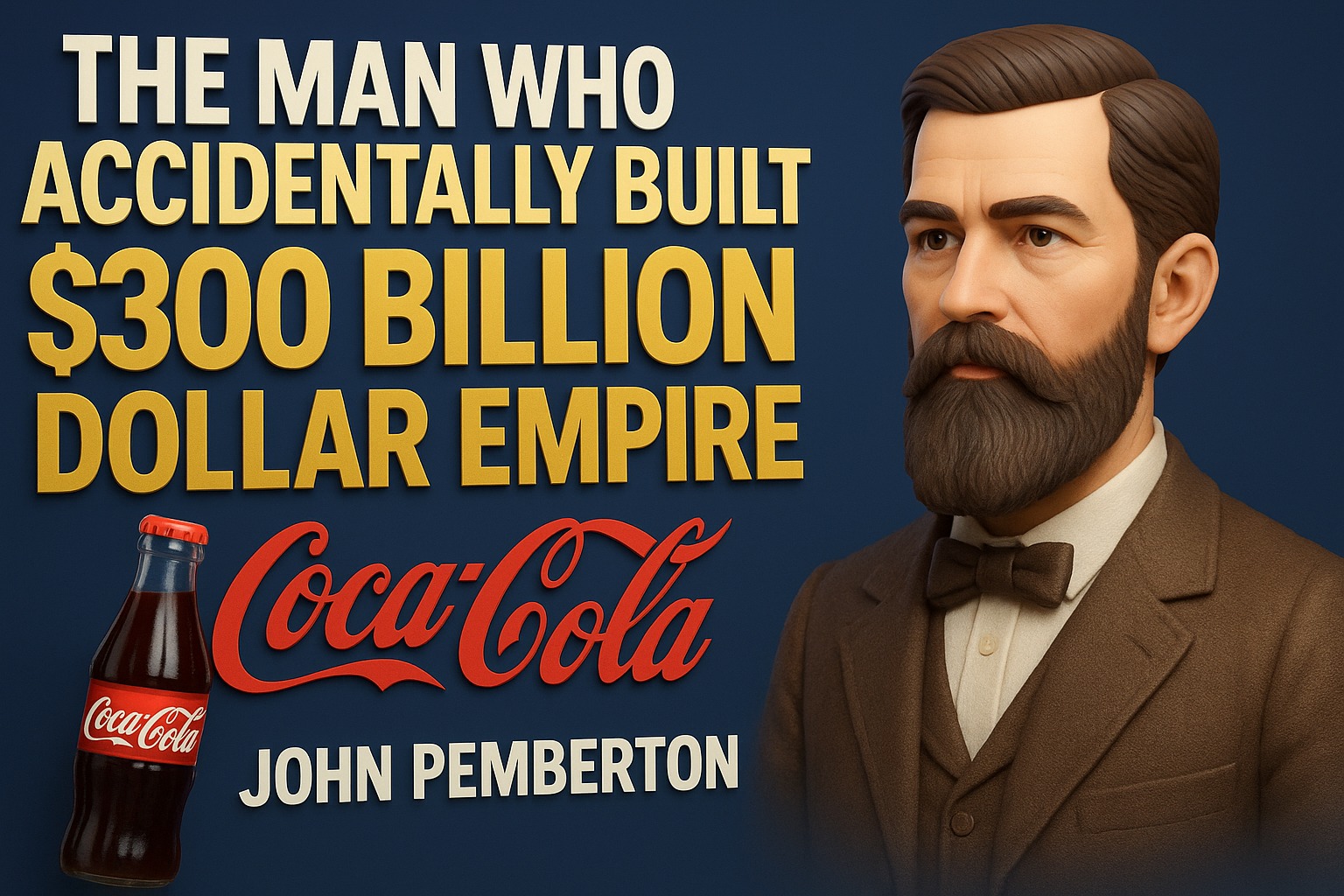
In the annals of business history, few stories are as ironic and fascinating as that of John Stith Pemberton, the man who inadvertently founded what would become one of the most valuable and recognizable brands in the world—Coca-Cola, now valued at over $300 billion.
John Pemberton was not a businessman or entrepreneur in the traditional sense. Born in 1831 in Georgia, he was a pharmacist and chemist by trade. Like many of his peers during the post-Civil War era, Pemberton was experimenting with medicinal concoctions in hopes of discovering a miracle cure. Ironically, his own motivation came from a personal need—he was severely wounded during the Civil War and became addicted to morphine. Seeking a less dangerous alternative, he began experimenting with various formulas.
In 1886, Pemberton developed a syrup made from coca leaves and kola nuts, combining it with carbonated water to create a refreshing, energizing tonic. He initially marketed it as a remedy for headaches, nervous disorders, and even impotence. It was first sold at Jacob’s Pharmacy in Atlanta for five cents a glass. He called it Coca-Cola, with the name and elegant script branding suggested by his bookkeeper, Frank M. Robinson.
At the time, neither Pemberton nor anyone else could have predicted the massive commercial success that Coca-Cola would eventually achieve. Tragically, Pemberton’s financial instincts did not match his scientific ones. He sold portions of his formula to various local businessmen, and shortly before his death in 1888, he sold the remaining rights to Asa Griggs Candler for just $1,750.
It was Candler, a visionary marketer, who transformed Coca-Cola from a medicinal tonic into a global consumer product. He invested in massive advertising campaigns, built bottling plants, and distributed coupons, embedding Coca-Cola into American culture. By the early 20th century, Coca-Cola had become a national icon.
Today, Coca-Cola is worth over $300 billion, operates in more than 200 countries, and sells 1.9 billion servings per day. The iconic red and white logo, the contoured glass bottle, and the classic jingle have all become deeply ingrained in global culture.
Yet, the man who started it all never saw this success. Pemberton died in poverty, unaware that his humble concoction would evolve into a symbol of modern capitalism and brand dominance.
What makes this story truly remarkable is the unintentional nature of the empire’s origin. Pemberton was solving a personal problem, not trying to build a company. But through a mixture of ingenuity, accident, and shrewd business by others, his invention became the cornerstone of one of the greatest consumer empires in history.
John Pemberton may not have lived to see his legacy, but his accidental creation laid the foundation for what we now know as one of the most successful brands the world has ever seen. WABSTALK