
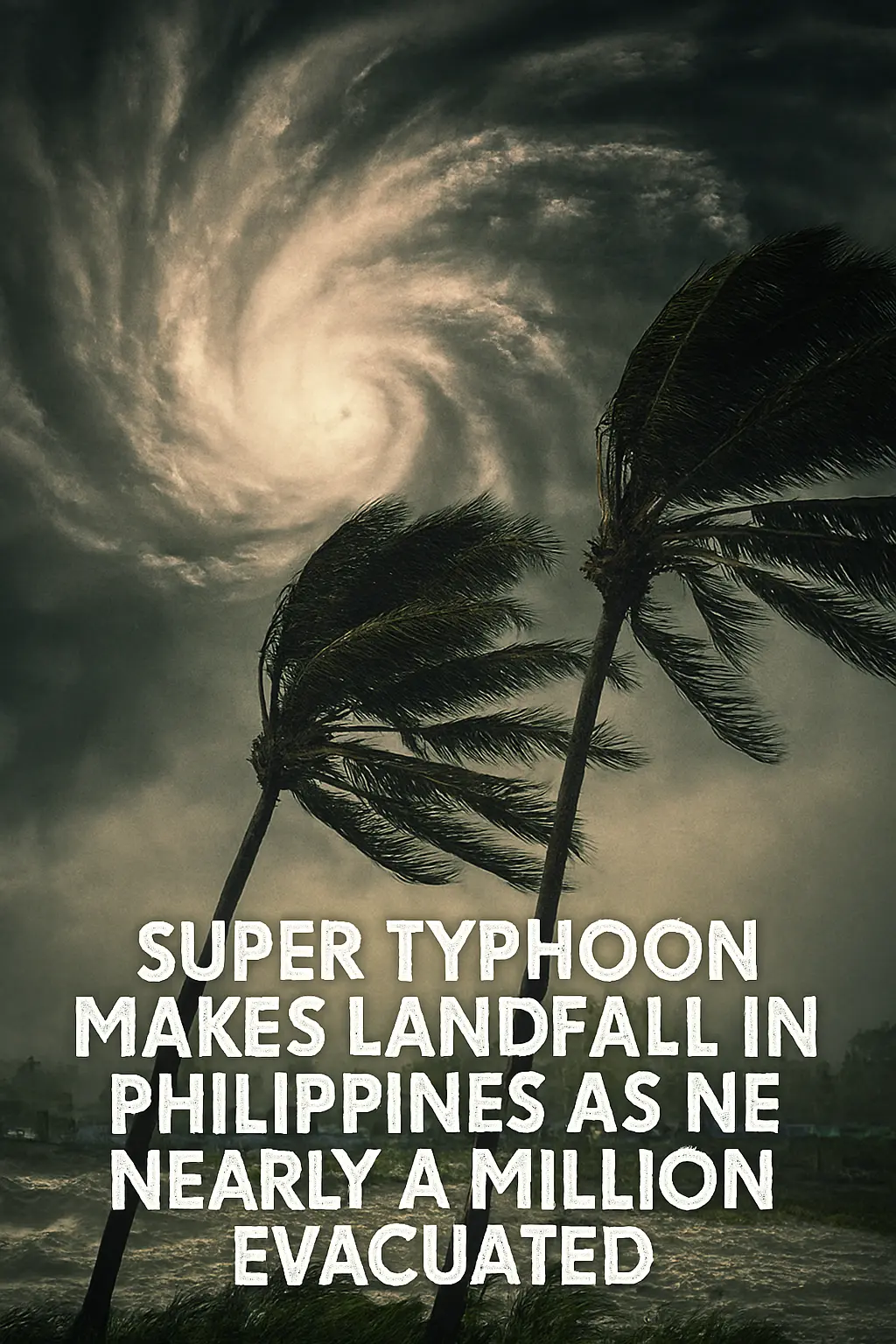
A powerful super typhoon has made landfall in the Philippines, bringing destructive winds, torrential rain, and widespread flooding that have forced the evacuation of nearly a million people across several provinces. The storm, one of the most intense to hit the country in recent years, made landfall early Sunday on the eastern coast of Samar Island, packing sustained winds exceeding 250 km/h (155 mph) and gusts reaching up to 300 km/h (186 mph).
According to the Philippine Atmospheric, Geophysical and Astronomical Services Administration (PAGASA), the storm—named Typhoon Sanro—is moving west-northwest across the Visayas region, with authorities warning of “catastrophic damage” in its path. Entire coastal towns have been submerged as storm surges up to 4 meters high battered low-lying communities. The government has suspended all flights and maritime operations, and electricity has been cut in several provinces as a precaution.
The National Disaster Risk Reduction and Management Council (NDRRMC) reported that around 960,000 residents were evacuated from coastal and landslide-prone areas ahead of the storm. Emergency shelters and schools are now being used to house displaced families, though officials fear overcrowding could lead to further health risks. In Tacloban City, memories of Typhoon Haiyan (Yolanda)—which devastated the area in 2013—have resurfaced, prompting many residents to evacuate early.
Philippine President Ferdinand Marcos Jr. has ordered all government agencies to be on “maximum alert,” emphasizing that the priority is saving lives. Military and coast guard units have been deployed for rescue and relief operations, while the Department of Social Welfare has pre-positioned food packs, water, and medical supplies across affected regions.
Meteorologists warn that the super typhoon’s strength is comparable to Haiyan, one of the deadliest tropical cyclones in recorded history. The combination of violent winds and torrential rains has already caused landslides in parts of Eastern Samar and Leyte, blocking key roads and isolating some rural communities. Floodwaters are also rising rapidly in the Bicol region, where rivers have overflowed due to nonstop rainfall.
Experts say the Philippines, located along the Pacific “Typhoon Belt,” faces increasing storm intensity due to climate change, which is warming ocean temperatures and fueling stronger cyclones. The country typically experiences about 20 tropical storms each year, but the frequency of super typhoons has been rising.
Authorities warn that even after the storm moves westward, heavy rainfall could continue for days, triggering flash floods and landslides in the mountainous interior. Rescue efforts are expected to expand as weather conditions improve, but early reports suggest widespread agricultural damage and infrastructure destruction.
The full extent of the devastation from the super typhoon in the Philippines is still unfolding, with officials bracing for potentially severe humanitarian and economic impacts.