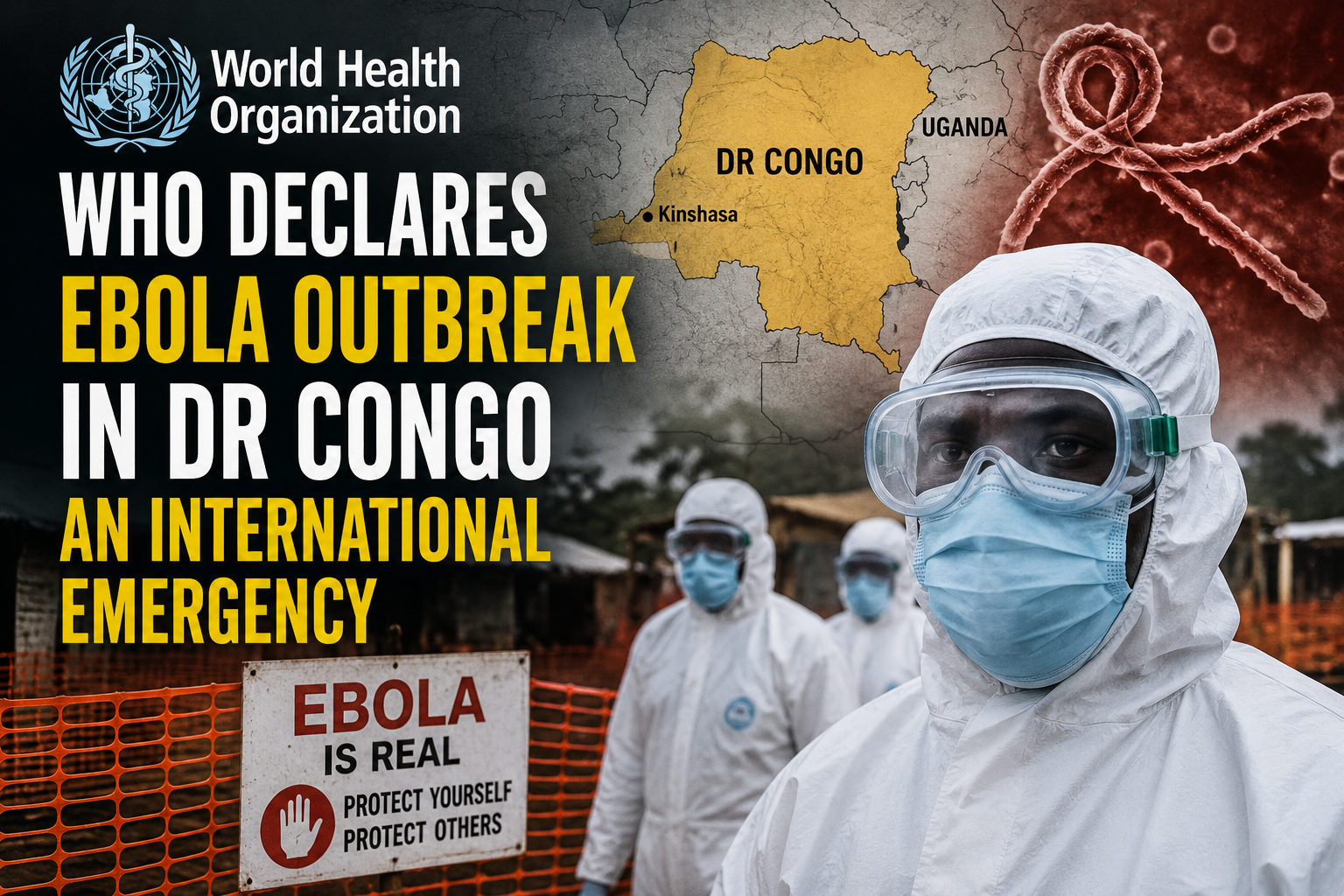
The World Health Organization has declared the Ebola outbreak in the Democratic Republic of the Congo and neighboring Uganda a “Public Health Emergency of International Concern” after a sharp rise in suspected infections and deaths linked to the rare Bundibugyo strain of the virus. Health officials say more than 300 suspected cases and around 80 deaths have been reported, with the outbreak centered in Ituri province in eastern Congo.
WHO Director-General Tedros Adhanom Ghebreyesus said the emergency declaration is intended to mobilize international support, funding, and coordination to stop the spread before it worsens. The organization clarified that the outbreak does not yet qualify as a pandemic, but neighboring countries remain at high risk because of cross-border movement and weak healthcare infrastructure in affected regions.
The Bundibugyo strain is especially concerning because there are currently no approved vaccines or targeted treatments for it, unlike the more common Ebola-Zaire strain. Medical experts fear the true number of infections could be significantly higher because many suspected cases are still awaiting confirmation. Cases have already appeared outside the outbreak epicenter, including in Uganda and the Congolese city of Goma, raising fears of wider regional transmission.
Health workers are intensifying contact tracing, screening, and isolation measures, while WHO has urged countries not to close borders, warning that travel restrictions could push people into unmonitored crossings and make containment more difficult. The outbreak is unfolding in a region already affected by armed conflict and mass displacement, complicating response efforts.
Global health agencies, including the Africa CDC, are now coordinating emergency responses as fears grow that the outbreak could expand further across Central and East Africa if rapid containment measures fail.