Israeli strike Lebanon journalists

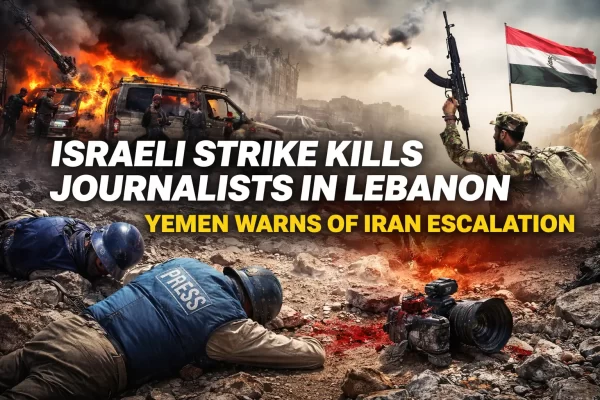
Israeli strike kills journalists in Lebanon, as Yemen says Iran ‘dragging country into war’

An Israeli airstrike in southern Lebanon has killed three journalists, intensifying global concern over the safety of media workers in conflict zones and raising fears of a wider regional war. The victims included reporters and a cameraman from Lebanese outlets, who were covering ongoing hostilities between Israel and Hezbollah when their vehicle was struck. Israel stated that the strike targeted one individual it accused of being linked to Hezbollah intelligence, though it did not provide evidence and did not address the deaths of the other journalists. Lebanese authorities strongly condemned the attack, calling it a violation of international law and protections afforded to journalists in war zones. The incident comes amid a sharp escalation in the broader Middle East conflict, particularly following joint U.S.-Israeli strikes on Iran. Journalists have increasingly found themselves in harm’s way, with multiple fatalities reported across Lebanon, Gaza, and Iran since the conflict intensified. Meanwhile, tensions have expanded beyond Lebanon. Yemen’s Houthi movement, aligned with Iran, has warned that continued attacks could drag the region deeper into war. Officials signaled readiness to intervene militarily, accusing external powers of escalating the conflict and destabilizing the region. In parallel developments, missile and drone attacks across the Gulf, along with strikes on infrastructure and military bases, indicate that the conflict is no longer contained to a single front. Analysts warn that involvement from additional regional actors could transform the situation into a full-scale multi-country war. The killing of journalists has added urgency to calls from international organizations for accountability and protection of civilians. As the conflict widens, the risks to media personnel—and the broader civilian population—continue to grow.

Read More
Trump Iran unconditional surrender

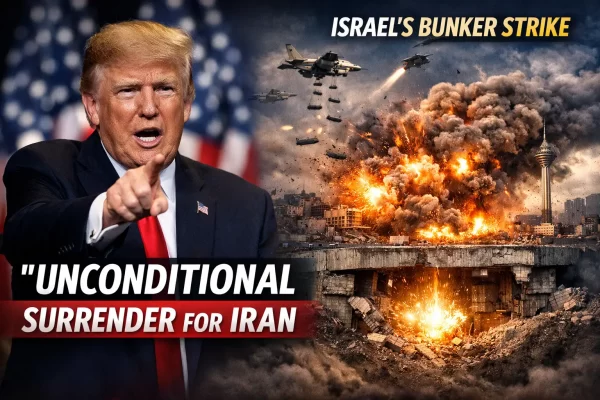
Trump demands Iran’s ‘unconditional surrender’ as Israel says it hit leadership bunker ‘with 50 jets’

U.S. President Donald Trump has demanded Iran’s “unconditional surrender”, dramatically escalating rhetoric as the conflict between Iran and Israel intensifies across the Middle East. The statement came as Israel claimed it had launched a massive airstrike using around 50 fighter jets to destroy a key underground bunker believed to be used by senior Iranian leadership in Tehran. Posting on his Truth Social platform, Trump said there would be “no deal with Iran except unconditional surrender,” signaling that Washington would not pursue negotiations unless Tehran fully capitulates. He also suggested that once Iran surrendered and installed what he described as a “great and acceptable leader,” the United States and its allies would help rebuild the country’s economy and restore stability. The remarks came amid a rapidly expanding regional war. Israeli military officials said their air force conducted a large-scale strike on a fortified underground command bunker beneath Iran’s leadership compound in Tehran. According to the Israel Defense Forces (IDF), about 50 warplanes dropped dozens of bombs on the site, targeting infrastructure believed to be used by senior regime figures following the death of Iran’s supreme leader earlier in the conflict. Israeli officials described the bunker as a secure command center spanning multiple streets beneath the capital, designed to protect leadership during wartime. The strike was part of a broader wave of Israeli attacks on Iranian and allied targets across the region. Meanwhile, Iran has continued retaliatory missile and drone attacks against Israeli positions and U.S. bases in the Gulf, raising fears of a wider regional confrontation. International leaders and humanitarian groups have urged de-escalation as casualties rise and displacement spreads across affected areas. Diplomatic efforts are reportedly underway by several countries to mediate the crisis, but Trump’s demand for unconditional surrender suggests the path to negotiations remains uncertain as the conflict deepens.

Read More
Russian soldiers executions

Russian soldiers tell BBC they saw fellow troops executed on commanders’ orders

Reports from Russian soldiers claiming they witnessed fellow troops being executed on commanders’ orders have raised serious allegations about battlefield discipline and potential war crimes during the ongoing conflict in Ukraine. In interviews with BBC, several servicemen described incidents in which soldiers accused of retreating or refusing orders were allegedly shot by their own side. The accounts, while difficult to independently verify, add to a growing body of testimony suggesting harsh enforcement tactics within parts of the Russian military structure. According to the soldiers, some executions were carried out as warnings to others, particularly during intense fighting when units were under pressure to hold positions. One interviewee claimed that commanders framed such actions as necessary to maintain order and prevent panic among troops facing Ukrainian advances. These statements, if accurate, could indicate violations of international humanitarian law, which prohibits extrajudicial killings and summary executions. Authorities in Russia have not publicly acknowledged the allegations and have repeatedly denied accusations of misconduct by their forces. Meanwhile, officials in Ukraine argue that the testimonies reflect systemic problems within Russian command structures, including poor morale and coercive discipline measures. Independent human rights investigators have previously documented claims of abuse, though confirming incidents in active combat zones remains challenging. The allegations come amid continued scrutiny of Russia’s military leadership and strategy under President Vladimir Putin, as the war enters another prolonged phase with heavy casualties reported on both sides. Analysts note that internal discipline problems often emerge in prolonged conflicts, particularly where communication breakdowns and logistical shortages create stress within units. WABS TALK If corroborated, the claims could increase international calls for investigations into potential war crimes and accountability mechanisms related to the conflict. However, experts caution that testimonies alone are not sufficient proof and require independent verification through forensic evidence and multiple sources. US wants Russia and Ukraine to end war by June, says Zelensky

Read More
New York snowstorm

Near impossible’ travel conditions in New York as 22 inches of snow falls on US east coast

A powerful nor’easter has paralyzed New York and much of the U.S. East Coast, dumping nearly 22 inches of snow across the region. The storm, described as one of the most severe in recent years, has created near impossible travel conditions. Authorities have declared a state of emergency, urging residents to remain indoors as blizzard-like winds and heavy snowfall continue to batter the area. Roads across New York City and surrounding states are buried under thick layers of snow, forcing officials to impose a travel ban. Only emergency and essential vehicles are permitted, while public transportation services face widespread disruptions. Airports have been hit especially hard, with thousands of flights canceled at JFK, LaGuardia, Newark, and Boston Logan, leaving travelers stranded and air traffic at a standstill. Residents are experiencing power outages as strong winds topple trees and damage utility lines. Local businesses, schools, and government offices remain closed, while grocery stores and pharmacies are struggling to keep up with demand as people stockpile essentials. The storm has also impacted neighboring states, including New Jersey, Pennsylvania, and Massachusetts, where snowfall totals are similarly extreme. Meteorologists warn that conditions may worsen as the storm continues to intensify, with blowing snow reducing visibility to near zero in many areas. Emergency services are stretched thin, responding to stranded motorists, medical emergencies, and infrastructure damage. Officials emphasize that staying indoors is the safest option until the storm subsides. This historic snowfall highlights the vulnerability of major urban centers to extreme winter weather. With near impossible travel conditions in New York, the storm serves as a reminder of the importance of preparedness and resilience in the face of natural disasters.

Read More
Trump global tariffs

Trump raises global tariffs to 15%, day after Supreme Court ruling

In a dramatic policy shift, President Donald Trump announced a global tariff increase to 15%, just one day after a pivotal Supreme Court ruling. This decision marks one of the most significant escalations in trade policy in recent years, with wide‑ranging implications for international commerce, domestic industries, and global markets. The tariff hike is aimed at strengthening U.S. manufacturing and reducing reliance on foreign imports. By raising duties across multiple categories, the administration seeks to encourage domestic production and protect American jobs. However, economists warn that such sweeping measures could trigger retaliatory actions from trading partners, potentially sparking new rounds of trade disputes. Global businesses are bracing for higher costs, particularly in sectors like technology, automotive, and consumer goods. Importers will face increased expenses, which may be passed on to consumers in the form of higher prices. Meanwhile, exporters in countries heavily dependent on U.S. markets are expected to feel immediate pressure, as competitiveness declines under the new tariff regime. The timing of the announcement—coming directly after a Supreme Court ruling—has added political weight to the decision. Analysts suggest that the ruling provided legal backing for broader executive authority in trade matters, paving the way for this aggressive tariff expansion. While supporters argue that the move will bolster national security and economic independence, critics caution that it risks destabilizing global supply chains and undermining long‑standing trade relationships. The coming weeks will reveal how international markets and governments respond to this bold step, and whether negotiations can ease tensions or escalate into a full‑scale trade conflict

Read More
Trump Iran warning

Trump says world has 10 days to see if Iran deal reached

Donald Trump has said the world has roughly 10 days to determine whether a new agreement can be reached with Iran, warning that failure to secure a deal could lead to serious consequences, including potential military escalation. His remarks come as tensions rise over Tehran’s nuclear program and ongoing diplomatic efforts involving the United States and international partners. Speaking after recent negotiations, Trump described the discussions as “productive but complicated,” emphasizing that Washington is seeking a comprehensive agreement that would permanently prevent Iran from obtaining nuclear weapons. He stressed that any deal must include strict limitations on uranium enrichment, expanded international inspections, and constraints on Iran’s missile development capabilities. According to Trump, previous diplomatic frameworks were inadequate, and the new proposal must deliver stronger guarantees. Indirect talks between American and Iranian officials have reportedly taken place in Geneva, where mediators are attempting to bridge longstanding disagreements. Iran continues to maintain that its nuclear activities are intended for civilian energy purposes, while rejecting demands to scale back certain defense programs it considers essential to national sovereignty. These conflicting positions remain a major obstacle to a breakthrough. Meanwhile, the United States has increased its military readiness in the Middle East, deploying additional naval and air assets to the region. Analysts view the buildup as both a pressure tactic in negotiations and a contingency measure should diplomacy fail. The possibility of confrontation has raised global concern, with several governments urging restraint and renewed diplomatic engagement to avoid a wider conflict. Despite his warning, Trump reiterated that his preferred outcome is a peaceful resolution. However, his 10-day timeframe underscores the urgency of the situation and signals that the coming days could be decisive for regional stability and international security.

Read More
Russia-Ukraine peace talks

Difficult’ Russia-Ukraine peace talks end without breakthrough

The latest round of Russia-Ukraine peace talks concluded in Geneva without delivering any meaningful progress toward ending the ongoing war. Over two days of negotiations, Ukrainian President Volodymyr Zelensky described the discussions as “difficult,” accusing Moscow of deliberately stalling the process. The talks, mediated by U.S. envoys, were expected to explore pathways toward a ceasefire and long-term settlement, but they ended abruptly after less than two hours on the second day. Ukrainian officials stressed their commitment to pursuing peace but voiced frustration at Russia’s reluctance to engage constructively. Zelensky emphasized that Kyiv’s delegation had been tasked with maximizing opportunities for peaceful solutions, yet Moscow appeared intent on dragging out negotiations. The Kremlin, meanwhile, maintained its position that Ukraine must make concessions, particularly regarding territorial disputes, which remain the central obstacle to progress. The Geneva talks were part of a U.S.-brokered initiative aimed at reducing tensions and finding common ground. Despite international pressure, both sides left without agreeing on concrete steps forward. Analysts highlight that the failure underscores the complexity of achieving a ceasefire, given the entrenched military and political positions. With the fourth anniversary of Russia’s full-scale invasion approaching, the lack of progress raises concerns about prolonged instability in Europe. Observers warn that continued stalemate could deepen humanitarian crises and further destabilize regional security. While the talks ended without breakthrough, both sides acknowledged that dialogue must continue, leaving open the possibility of future negotiations.

Read More
Palestinian officials

Palestinians say new Israeli measures in West Bank amount to de facto annexation

Palestinian officials and civil society groups say a series of new Israeli measures in the occupied West Bank amount to de facto annexation, warning that recent actions are permanently reshaping the territory’s political and geographic reality. The measures include expanded settlement activity, tighter military controls, and administrative changes that critics argue undermine any future Palestinian state. According to Palestinian authorities, Israel has accelerated approval of new housing units in Jewish settlements while simultaneously restricting Palestinian construction and land access. Large areas of the West Bank have reportedly been redesignated as closed military zones or nature reserves, limiting Palestinian movement and agricultural use. Palestinians say these steps consolidate Israeli control without a formal declaration of annexation. Recent changes in governance have intensified concerns. Israeli officials have transferred additional administrative powers over the West Bank from the military to civilian authorities, a move Palestinians argue blurs the line between occupation and sovereignty. Human rights groups say this shift signals a long-term strategy to integrate the territory into Israel while denying Palestinians equal rights. The Israeli government maintains that its actions are driven by security needs and legal considerations, rejecting claims of annexation. Israeli officials argue that settlement expansion is limited and that final borders should be determined through negotiations. However, peace talks have been stalled for years, and Palestinians say facts on the ground are making a negotiated solution increasingly unrealistic. International reaction has been cautious but critical. Several governments have expressed concern that Israeli policies threaten the viability of a two-state solution. Palestinian leaders warn that continued settlement growth and land reclassification could lead to increased instability and resentment in the region. As tensions rise, Palestinians say the cumulative effect of these measures is clear: even without formal legislation, Israel is entrenching permanent control over large parts of the West Bank, fundamentally altering the prospects for peace. WABS TALK EU adds Iran’s Revolutionary Guards to terrorist list.

Read More
India–US trade deal

Hope and uncertainty as India and US strike long-delayed trade deal

India and the United States have finally reached a long-awaited trade agreement, marking a significant milestone in bilateral relations and raising hopes of stronger economic cooperation. Announced after months of intense negotiations, the deal is being seen as a breakthrough that could ease trade tensions, boost exports, and deepen strategic ties between the world’s largest democracy and its biggest economy. Markets reacted positively to the news, with Indian equities and the rupee showing immediate gains. Export-oriented sectors such as textiles, engineering goods, and jewellery are expected to benefit from reduced tariffs and improved access to the US market. Business leaders in both countries welcomed the agreement, calling it a step toward greater stability and predictability in cross-border commerce. Despite the optimism, uncertainty continues to surround key aspects of the pact. Several details remain unclear, including the full scope of tariff cuts, timelines for implementation, and how sensitive sectors like agriculture and dairy will be protected. Analysts caution that while the headline agreement is encouraging, its real impact will depend on the fine print and how effectively both governments follow through on commitments. There are also geopolitical dimensions to consider. Energy cooperation and India’s oil sourcing policies have reportedly featured in discussions, reflecting Washington’s broader strategic priorities. At home, Indian opposition parties have raised concerns about whether small farmers and domestic industries could face increased competition. For the United States, the deal represents an effort to strengthen economic ties with a key Indo-Pacific partner, while India sees it as an opportunity to attract investment, expand exports, and position itself as a reliable global manufacturing hub. Ultimately, the trade agreement signals renewed momentum in India–US relations. Yet it remains a delicate balancing act between opportunity and risk. As both sides move toward implementation, businesses and policymakers alike will be watching closely to see whether this long-delayed deal delivers lasting economic gains or becomes another chapter of unfinished promises WABS TALK . EU adds Iran’s Revolutionary Guards to terrorist list.

Read More
DOJ Epstein Files Release

US justice department releasing more than three million pages from Epstein files

On January 30, 2026, the U.S. Justice Department announced a major disclosure of documents in its ongoing probe into convicted sex offender Jeffrey Epstein, releasing more than three million pages of records as part of a mandated transparency effort under the Epstein Files Transparency Act. Deputy Attorney General Todd Blanche said the release includes a large volume of material — over 2,000 videos and about 180,000 images — drawn from the department’s investigations, which span more than two decades of probes in Florida and New York, as well as related inquiries into Epstein’s network and activities. Although the law required all unclassified documents to be made public by December 19, 2025, the Justice Department missed that deadline due to the enormity of the review and redaction process. Hundreds of attorneys were tasked with examining the material to properly redact personally identifying information of victims, sensitive law enforcement details, and content that could jeopardize ongoing investigations. Blanche emphasized that while extensive redactions were necessary — including removing the identities of all women in images except Ghislaine Maxwell — the department did not withhold records for political reasons, dismissing claims of shielding any individual from scrutiny. The released files add to previously disclosed batches and represent a significant step in fulfilling the department’s legal obligations under the new transparency law, even as some material remains subject to further review or restricted access by Congress. The surge of public attention around the case — driven by both the scale of the release and the high-profile figures referenced in some records — follows widespread criticism from lawmakers and advocacy groups who had pressed the Justice Department for a more complete disclosure of Epstein-related materials. EU adds Iran’s Revolutionary Guards to terrorist list

Read More