EU adds Iran’s Revolutionary Guards to terrorist lis

EU adds Iran’s Revolutionary Guards to terrorist list

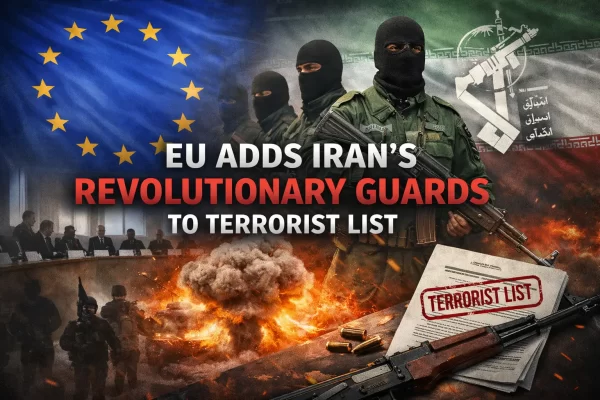
EU adds Iran’s Revolutionary Guards to terrorist list — On 29 January 2026, the European Union (EU) formally added Iran’s Islamic Revolutionary Guard Corps (IRGC) to its official terrorist organizations list, marking a major escalation in the bloc’s response to Tehran’s domestic repression and regional conduct. The decision was made unanimously by the 27 EU member states’ foreign ministers during a meeting in Brussels, with support from traditionally cautious capitals including France, Germany, and Italy. The move reflects growing concern within the EU over the IRGC’s role in violently suppressing widespread protests inside Iran. Human rights groups say the crackdown led to thousands of deaths and mass arrests, drawing strong international condemnation. EU foreign policy chief Kaja Kallas said the designation was justified because “repression cannot go unanswered,” adding that labeling an organization accused of killing its own citizens as terrorist sends a clear political signal. By placing the IRGC alongside extremist groups such as al-Qaida and ISIS, the EU now criminalizes material support or cooperation with the Guard within its jurisdiction. The listing triggers asset freezes, travel bans, and legal penalties under EU law. Member states also gain stronger legal authority to investigate networks tied to the IRGC and enforce financial restrictions against individuals or entities linked to the group. Iran swiftly condemned the decision, warning of destabilizing consequences and possible retaliation. Tehran accused the EU of politicizing counterterrorism measures and interfering in Iran’s internal affairs. While some analysts argue the step is largely symbolic given existing sanctions imposed by the United States, Canada, and Australia, the designation represents a significant political rebuke. The move aligns European policy more closely with Western partners critical of Iran’s domestic crackdown and regional activities. It also signals a tougher EU stance toward Tehran at a time of heightened tensions, reinforcing pressure on Iran over human rights and security concerns.

Read More
Trump warns Iran time is running out

Trump warns Iran ‘time is running out’ for nuclear deal as US military builds up in Gulf

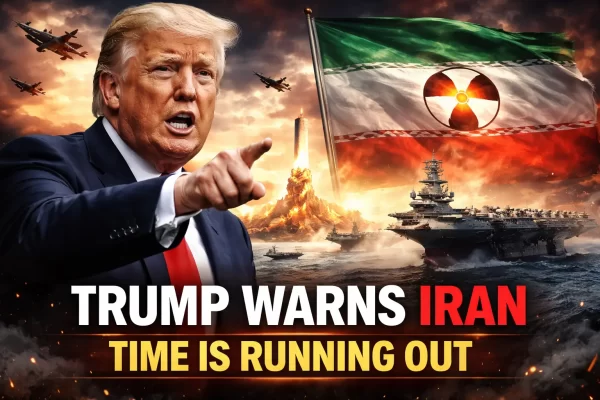
President Donald Trump has issued a stark warning to Iran that “time is running out” for Tehran to negotiate a fresh nuclear deal, intensifying one of the most serious diplomatic standoffs between Washington and Tehran in years. Trump used his Truth Social platform to demand that Iran return to negotiations on its nuclear programme under terms that would completely bar nuclear weapons development. He framed the ultimatum as urgent, urging Tehran to “come to the table” before diplomatic avenues close and military action becomes unavoidable. Alongside this warning, the United States has deployed a significant military buildup in the Persian Gulf region, centred on a “massive armada” led by the aircraft carrier USS Abraham Lincoln. Trump described the force as “ready, willing, and able to rapidly fulfil its mission with speed and violence, if necessary,” underscoring that diplomatic pressure is being backed by a credible military posture. In his message, Trump referenced past U.S. strikes on Iranian nuclear facilities during the 2025 conflict and warned that “the next attack will be far worse” if Iran refuses to negotiate. Tehran has rebuffed what it calls diplomacy under threat, insisting that negotiations must occur without military pressure and that it will defend itself if attacked. Iranian officials have rejected recent U.S. overtures and described Washington’s approach as ineffective and confrontational. The current crisis is unfolding amid broader regional and global concern over Iran’s nuclear trajectory, internal unrest, and the growing risk that further escalation could ignite a wider Middle East conflict. U.S. allies in the region have urged restraint while quietly strengthening their own defences. Some governments remain reluctant to host American military operations, complicating Washington’s strategic options. With tensions rising, Trump has made clear that his administration prefers a negotiated settlement — but only on strict terms. As military forces gather in the Gulf and rhetoric hardens on both sides, the coming weeks may prove decisive in determining whether diplomacy prevails or the standoff slides toward open confrontation.

Read More
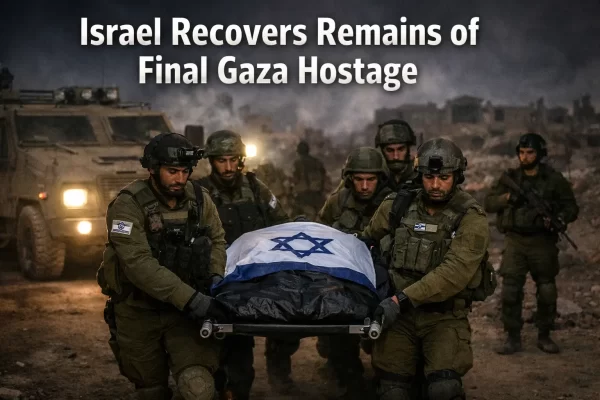
Israel Gaza Hostage Remains

Israel says it has retrieved remains of final Gaza hostage

Israel has announced that it has recovered the remains of what it says was the final Israeli hostage held in Gaza, marking a grim milestone in the aftermath of the October 7 attacks and the prolonged war that followed. Israeli officials confirmed the operation was carried out by the military and domestic security services during a targeted mission in southern Gaza. The remains were transferred back to Israel for forensic identification, after which authorities notified the victim’s family. The individual had been presumed dead for months, but confirmation only came following the recovery process. The announcement brings symbolic closure to Israel’s hostage recovery efforts, which have been ongoing alongside intense military operations across Gaza. According to Israeli leaders, the mission reflects a continued commitment to returning every captive, living or deceased, to their families. Prime Minister Benjamin Netanyahu said the country “bows its head in mourning” and reaffirmed Israel’s pledge to account for all those taken during the Hamas-led assault. Defense officials described the recovery as both operationally complex and emotionally significant, emphasizing that intelligence gathering and ground coordination played a critical role. Families of hostages have expressed mixed emotions, combining relief at finally receiving answers with deep grief over the loss of their loved ones. Advocacy groups representing relatives said the moment underscores the human cost of the conflict and renewed calls for accountability. The development comes amid ongoing fighting and mounting international pressure for a ceasefire and expanded humanitarian access to Gaza. Palestinian health authorities continue to report heavy civilian casualties, while aid agencies warn of worsening conditions across the enclave. With the confirmation of the Israel Gaza hostage remains, attention now shifts to broader diplomatic efforts aimed at ending the war and addressing the future governance of Gaza. For many Israelis, the recovery closes one painful chapter, even as the wider conflict shows few signs of resolution.

Read More
Minneapolis immigration agents shooting

One dead after Minneapolis shooting involving immigration agents

A fatal shooting in Minneapolis, Minnesota, involving U.S. federal immigration agents has resulted in the death of one person, according to multiple media reports and hospital records. The incident occurred on January 24, 2026, at the intersection of East 26th Street and Nicollet Avenue South during a broader immigration enforcement operation led by U.S. Immigration and Customs Enforcement (ICE) agents. A 51-year-old man who was shot in the chest by an ICE agent was taken to a local hospital and later pronounced dead, marking another deadly encounter in the city amid heightened federal enforcement activity. Local law enforcement sources and eyewitness accounts indicate that federal agents were engaged in a mission tied to expanded immigration operations when the confrontation occurred. Officials from the Department of Homeland Security later stated that the man was armed and that a firearm with two magazines was recovered at the scene. This assertion has been cited in official statements as justification for the use of deadly force, though further details have not yet been independently confirmed. The shooting follows earlier controversial incidents involving immigration officers in Minneapolis. On January 7, 2026, an ICE agent fatally shot Renée Nicole Good, a 37-year-old U.S. citizen and mother, during an encounter on Portland Avenue South. Accounts from local authorities and federal officials have sharply differed over whether she posed an imminent threat at the time of the shooting, adding to public concern and scrutiny. Both deaths have intensified unrest in the city, prompting protests and renewed calls from Minnesota officials for federal immigration enforcement actions to be paused. Governor Tim Walz condemned the January 24 shooting as “sickening” and urged the Trump administration to halt the current enforcement campaign in the state, arguing that it endangers community safety and undermines public trust. The situation remains fluid, with investigations ongoing and community reactions continuing. The incidents have reignited a national debate over the use of force by federal agents in densely populated urban areas and the level of oversight applied to immigration enforcement operations.

Read More
Trump Nato troops Afghanistan remarks

Trump remarks about Nato troops in Afghanistan are ‘insulting’, says Starmer

UK Labour leader Sir Keir Starmer has condemned remarks by former US president Donald Trump about Nato troops in Afghanistan, describing them as “insulting” and disrespectful to allied forces who served and died alongside American soldiers during the conflict. Starmer said Trump’s comments undermined the sacrifices made by British and other Nato personnel over two decades of operations in Afghanistan. He stressed that the mission was conducted collectively, under Nato command, and involved shared decision-making and shared risk. “British troops stood shoulder to shoulder with US forces,” Starmer said. “Any suggestion that allied contributions were secondary or unworthy is deeply offensive to the families of those who lost their lives.” Trump, who has repeatedly criticised the Afghanistan war and the chaotic withdrawal in 2021, has in recent remarks questioned the value of Nato involvement and accused allies of failing to meet their responsibilities. While Trump did not single out the UK by name, his broader comments about allied performance prompted a strong reaction in London. The UK lost 457 service personnel during the Afghanistan campaign, making it the second-largest contributor of troops after the United States. British forces played key roles in combat operations, training Afghan security forces, and reconstruction efforts, particularly in Helmand province. Starmer said it was legitimate to debate the political decisions that led to the war and the manner of the withdrawal, but argued that criticism should never be directed at the troops themselves. He warned that dismissive rhetoric risked damaging trust within Nato at a time of heightened global insecurity. The comments also drew criticism from senior military figures and veterans’ groups, who said allied unity was essential for the credibility of the alliance. With Trump campaigning for a return to the White House and questioning long-standing US security commitments, the row is likely to fuel further debate in Europe about the future of Nato and the reliability of US leadership within the alliance.

Read More
Trump Greenland negotiations

Trump wants ‘immediate negotiations’ to acquire Greenland but insists he ‘won’t use force’

Former US President Donald Trump has renewed his controversial interest in Greenland, calling for “immediate negotiations” to acquire the strategically vital Arctic island while insisting that the United States would not use military force to achieve the goal. The remarks have reignited international debate over sovereignty, security, and the future balance of power in the Arctic region. Trump framed his position as a matter of national and global security, arguing that Greenland’s location and natural resources make it critical at a time of rising competition among major powers. He stressed that his approach would rely on diplomacy and economic engagement rather than coercion, saying that negotiations could bring mutual benefits to both the United States and Greenland’s population. According to Trump, closer ties would lead to investment, infrastructure development, and enhanced security cooperation. Greenland, an autonomous territory within the Kingdom of Denmark, has repeatedly rejected the idea of being sold or transferred to another country. Danish officials have reaffirmed that Greenland is not for sale, while Greenlandic leaders have emphasized the island’s right to self-determination. Trump’s latest comments nevertheless place renewed pressure on Copenhagen and Nuuk, particularly as Arctic shipping routes open and interest in rare earth minerals intensifies. Analysts note that Trump’s insistence on non-forceful methods appears designed to soften criticism that his proposal undermines international norms. However, critics argue that even pushing for acquisition risks destabilizing relations with allies and sets a troubling precedent. Supporters counter that strategic realities require bold thinking and that negotiations do not automatically imply an outcome. The episode highlights the growing geopolitical importance of the Arctic, where climate change, security concerns, and resource competition intersect. Whether Trump’s call for talks gains traction or fades as diplomatic resistance hardens, the renewed focus on Greenland underscores how Arctic politics are moving closer to the center of global strategic discussions.

Read More
Trump Greenland Nobel Prize

Trump ties Greenland demands to Nobel Prize in message to Norway leader

Donald Trump has once again placed Greenland at the centre of global debate, this time linking US ambitions over the Arctic island to the Nobel Peace Prize in a message reportedly sent to Norway’s leader. The unusual communication has drawn sharp reactions across Europe, reviving tensions over sovereignty, diplomacy, and Trump’s unconventional approach to foreign policy. According to officials familiar with the matter, Trump argued that US control or decisive influence over Greenland would strengthen global security, reduce great-power rivalry in the Arctic, and contribute to long-term peace. He framed these claims within the context of Norway’s role as host of the Nobel Peace Prize, suggesting that such a geopolitical achievement would merit consideration for the prestigious award. The message was described as direct and characteristically provocative, reflecting Trump’s long-standing view of himself as a dealmaker capable of reshaping international order. The Trump Greenland Nobel Prize narrative has unsettled Nordic leaders, particularly Denmark, which retains sovereignty over Greenland. Danish officials have repeatedly stressed that Greenland is not for sale and that its future must be decided by its own people. Norwegian sources, meanwhile, emphasised that the Nobel Committee operates independently and does not consider political lobbying or territorial proposals when awarding the prize. Greenland’s strategic value has increased significantly in recent years due to climate change, melting ice, and expanded access to shipping routes and natural resources. Both China and Russia have stepped up Arctic engagement, a trend Trump has often cited as justification for stronger US involvement. Critics, however, argue that tying territorial ambitions to a peace prize undermines diplomatic norms and risks inflaming regional tensions rather than easing them. Political analysts note that Trump has previously linked his diplomatic initiatives to Nobel recognition, pointing to Middle East agreements and relations with North Korea. In this case, the Greenland remarks appear aimed at reinforcing his image as a leader willing to challenge traditional boundaries of diplomacy. As reactions continue, the episode underscores how Greenland remains a flashpoint in Arctic geopolitics—and how Trump continues to blend personal legacy with international strategy.

Read More
Berlin power outage sabotage vulnerability

Berlin power outage highlights German vulnerability to sabotage

A recent power outage in Berlin has drawn renewed attention to Germany’s vulnerability to sabotage and the growing risks facing critical infrastructure across Europe. Although electricity was restored within hours, the disruption affected thousands of households, transport systems, and public services, underscoring how even brief interruptions can have wide-ranging consequences in a major capital. German authorities said initial assessments pointed to a technical failure, but the incident quickly reignited debate about whether aging infrastructure and rising geopolitical tensions have made the country more exposed to deliberate attacks. In recent years, security agencies have repeatedly warned that power grids, telecommunications networks, rail systems, and data centers are increasingly attractive targets for both state and non-state actors seeking to cause disruption without engaging in direct military confrontation. Berlin, as Germany’s political and economic hub, represents a particularly sensitive target. The outage highlighted how densely interconnected systems amplify risk: when electricity fails, traffic signals, public transport, mobile communications, and even emergency response capabilities can be affected almost simultaneously. Experts argue that such cascading effects are precisely what make infrastructure sabotage an effective tool for hostile actors. The incident has also raised questions about preparedness and resilience. While Germany has invested heavily in renewable energy and digitalization, critics say insufficient attention has been paid to physical security, redundancy, and rapid-response mechanisms. Older substations, limited backup capacity, and fragmented responsibility between federal, state, and private operators are often cited as structural weaknesses. In response, officials have reiterated calls for stronger protection of critical infrastructure, including enhanced surveillance, stricter security standards for operators, and closer coordination between intelligence agencies and utility companies. There is also growing emphasis on stress-testing systems against worst-case scenarios, including coordinated cyber and physical attacks. The Berlin power outage may prove to be a warning rather than an isolated event. As Europe navigates an era of heightened security risks, Germany faces mounting pressure to ensure that its infrastructure is not only efficient and sustainable, but also resilient against sabotage and disruption.

Read More
Maduro court hearing

‘I’m a prisoner of war’ – In the room for Maduro’s dramatic court hearing

Venezuela’s political tensions reached a dramatic peak as President Nicolás Maduro appeared before a court in a hearing that quickly became a stage for defiance, symbolism, and international messaging. Declaring “I’m a prisoner of war,” Maduro framed the proceedings not as a legal process but as part of a broader geopolitical confrontation, casting himself as a target of foreign pressure rather than a defendant subject to judicial scrutiny. Inside the courtroom, the atmosphere was tightly controlled. Security was heavy, access was restricted, and the audience was carefully selected, underscoring the sensitivity of the moment. Maduro, composed yet combative, used his remarks to reinforce a narrative long central to his leadership: that Venezuela is under siege from external forces seeking regime change. His words were clearly aimed beyond the room, intended for supporters at home and observers abroad. The Maduro court hearing unfolded against a backdrop of economic strain, sanctions, and ongoing disputes over legitimacy and governance. For critics, the spectacle reinforced concerns about the independence of Venezuela’s judiciary and the blurring of lines between political power and legal institutions. For supporters, Maduro’s rhetoric reaffirmed his image as a leader resisting what he describes as imperial interference. Observers noted that the hearing was less about legal arguments and more about political positioning. Maduro’s “prisoner of war” statement echoed past claims that sanctions and diplomatic isolation amount to collective punishment, a theme frequently invoked by his government to rally domestic backing and justify hardline policies. International reaction has been cautious but attentive. The courtroom drama is likely to influence ongoing negotiations, sanctions discussions, and regional diplomacy. Whether the hearing marks a turning point or merely another chapter in Venezuela’s prolonged crisis remains unclear. What is certain is that the Maduro court hearing was designed to be seen and remembered—not just as a legal event, but as a political message crafted for a global audience.

Read More
Trump Venezuela transition

Trump says US will ‘run’ Venezuela until ‘safe transition can take place’

Donald Trump has said the United States will “run” Venezuela until a “safe transition can take place,” marking one of his most forceful statements yet on the future of the crisis-hit South American nation. Speaking at a campaign-style event, Trump framed the comments as part of a broader strategy to restore stability, democracy, and economic order in Venezuela, which has been mired in political turmoil, sanctions, and economic collapse for years. Trump accused Venezuela’s current leadership of destroying the country’s economy, driving millions to flee, and turning the nation into what he described as a hub for crime and instability that affects the wider region. He argued that US involvement would be temporary and focused on overseeing a transition that ensures free elections, institutional reform, and the return of basic governance. According to Trump, the objective would be to hand control back to Venezuelans once conditions are deemed secure and democratic norms restored. The remarks immediately sparked controversy, with critics saying they suggest an unprecedented level of direct US control over another sovereign nation. Opponents argue that such language risks escalating tensions in Latin America and could revive memories of past US interventions in the region. They also warn that any perception of foreign rule could undermine the legitimacy of a future Venezuelan government. Supporters, however, say Trump’s comments reflect frustration with years of failed diplomatic efforts and sanctions that have not dislodged entrenched leadership or improved living conditions. They argue that a managed transition, backed by international partners, could help stabilize the country, revive oil production, and stem migration flows that have affected neighboring states and the United States. Venezuela remains one of the world’s most complex political crises, with deep divisions at home and competing interests abroad. Trump’s statement signals that, if returned to office, he may pursue a far more assertive approach, reshaping US policy toward Venezuela and potentially redefining Washington’s role in the region during any future transition.

Read More