
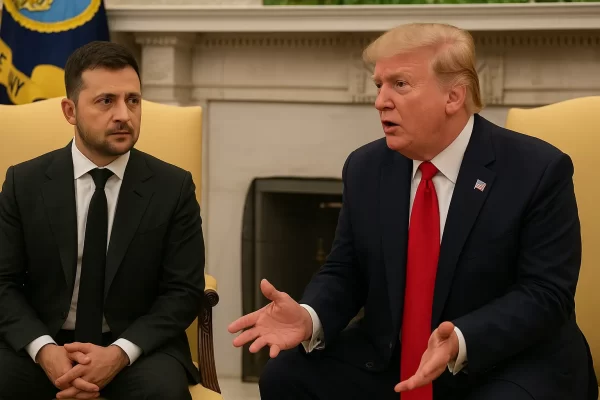
Trump-Zelenskyy meeting

Trump-Zelenskyy meeting in Washington LIVE: Zelenskyy in U.S. stresses need for security guarantees

Ukrainian President Volodymyr Zelenskyy arrived in Washington, D.C., on Monday for high-level talks with former U.S. President Donald Trump, who is seeking to play a renewed role in shaping the path forward for Ukraine amid its ongoing conflict with Russia. The Trump-Zelenskyy meeting comes at a pivotal moment, as Kyiv continues to push for stronger security commitments from the United States and its Western allies. Speaking to reporters ahead of the closed-door talks, Zelenskyy underlined that Ukraine’s future depends not only on military support but also on long-term security guarantees. He reiterated that Russia’s war against Ukraine has entered a decisive stage, and Western unity is essential in countering Moscow’s aggression. “We are fighting not just for Ukraine’s sovereignty, but for stability and security in Europe,” Zelenskyy stated. Trump, who has previously expressed skepticism about the scale of U.S. involvement in Ukraine, struck a more measured tone during his appearance with Zelenskyy. While avoiding specifics on future aid packages, he acknowledged Ukraine’s resilience and said discussions would focus on “finding realistic steps that bring lasting peace.” Trump added that any U.S. support must be tied to “clear objectives and accountability,” a remark likely aimed at addressing concerns among his political base about the cost of supporting Ukraine. The Trump-Zelenskyy meeting is being closely watched not only in Washington but across Europe, where allies are keen to see whether Trump could shift U.S. policy toward a more restrained role in Ukraine’s defense. Analysts note that Zelenskyy’s visit is a strategic move to ensure bipartisan American backing, regardless of who occupies the White House after the 2024 elections. Zelenskyy’s agenda also includes meetings with congressional leaders and defense officials to secure commitments on advanced air-defense systems and long-term financial support. Ukrainian officials have stressed that without dependable guarantees, any ceasefire deal with Russia would leave Kyiv vulnerable to renewed attacks. The atmosphere in Washington reflects both urgency and caution. For Ukraine, the visit is an attempt to lock in assurances that will survive political changes in the U.S. For Trump, it is a chance to demonstrate statesmanship while navigating the fine line between supporting an ally and reassuring voters who demand a more inward-focused foreign policy. As the Trump-Zelenskyy meeting unfolds, the central question remains: can Ukraine secure the guarantees it needs to stand against Russia, while also convincing U.S. leaders that their support aligns with America’s strategic interests? For now, all eyes are on Washington, where the outcome of this meeting could shape the trajectory of the war and Ukraine’s future security framework.

Read More
Global plastics treaty collapse

Global plastic talks collapse as countries remain deeply divided

After nearly three years of effort, the sixth round of UN-led negotiations aiming to forge a legally binding global treaty on plastic pollution ended in failure in Geneva. Delegates from approximately 180 countries exhausted nights of talks but failed to find common ground. At the heart of the impasse lay a fundamental disagreement: Should the treaty tackle plastic pollution urgently through binding limits on production—or focus narrowly on waste management? The High Ambition Coalition—comprising the EU, many African, Latin American nations, and small island states—pushed for bold measures to cap plastic production and phase out toxic chemicals. In stark contrast, the Like-Minded Group, made up of oil-producing countries such as Saudi Arabia, Russia, Iran, and supported by the U.S., insisted that the treaty remain limited to waste-related issues. The U.S., under the Trump administration, played a particularly obstructive role—aligning with petrostates and rejecting key provisions on production caps, additives, and chemical regulation. The Washington Times This alliance intensified criticism from environmental advocates and undercut hopes for binding commitments. Observers described the final plenary sessions as chaotic and disorganized—delegates adjourned late at night, only to reconvene at dawn with no resolution. Two draft texts were circulated, but neither was accepted, and no future dates for negotiations were finalized. Reacting to the collapse, several countries voiced disappointment, particularly small island states. Tuvalu warned of the dire consequences: “Millions of tons of plastic waste will continue to be dumped in our oceans, affecting our ecosystem, food security, livelihood and culture.” Cuba lamented a “historic opportunity” lost, while France’s environment minister denounced petrostates for prioritizing short-term financial interests over planetary wellbeing. The failure underscored the limitations of the UN’s usual consensus-based decision-making, which allowed a minority of nations to block action despite widespread support for more ambitious goals. Some groups are now advocating for alternative pathways—like voting mechanisms or coalitions of willing nations—to push the agenda forward. Wildfires rage across southern Europe as temperatures top 40C What Lies Ahead? This collapse marks a critical diplomatic setback—and a reminder that without unity and political will, the global plastics crisis will only escalate.  Wabstalk

Read More
Southern Europe wildfires 2025

Wildfires rage across southern Europe as temperatures top 40C

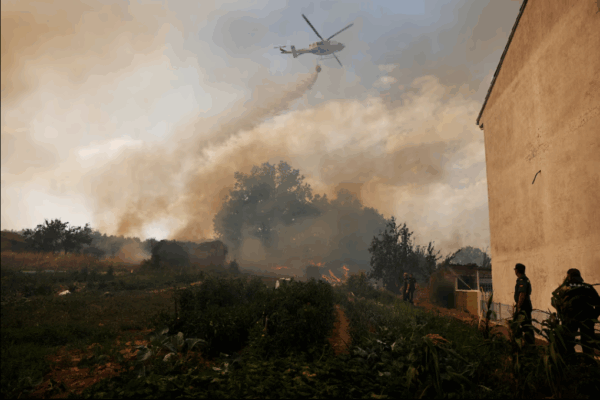
Southern Europe is grappling with a sweeping heatwave that has pushed daytime temperatures above 40°C in many areas and helped spark a new wave of destructive wildfires across the Mediterranean. Blazes have ignited in Spain, Portugal, France, Greece and parts of the Balkans, forcing thousands of people from their homes, overwhelming local fire services and grounding some firefighting aircraft when conditions become too dangerous. In Spain, fierce fires produced rare and terrifying “fire whirls” — spinning columns of flame driven by extreme heat and turbulent winds — that forced firefighters to withdraw in several areas and prompted mass evacuations near UNESCO-listed sites and coastal resorts. Emergency services reported multiple fatalities and numerous injuries in different countries as flames raced through dry brush and forests made tinder-dry by weeks of intense heat. Wabstalk Portugal and France have been particularly hard hit: Portugal deployed thousands of firefighters and dozens of aircraft to battle large blazes in the north and centre of the country, while southern France saw one of its largest recent wildfires scorch tens of thousands of hectares and prompt long-term evacuations and state-level emergency responses. Officials warned that high winds and record-setting daytime highs — reaching into the low-to-mid 40s Celsius in some pockets — could re-ignite contained fires or drive fresh outbreaks. Greece, meanwhile, reported multiple simultaneous outbreaks across islands and coastal regions popular with tourists, heightening concerns about summer visitors’ safety and the knock-on effect for local economies. Authorities in several countries have said arson and negligent human activity appear to have played a role in some fires, compounding the natural risk from heat and drought. Cross-border mutual aid — including extra aircraft, crews and equipment — has been mobilised in an attempt to contain the worst incidents. Climate scientists and emergency planners are warning that these extreme heat episodes are becoming more frequent and severe as the atmosphere warms: hotter, drier summers increase fire risk, lengthen fire seasons and make suppression more difficult and dangerous. As firefighters battle current blazes, governments face urgent questions about land management, prevention, and long-term investments in resilience to reduce the scale and human cost of future fire seasons. Explosion reported at U.S. Steel plant, multiple people injured

Read More