
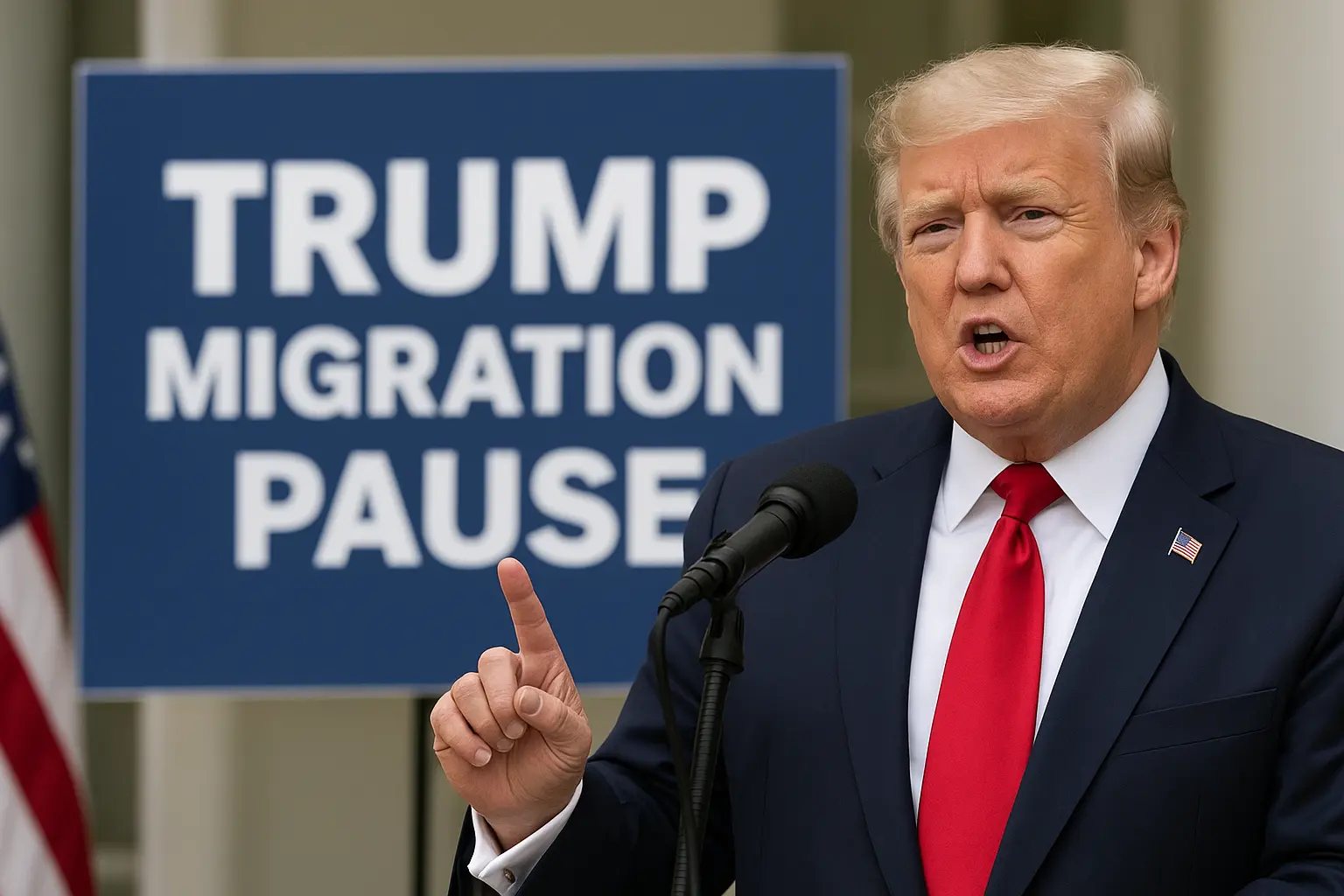
Donald Trump has announced that the United States will “permanently pause migration from all ‘Third World Countries’,” a move he claims is essential to give the “U.S. system time to fully recover.” His declaration, widely circulated through his social media post, marks one of the most sweeping immigration positions taken during his presidency.
In his late-night statement, Trump outlined a set of hardline measures aimed at reshaping the immigration system. He said he intends to eliminate “all federal benefits and subsidies to noncitizens,” arguing that only individuals who contribute economically and culturally should remain in the country. He further stated that he would strip legal status and deport anyone he considers “not a net asset to the United States” or “incapable of loving our country.”
The announcement followed a fatal shooting near the White House that was allegedly carried out by an Afghan national. The incident fueled political debate over national security and immigration enforcement. Trump’s response signals a significant escalation in his administration’s longstanding crackdown on migration, which has included tightened border controls, travel restrictions, and expanded deportations.
He also warned that his administration would move to “denaturalise migrants who undermine domestic tranquility,” while expanding criteria for deportation to include foreign nationals deemed security risks or “non-compatible with Western civilisation.” The broad and undefined language of these criteria has triggered concern among legal experts and civil rights groups, who argue that such proposals could lead to inconsistent or discriminatory enforcement.
One of the most notable gaps in Trump’s announcement is the absence of a clear definition of what constitutes “Third World Countries.” No list was provided, leaving observers to speculate about how broadly the policy could be applied. This ambiguity raises fears that immigrants from large portions of Asia, Africa, Latin America, and the Caribbean could face unprecedented barriers.
Critics say the proposal lacks legal clarity, implementation details, and constitutional grounding. Past attempts by the Trump administration to impose similar restrictions — including travel bans and tightened visa rules — frequently faced court challenges and resistance from Congress. Analysts warn that a sweeping “migration pause” could be tied up in legal battles for months or years.
If implemented as described, the plan could disrupt existing refugee admissions, family reunification petitions, employment visas, and Green Card processes. It may also create uncertainty for millions of immigrants already living in the United States, many of whom fear the potential expansion of deportation criteria.
Trump’s proposal has intensified the national conversation on immigration, setting the stage for renewed political conflict as policymakers, advocates, and courts assess the legality and impact of such an unprecedented halt to migration.