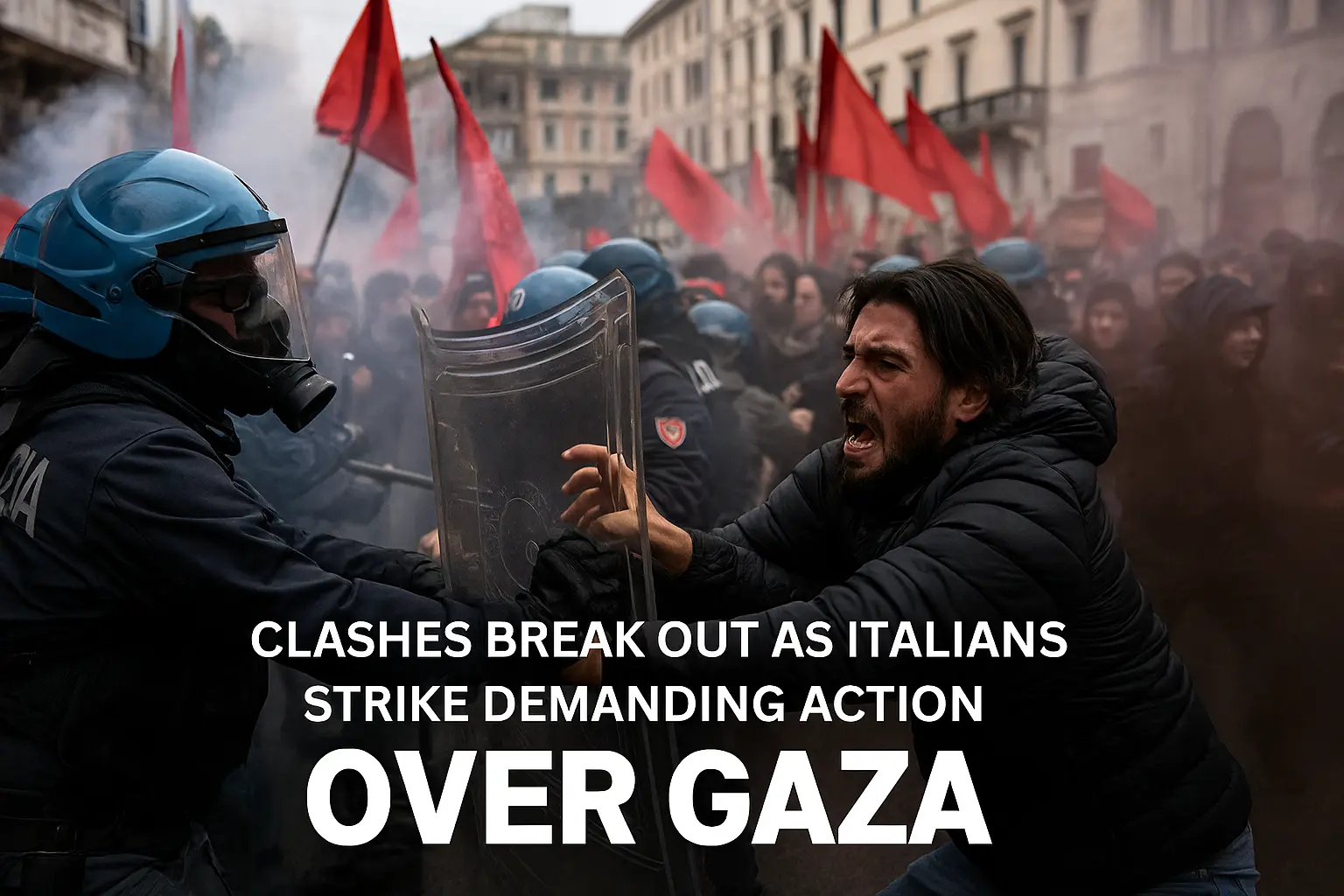
Italy witnessed widespread unrest as thousands of demonstrators took to the streets demanding urgent government action over the escalating crisis in Gaza. What began as a coordinated strike soon turned violent when protesters clashed with police in several major cities, highlighting the growing tensions within Italian society over foreign policy and humanitarian concerns.
The nationwide strike, organized by unions, student groups, and pro-Palestinian activists, aimed to pressure the Italian government into taking a firmer stance on Israel’s military actions in Gaza. Demonstrators carried banners calling for an immediate ceasefire, an end to arms sales, and increased humanitarian support for Palestinian civilians. Many also criticized the European Union for what they perceive as inaction in the face of the worsening conflict.
In Rome, thousands gathered near government buildings, chanting slogans and waving Palestinian flags. Police in riot gear attempted to disperse the crowds when protesters blocked major roads, leading to scuffles. Several individuals were detained, and local reports suggest that both officers and demonstrators sustained injuries. Similar scenes were reported in Milan, Naples, and Bologna, where strikes brought public transport to a halt and disrupted daily life.
Union leaders have defended the strike, arguing that Italian workers and students are standing in solidarity with Gaza’s civilians, who continue to face bombardments and shortages of food, water, and medicine. “This is not only a foreign issue,” said one organizer. “It is about basic human rights and our moral responsibility as Europeans.”
The Italian government has so far expressed “concern” over the violence in Gaza but has avoided committing to stronger measures such as sanctions or halting arms exports. Prime Ministerial officials urged protesters to remain peaceful while emphasizing that diplomatic solutions should be pursued at the EU and UN levels. However, critics argue that this cautious stance only fuels public anger and alienation.
The clashes come amid growing international pressure on Western governments to act decisively. Human rights groups have repeatedly called for Italy and other EU nations to suspend military cooperation with Israel until civilian safety is guaranteed. At the same time, divisions within Italy itself are widening, with some political factions supporting Israel’s right to defend itself, while others side firmly with the Palestinian cause.
As the situation in Gaza deteriorates further, it remains to be seen whether Italy’s government will adjust its policy or continue to tread a middle ground. For many Italians who joined the strike, the message was clear: silence is no longer an option.