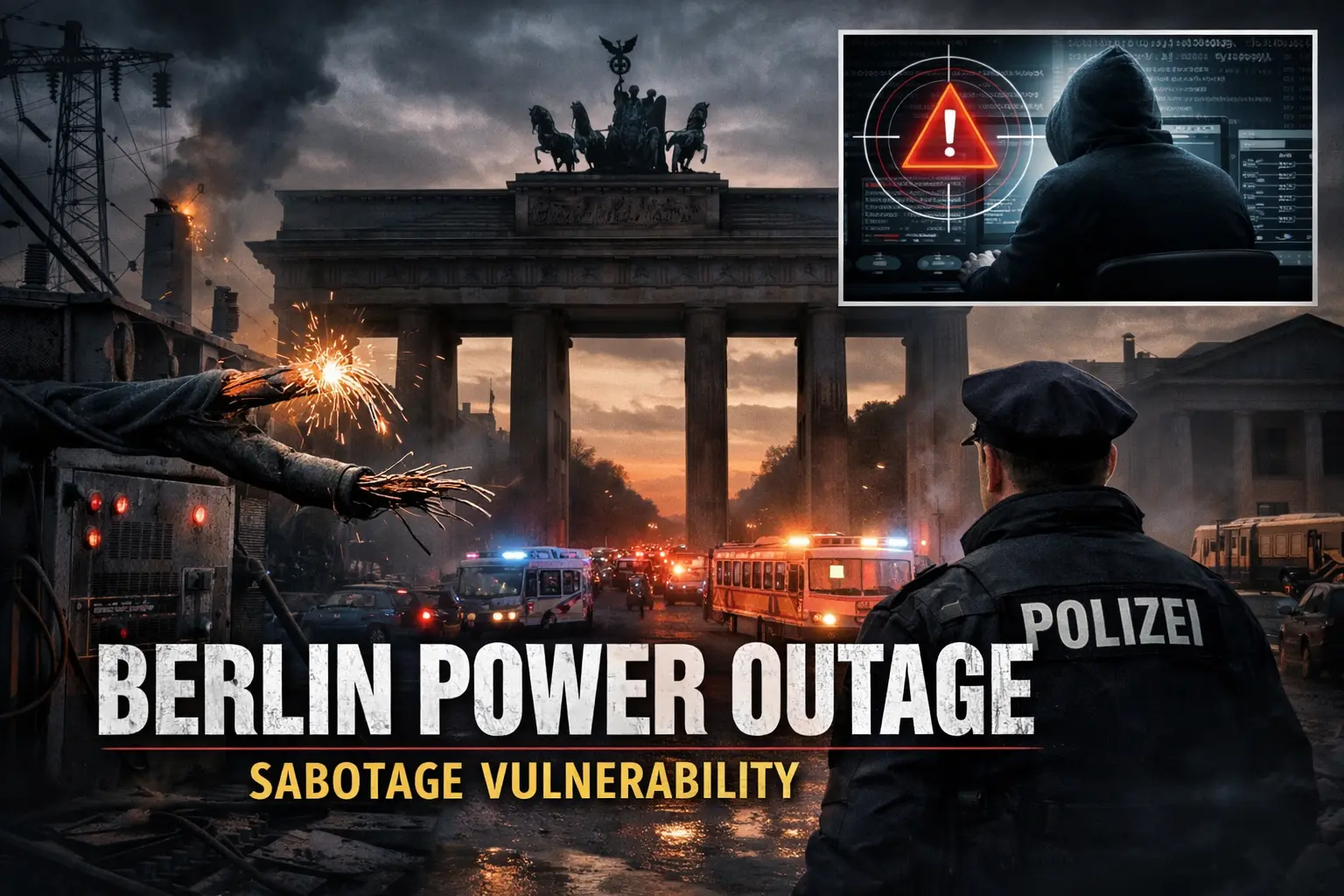
A recent power outage in Berlin has drawn renewed attention to Germany’s vulnerability to sabotage and the growing risks facing critical infrastructure across Europe. Although electricity was restored within hours, the disruption affected thousands of households, transport systems, and public services, underscoring how even brief interruptions can have wide-ranging consequences in a major capital.
German authorities said initial assessments pointed to a technical failure, but the incident quickly reignited debate about whether aging infrastructure and rising geopolitical tensions have made the country more exposed to deliberate attacks. In recent years, security agencies have repeatedly warned that power grids, telecommunications networks, rail systems, and data centers are increasingly attractive targets for both state and non-state actors seeking to cause disruption without engaging in direct military confrontation.
Berlin, as Germany’s political and economic hub, represents a particularly sensitive target. The outage highlighted how densely interconnected systems amplify risk: when electricity fails, traffic signals, public transport, mobile communications, and even emergency response capabilities can be affected almost simultaneously. Experts argue that such cascading effects are precisely what make infrastructure sabotage an effective tool for hostile actors.
The incident has also raised questions about preparedness and resilience. While Germany has invested heavily in renewable energy and digitalization, critics say insufficient attention has been paid to physical security, redundancy, and rapid-response mechanisms. Older substations, limited backup capacity, and fragmented responsibility between federal, state, and private operators are often cited as structural weaknesses.
In response, officials have reiterated calls for stronger protection of critical infrastructure, including enhanced surveillance, stricter security standards for operators, and closer coordination between intelligence agencies and utility companies. There is also growing emphasis on stress-testing systems against worst-case scenarios, including coordinated cyber and physical attacks.
The Berlin power outage may prove to be a warning rather than an isolated event. As Europe navigates an era of heightened security risks, Germany faces mounting pressure to ensure that its infrastructure is not only efficient and sustainable, but also resilient against sabotage and disruption.