Russia heaviest strikes Ukraine

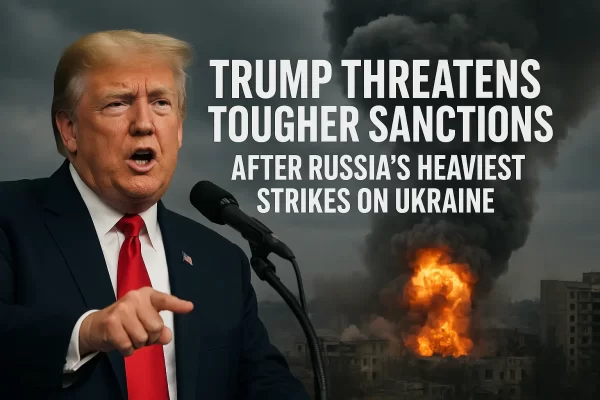
Trump threatens tougher sanctions after Russia’s heaviest strikes on Ukraine

In a sharp escalation of rhetoric, former U.S. President Donald Trump has threatened to impose tougher sanctions on Russia following what Ukrainian officials described as the heaviest strikes on their territory since the war began. The wave of missile and drone attacks devastated multiple cities, leaving widespread destruction and further straining already fragile humanitarian conditions. According to Kyiv, the strikes targeted not only military infrastructure but also civilian areas, including power grids, residential neighborhoods, and hospitals. Ukraine’s President Volodymyr Zelenskyy condemned the attacks as “terrorism aimed at breaking the spirit of the people.” International aid organizations have warned of worsening conditions as millions face blackouts and limited access to essential services. Trump, speaking at a campaign event, argued that Russia’s “aggression must meet an even stronger response.” He claimed that, if in office, his administration would dramatically tighten economic sanctions on Moscow and pressure U.S. allies in Europe and Asia to follow suit. While Trump has previously faced criticism for his mixed messaging on Russia, his latest remarks reflect the growing global outrage over the escalating conflict. The Biden administration, meanwhile, has already coordinated multiple rounds of sanctions with NATO allies, targeting Russian banks, energy companies, and defense suppliers. However, analysts note that the Kremlin has found ways to adapt, leveraging trade with non-Western partners such as China, India, and Iran. Trump’s call for “maximum sanctions” signals a push for more aggressive economic isolation, though experts warn that achieving full international compliance would be challenging. European leaders have also reacted strongly to the renewed strikes. The European Union is reportedly preparing its own expanded sanctions package, focusing on closing loopholes that allow Russia to import restricted technology through third-party countries. Germany and France, in particular, have expressed frustration over Moscow’s continued escalation despite ongoing diplomatic efforts. For Ukraine, the immediate priority remains securing additional air defense systems to counter the missile and drone attacks. Zelenskyy reiterated his plea to Western nations for advanced weaponry, including Patriot missile systems and long-range strike capabilities. “Every day without stronger defenses costs Ukrainian lives,” he said in a televised address. Google fined €2.95bn by EU for abusing advertising dominance The latest strikes underscore the shifting dynamics of the war as Russia seeks to regain momentum on the battlefield. With winter approaching, Ukraine faces both military and humanitarian challenges, and the debate over sanctions is set to dominate international discussions in the coming weeks. Whether Trump’s threats translate into policy remains uncertain, but his remarks highlight how the war in Ukraine continues to shape global politics Wabstalk

Read More
Google fined €2.95bn

Google fined €2.95bn by EU for abusing advertising dominance

The European Union has once again taken strong action against a tech giant, as Google has been fined €2.95 billion for abusing its advertising dominance in the European market. This marks one of the largest penalties ever imposed on a technology company by the European Commission, highlighting growing concerns over the influence of Big Tech and the need to ensure fair competition. EU’s ruling against Google The European Commission ruled that Google systematically exploited its dominant position in the online advertising sector to disadvantage competitors and restrict innovation. According to the investigation, Google allegedly used its advertising platform to favor its own services, while making it harder for rivals to compete fairly. This practice was seen as a direct violation of EU antitrust rules, which aim to protect fair market competition and prevent monopolistic abuse. The Commission’s statement emphasized that Google’s conduct had long-lasting negative effects on both advertisers and publishers. By controlling access to the online ad ecosystem, Google limited choice, raised costs for businesses, and ultimately harmed consumers who faced fewer options and higher prices. Impact on digital advertising Online advertising represents a major portion of Google’s revenue, with billions generated annually through platforms like Google Ads and AdSense. The ruling could reshape the digital advertising landscape across Europe. Regulators argue that unchecked dominance allows Google to act as both a broker and competitor, creating a conflict of interest. The EU has demanded not only the financial penalty but also structural changes in how Google operates its advertising business in Europe. The company will be required to open its platforms to greater competition and ensure transparency for advertisers and publishers. If Google fails to comply, it could face additional daily fines. Google’s response In a statement, Google expressed disagreement with the decision, arguing that its advertising services provide value to businesses and consumers alike. The company indicated it may appeal the ruling, stressing that competition in the online advertising industry remains robust with many alternatives available to advertisers. Despite this defense, analysts note that Google’s dominant share of the ad market—estimated to be more than 70% in certain areas—makes it difficult for smaller firms to compete. Critics argue that Google’s practices undermine innovation, as rivals struggle to gain a foothold against the tech giant’s integrated ecosystem. Wider implications for Big Tech This case is the latest in a series of EU regulatory actions against technology giants, including previous fines on Google related to its shopping and Android businesses. It underscores the European Union’s determination to hold Big Tech companies accountable for anti-competitive behavior. Experts believe the ruling could set a precedent for stricter regulations not only in Europe but also globally. Countries such as the United States, India, and Australia are already scrutinizing Google’s advertising practices, and the EU’s landmark fine may encourage similar actions elsewhere. read alsoThree dead after historic funicular railway derails in Lisbona Conclusion The €2.95 billion fine sends a strong message that the European Union is committed to curbing abuses of advertising dominance and ensuring a fairer digital economy. For Google, the ruling represents another major challenge in navigating regulatory pressure, while for advertisers and consumers, it may signal the beginning of a more competitive and transparent online advertising market. Wabstalk

Read More
Lisbon funicular railway derailment

Three dead after historic funicular railway derails in Lisbon

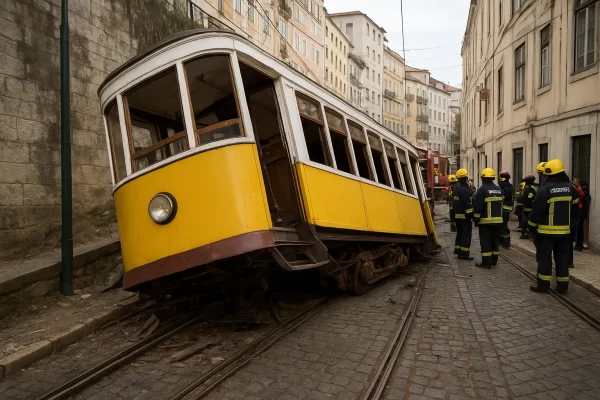
A tragic accident struck the Portuguese capital on Wednesday when a historic funicular railway in Lisbon derailed, leaving three people dead and several others injured. The incident occurred on one of the city’s most popular tourist attractions, shaking both locals and visitors who often rely on these iconic cable-driven carriages to navigate Lisbon’s steep hills. According to local authorities, the derailment happened in the afternoon near the upper station of the railway. Emergency services were quickly dispatched, with firefighters, paramedics, and police arriving within minutes to assist victims and secure the site. Eyewitnesses described scenes of panic as the carriage suddenly jolted off the track, throwing passengers against the wooden interiors and shattering parts of the historic structure. The funicular, which had been in operation for over a century, is considered a cultural landmark in Lisbon. Built in the late 19th century, it was designed to help residents and tourists easily travel up and down the city’s steep inclines. Over the decades, it has become not just a means of transport but also a major symbol of Lisbon’s heritage, drawing thousands of visitors every year. Investigators are now working to determine the cause of the derailment. Preliminary reports suggest that mechanical failure or issues with the braking system may have contributed to the tragedy. Officials have confirmed that the funicular railway had undergone regular maintenance checks, though questions are now being raised about whether those inspections were sufficient and up to modern safety standards. Lisbon Mayor Carlos Moedas expressed his condolences to the victims’ families, calling the accident a “devastating day for our city.” He also assured the public that a full investigation would be launched to ensure accountability and prevent future incidents. Portugal’s Prime Minister, António Costa, echoed these sentiments, stating that safety must remain the highest priority, especially for transport systems that carry both residents and international visitors daily. Tourists who were nearby at the time of the accident described the shock of seeing emergency crews pull survivors from the wreckage. Many had gathered to take photographs of the funicular, which is widely featured in guidebooks and travel blogs as a quintessential Lisbon experience. Some said the accident would change the way they perceived what had always been considered a charming and safe ride. This tragedy has sparked wider debates about the balance between preserving historic infrastructure and ensuring modern safety. While Lisbon’s funicular railways are cherished symbols of the city’s identity, experts warn that aging transport systems can pose hidden risks if not regularly upgraded. Calls are now growing for the government to conduct comprehensive inspections on all similar attractions across Portugal. For the people of Lisbon, the derailment is not only a human tragedy but also a blow to the city’s cultural heritage. The funicular was more than a transport system—it was a living monument to Lisbon’s history. As the city mourns the lives lost, officials face pressure to ensure that such a disaster never happens again. Reeling from Trump’s tariffs, India and China seek a business reboot Wabstalk

Read More
Afghanistan earthquake

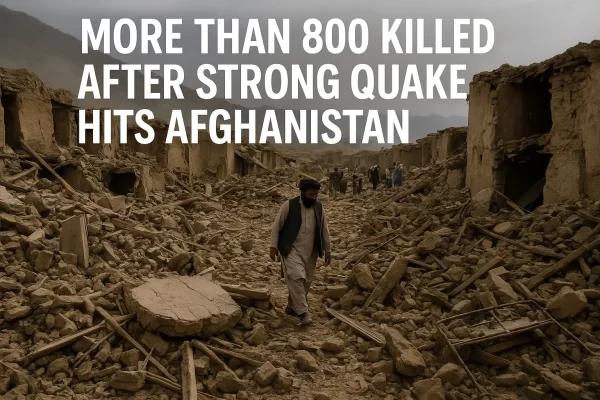
A devastating Afghanistan earthquake has left the nation in mourning, with more than 800 people reported dead and thousands injured after a powerful tremor struck late on Saturday night. The quake, measured at a magnitude of 6.8, shook large parts of the western and central provinces, reducing villages to rubble and forcing survivors to search desperately for loved ones buried under collapsed homes. The Afghan government has declared a state of emergency and appealed for urgent international aid. Rescue efforts remain severely hampered by difficult terrain, poor infrastructure, and limited resources, particularly in remote districts where roads and communication lines were destroyed. Local officials warn that the death toll may rise significantly as many areas remain inaccessible. Witnesses described terrifying scenes as houses made of mud and brick crumbled instantly. “Everything was shaking, the walls collapsed on my family, and I could hear screams from every direction,” said Abdul Karim, a resident of Herat province, one of the hardest-hit areas. Entire communities have been flattened, with satellite images showing vast stretches of rubble where once stood tightly packed neighborhoods. Hospitals in western Afghanistan are overwhelmed with casualties. Medical staff are treating the injured in open fields due to a lack of beds and supplies. The World Health Organization and the Red Crescent have already mobilized emergency teams, sending medicines, tents, and food to the affected regions. However, relief organizations highlight that Afghanistan’s ongoing humanitarian crisis—caused by conflict, drought, and economic collapse—has made the disaster response even more challenging. The United Nations expressed deep concern, with Secretary-General António Guterres urging the world to act swiftly: “The people of Afghanistan are facing yet another tragedy. International solidarity is not just necessary—it is urgent.” Neighboring countries, including Pakistan and Iran, have offered rescue teams and medical support, while international aid agencies are preparing for a long-term recovery mission. Experts warn that Afghanistan is highly vulnerable to natural disasters due to its mountainous geography and fragile infrastructure. Earthquakes often hit the region, but this recent disaster is one of the deadliest in years. Many homes, built with traditional materials and lacking seismic safety standards, collapsed within seconds of the tremor, leaving families with little chance to escape. For survivors, the struggle has only just begun. Thousands have been displaced, left without shelter as night temperatures drop. Clean water and food supplies are running dangerously low, raising fears of disease outbreaks. Aid workers stress the urgent need for tents, blankets, and emergency medical supplies. As Afghanistan grieves for its dead, the tragedy underscores the urgent necessity for stronger disaster preparedness, regional cooperation, and humanitarian support. The Afghanistan earthquake has not only destroyed homes and lives but also deepened an already dire humanitarian crisis in the country.

Read More
India-China trade relations

Reeling from Trump’s tariffs, India and China seek a business reboot

The ripple effects of former U.S. President Donald Trump’s tariff policies are still being felt across global trade corridors. India and China, two of the world’s largest emerging economies, have been particularly impacted. Both nations faced higher costs of exports, reduced market access, and increasing uncertainty during the years when Trump’s administration placed steep tariffs on a wide range of imports. Now, in the aftermath, New Delhi and Beijing are exploring ways to reboot their business and trade strategies to secure more sustainable economic growth. During Trump’s tenure, Washington implemented aggressive protectionist measures under the “America First” policy, targeting China with tariffs on hundreds of billions of dollars’ worth of goods. India was not spared either. Tariff hikes on steel, aluminum, and other exports forced Indian businesses to look for alternative markets while raising costs for U.S. importers. These moves strained the economic ties of both Asian giants with the United States, compelling them to rethink their global positioning. In recent months, India and China have signaled renewed interest in fostering trade ties—both bilaterally and with other key partners. China, still the world’s largest exporter, has been trying to diversify away from U.S.-centric markets by strengthening supply chain links with Southeast Asia, Africa, and Europe. India, meanwhile, has pushed forward with initiatives like “Make in India” and Production Linked Incentives (PLIs) to boost domestic manufacturing while actively seeking free trade agreements (FTAs) with the EU, the UK, and the Gulf states. Despite ongoing border tensions and strategic rivalry, both India and China recognize that collaboration in specific business sectors could offer mutual benefits. For instance, technology, renewable energy, and pharmaceuticals are areas where cross-border cooperation could help both economies counterbalance Western trade barriers. Global analysts also note that the lingering aftershocks of Trump’s tariffs have reshaped supply chains. Many multinational companies are adopting a “China + 1” strategy, diversifying operations by investing in India alongside their Chinese bases. This trend has created new competition but also opportunities for collaboration between the two countries. Ultimately, the tariff wars initiated by the Trump administration have underscored the risks of overdependence on any single market. For India and China, the challenge lies in recalibrating their strategies—reducing vulnerabilities while expanding global influence. The next phase of their business reboot will depend not only on bilateral diplomacy but also on how effectively they can integrate into shifting global trade dynamics. ‘The most ingenious stunt since the Trojan Horse’: The Soviet artwork that spied on the US Wabstalk

Read More
Russian strikes on EU headquarters

European leaders outraged after Russian strikes kill 19 and damage EU’s HQ

The European Union was thrown into shock and anger after Russian missile strikes killed 19 civilians and caused serious damage to the EU’s headquarters in Brussels. The incident, one of the most direct assaults on European soil since the start of the Ukraine war, has provoked widespread condemnation and escalated tensions between Moscow and the West. According to initial reports, the strikes occurred late Tuesday night, targeting what Russia described as “strategic infrastructure.” However, missiles landed dangerously close to central Brussels, striking residential buildings, transport hubs, and partially damaging the EU headquarters complex. Emergency services confirmed that 19 people were killed and over 60 injured, many of them critically. European leaders immediately condemned the attack as a deliberate act of aggression. European Commission President Ursula von der Leyen described it as “an unforgivable assault on European democracy and sovereignty.” She vowed that the EU would respond with “unprecedented unity and strength.” NATO officials also met urgently to discuss enhanced defense measures, while U.S. President Joe Biden called the strikes “a reckless escalation that endangers the entire continent.” The damage to the EU’s headquarters carries not only physical but also symbolic weight. For decades, the building has stood as the heart of Europe’s political and diplomatic institutions. Analysts say that by striking so close to the EU’s power center, Russia appears intent on sending a warning signal to Europe about its continued support for Ukraine. Moscow, however, denied intentionally targeting the EU headquarters. The Russian defense ministry claimed the missiles were aimed at military communication hubs and that any civilian casualties were “unintended consequences of Western provocation.” This explanation has been widely rejected by European leaders, who argue that Moscow has a long record of attacking civilian infrastructure in Ukraine and beyond. The attack has already triggered calls for stronger sanctions on Russia. Several EU member states are urging an immediate embargo on remaining Russian energy imports and a fast-track delivery of advanced defense systems to Ukraine. Germany, France, and Poland issued a joint statement demanding “firm collective action” and pledged increased military aid to Kyiv. Meanwhile, security in Brussels has been dramatically tightened. Thousands of residents have been evacuated from the vicinity of the EU quarter, and NATO forces have increased their presence across key European cities. The strikes mark a dangerous turning point in the war, bringing the conflict directly into the European Union’s core. As anger grows, European leaders are now grappling with how far they are willing to go in confronting Moscow without triggering a wider war. ‘The most ingenious stunt since the Trojan Horse’: The Soviet artwork that spied on the US Wabstalk

Read More
Australian police shooting

Manhunt under way after two police officers shot dead in rural Australian town

Australia has been shaken by a tragic and violent incident in a rural community, where two police officers were shot dead during what began as a routine call-out. The incident occurred late Monday evening in a small Queensland town, sparking a massive manhunt as authorities search for the gunmen responsible. According to police reports, four officers were dispatched to a remote property after receiving information about a missing person. Upon arrival, they were met with unexpected and deadly gunfire. Two officers, both in their 20s, were fatally shot at the scene. A third officer sustained injuries but managed to escape and raise the alarm, while a fourth was able to take cover and later alert reinforcements. Queensland Police Commissioner described the attack as a “senseless act of violence” that has left the entire nation mourning. “These young officers put on their uniforms each day to serve and protect their community. Tonight, two families will not see their loved ones come home,” she said. Flags across the state are being flown at half-mast in tribute. Local residents reported hearing multiple gunshots and seeing smoke near the property where the officers were ambushed. Some community members were advised to remain indoors as heavily armed tactical units scoured the area. Roadblocks have been set up, and aerial surveillance is being used to track the suspects. Prime Minister Anthony Albanese expressed his condolences, calling the incident “a heartbreaking reminder of the risks our police officers take every single day.” He added that Australians everywhere would be grieving alongside the families of the fallen officers. Authorities have not yet confirmed how many suspects were involved, though police believe at least two armed individuals may still be at large. Investigators are piecing together the circumstances that led to the deadly confrontation, while security forces remain on high alert. The rural town, normally quiet and close-knit, has been left in shock. Community leaders have urged residents to stay calm and cooperate fully with police. “We never imagined something like this could happen here,” one resident told reporters, her voice trembling. “This is a tragedy we will never forget.” As the manhunt continues, law enforcement agencies across Queensland and neighboring states are on standby to provide additional support. Police have appealed to the public not to approach the suspects if sighted, but instead to immediately call emergency services. Also Read Germany should look for new trade partners, Chancellor Merz says The deaths of the two young officers mark one of the darkest days in recent Australian policing history. With tributes pouring in from across the country, the tragedy highlights both the courage of frontline officers and the profound dangers they face in the line of duty. Wabstalk

Read More
Germany trade partner

Germany should look for new trade partners, Chancellor Merz says

German Chancellor Friedrich Merz has called for a strategic shift in the country’s economic policies, urging Berlin to diversify its global trade relationships. Speaking at a business forum in Berlin on Saturday, Merz stressed that Germany’s heavy dependence on a few major markets—particularly China—has exposed vulnerabilities that must be addressed to secure long-term stability. According to the Chancellor, Germany’s export-driven economy cannot afford to rely excessively on one or two major partners. “For too long, we have put most of our eggs in the same basket. It is time to broaden our economic horizons and look for new trade partners,” Merz told business leaders. His remarks underline growing concerns that Germany’s economy, Europe’s largest, is facing mounting challenges from geopolitical tensions, slowing demand in key markets, and global supply chain disruptions. Merz highlighted that the world economy is undergoing rapid changes, with new opportunities emerging across Asia, Africa, and Latin America. He emphasized that Germany should actively seek trade agreements with countries such as India, Brazil, and nations in Southeast Asia. Expanding cooperation with African economies, which are projected to see significant growth in the coming decade, was also mentioned as a priority. The Chancellor also noted that the European Union must play a leading role in securing diversified trade links. “A strong European strategy is essential. Germany cannot act alone—we need a united European approach to build partnerships that reduce risks and enhance resilience,” Merz said. His call comes amid broader EU efforts to finalize trade deals with Mercosur, Australia, and other regions. Economic analysts argue that Germany’s long-standing reliance on China as both a supplier and a market has created imbalances. While China remains one of Germany’s largest trading partners, concerns about political tensions, human rights issues, and China’s own slowing growth have triggered debates about reducing exposure. The recent global supply chain crisis, compounded by energy challenges following Russia’s war in Ukraine, has added urgency to these discussions. German industries, especially the automotive and machinery sectors, have been pushing for new markets to offset declining competitiveness in traditional regions. However, experts caution that expanding into new territories will require time, investment, and diplomatic efforts. Building trust with partners in Africa and Latin America, for example, will not only involve trade deals but also investments in infrastructure and technology transfer. Famine confirmed in Gaza City is ‘failure of humanity’, UN chief says Chancellor Merz concluded his remarks by urging German companies to adopt a forward-looking strategy. “Our prosperity depends on our ability to adapt. New trade partners will mean new opportunities, new jobs, and stronger resilience for Germany.” Wabstalk

Read More
Famine in Gaza City

Famine confirmed in Gaza City is ‘failure of humanity’, UN chief says

The United Nations has confirmed that famine is now taking hold in Gaza City, with Secretary-General António Guterres calling it a “failure of humanity” and an urgent wake-up call for the international community. The declaration follows weeks of mounting evidence of widespread hunger, collapsing food systems, and mass displacement in the war-torn territory. According to the UN’s latest food security assessment, more than half of Gaza’s population is experiencing catastrophic levels of food insecurity. In Gaza City, the devastation is most acute, with children and vulnerable groups facing the brunt of starvation. Humanitarian organizations report that many families have gone days without food, relying on unsafe water and whatever scraps they can find for survival. Guterres described the situation as both “entirely preventable” and “man-made,” stressing that aid convoys have faced repeated blockages, delays, and security risks. “This famine in Gaza City is not the result of drought or natural disaster—it is the result of relentless conflict, restrictions, and a breakdown in basic humanitarian law,” he said during a press briefing in New York. Aid agencies have long warned that Gaza was on the brink of famine due to continued military operations, damaged infrastructure, and restricted access to life-saving supplies. The confirmation by the UN’s Integrated Food Security Phase Classification (IPC) means the crisis has reached the most severe level on its scale, indicating extreme hunger and high mortality rates. The World Food Programme (WFP) has called for immediate and unrestricted humanitarian access, while UNICEF has warned of irreversible consequences for children, including stunted growth, disease, and death. “Children are paying the highest price of this war,” said Catherine Russell, UNICEF’s Executive Director. International reaction has been swift but divided. Some world leaders have urged for an immediate humanitarian ceasefire to allow aid deliveries, while others maintain that security conditions must be addressed first. Human rights groups argue that political disagreements cannot justify the starvation of civilians. Meanwhile, health officials in Gaza City report that hospitals are overwhelmed with malnourished patients, many of whom arrive too late to receive effective treatment. Medical supplies remain critically low, compounding the crisis and increasing preventable deaths. The famine declaration underscores the urgent need for coordinated international action. The UN chief reiterated his call for an immediate ceasefire, safe humanitarian corridors, and accountability for those obstructing aid. “History will judge us harshly if we fail to act,” Guterres warned. As famine grips Gaza City, the world faces a defining moral test: whether to prioritize political agendas or the survival of millions trapped in an unfolding humanitarian catastrophe.

Read More
Milan Malpensa airport fire

Man sets fire to check-in area at Milan’s Malpensa airport

A major security scare unfolded at Milan’s Malpensa Airport after a man deliberately set fire to the check-in area, causing chaos and disruption for hundreds of passengers. The incident occurred on Tuesday morning in Terminal 1, Italy’s second-busiest airport, which serves as a key international hub for both business and leisure travelers. According to local authorities, the suspect entered the departure hall carrying a small container of flammable liquid. Witnesses reported seeing the man pour the substance near the check-in counters before igniting it, sending flames and thick smoke across the area. Panic quickly spread as travelers rushed to escape, leaving behind luggage and belongings. Emergency services, including firefighters and airport security, responded within minutes. The blaze was contained before it could spread to other sections of the terminal, but significant damage was reported to several check-in counters and parts of the floor. No fatalities occurred, though at least nine people suffered from smoke inhalation and minor injuries during the evacuation. The suspect was apprehended shortly after the attack. Police confirmed that he is a 37-year-old Italian national with a history of mental health issues and prior minor offenses. Investigators have ruled out terrorism at this stage, describing the act as intentional but isolated. The man is now in custody and facing charges of arson and endangering public safety. The incident caused widespread disruption at Malpensa, with dozens of flights delayed or diverted to other airports, including Milan Linate and Bergamo Orio al Serio. Hundreds of passengers were forced to wait for hours as authorities worked to clear smoke and assess damage. Airport officials later reopened sections of the terminal, but advised travelers to check flight statuses before heading to the airport. Italy’s Interior Ministry released a statement praising the swift actions of firefighters and airport staff, noting that their quick intervention prevented what could have been a far more serious disaster. Security at Malpensa has been temporarily heightened, with additional patrols and baggage checks put in place. For passengers, the scare was a stark reminder of vulnerabilities in crowded public spaces. Several travelers described the scene as chaotic, with parents clutching children as alarms rang and smoke spread across the hall. One passenger, en route to London, said: “It felt like something you see in the movies. Everyone was just running in every direction.” read also Zelensky leaves White House unscathed as he buys more time While normal operations gradually resumed later in the day, the event has sparked renewed debate over airport security and mental health monitoring. Authorities have promised a full review of safety procedures to ensure incidents like the Milan Malpensa airport fire are not repeated. Wabstalk

Read More