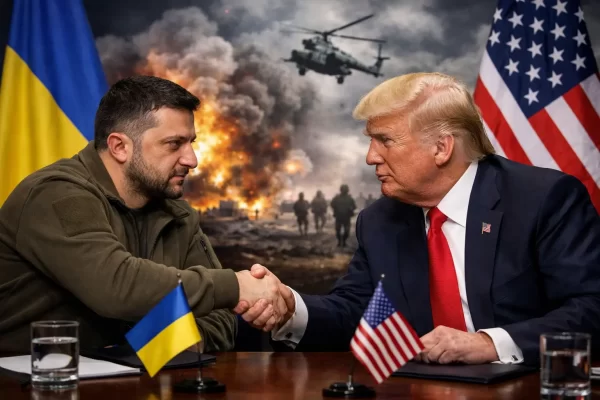

Zelensky

Zelensky warns against giving away territory as latest Ukraine talks end

Ukrainian President Volodymyr Zelensky has issued a firm warning against any proposals that involve surrendering territory to Russia, as the latest round of diplomatic discussions concluded without major breakthroughs. Speaking after the talks, Zelensky emphasized that Ukraine’s sovereignty and territorial integrity are non-negotiable, underscoring that no peace plan can succeed if it compromises the nation’s internationally recognized borders. The talks, which brought together Ukrainian officials and a coalition of international mediators, focused on exploring new frameworks for a potential ceasefire and long-term security guarantees. While some participants suggested considering territorial concessions as part of a broader compromise, Kyiv firmly rejected this approach. Zelensky stressed that accepting such terms would not only undermine Ukraine’s future security but also set a dangerous precedent for global norms surrounding territorial aggression. Despite the lack of concrete progress, diplomats described the negotiations as “constructive,” noting that all sides remain committed to pursuing a peaceful resolution. Ukraine reiterated that any sustainable peace agreement must include the full withdrawal of Russian forces, the return of all occupied regions, and binding security assurances to prevent future escalations. Zelensky also called on international partners to maintain strong political and military support for Ukraine, warning that weakening assistance would embolden Russian aggression and prolong the conflict. He highlighted the importance of unity among allies, especially as winter approaches and fighting continues on multiple fronts. While the talks ended without major advancements, the Ukrainian government said discussions would continue in the coming weeks. For Kyiv, the stance remains clear: peace is possible, but not at the cost of territorial loss or national sovereignty.

Read More
Nigeria mass abduction

Nigeria sees one of worst mass abductions as 315 taken from school

Nigeria is facing one of its most devastating mass abductions in years after 315 people — including 303 students and 12 teachers — were seized from St. Mary’s Catholic Primary and Secondary School in the Papiri community of Niger State. The attack, carried out by heavily armed gunmen in the early hours, has renewed nationwide alarm over the persistent vulnerability of schools amid rising insecurity. The gunmen reportedly arrived in large numbers, overwhelming the limited security presence before storming classrooms and staff quarters. Many students attempted to flee into nearby bushes, but dozens were later confirmed to be among those abducted, raising the total number well above initial estimates. Local authorities and community leaders described the abduction as one of the largest school kidnappings ever recorded in the country, surpassing several high-profile incidents from previous years. The Christian Association of Nigeria confirmed the updated figure of 315 abducted after a detailed headcount, noting that some early reports had underestimated how many students were missing. Out of 629 enrolled students at the school, nearly half were taken, underscoring the scale of the crisis and the attackers’ ability to operate with impunity. The abduction follows another major kidnapping just days earlier, in which 25 girls were taken from a secondary school in Kebbi State. The back-to-back incidents have heightened fear across northern Nigeria and prompted authorities in nearby states to order emergency school closures as a precaution. The surge in violence has also pressured the federal government to reassess its security strategies, as armed groups increasingly target educational institutions for ransom or political leverage. President Bola Tinubu cancelled planned international commitments to address the crisis, directing military, police, and local security forces to conduct an intensive rescue operation across forests surrounding the area. Security personnel have reportedly launched coordinated searches, but large-scale abductions in remote regions often pose significant challenges due to difficult terrain and the mobility of the armed groups responsible. Community leaders have appealed for calm but expressed frustration over what they describe as recurring lapses in intelligence and protection for rural schools. The Christian Association of Nigeria urged the public to avoid circulating misinformation, dismissing claims that the school received prior warnings as false and harmful. Civil-society organizations, including major child-rights groups, have renewed calls for stronger national policies to protect schoolchildren, stressing that attacks on educational facilities have become disturbingly routine. The mass abduction in Niger State stands as a stark reminder of the insecurity gripping parts of the country. As families await news of their loved ones, the incident highlights the urgent need for sustained security reforms, improved community protection, and a strengthened commitment to safeguarding children — especially in regions where schools have increasingly become targets.

Read More
Zelensky negotiations with US

Zelensky ready to work with US on ‘their vision’ for ending Ukraine war

Ukrainian President Volodymyr Zelensky has signaled a willingness to engage closely with Washington on a U.S.-backed peace proposal, describing his approach as “constructive, honest and prompt.” Following a meeting in Kyiv with U.S. Army Secretary Daniel Driscoll, Zelensky affirmed that Ukrainian and American teams would collaboratively work on the key elements of the plan. Although the full details of the 28-point plan have not been publicly disclosed, reports suggest it contains highly sensitive terms — including territorial concessions, military restrictions, and a new security architecture. According to media coverage, some of the most controversial proposals would require Ukraine to cede control over the Donbas region, formally recognize Russian control over Crimea, Luhansk, and Donetsk, and limit its army to 600,000 troops. In exchange, Ukraine would receive “robust security guarantees,” though the exact form and enforceability of those guarantees remain unclear. For Zelensky, agreeing to negotiate does not mean blind capitulation. His office says that while he has accepted a draft, he has also “outlined the fundamental principles that matter to our people.” He frames the collaboration as essential for a “just peace that respects everyone’s sovereignty, a durable peace that can’t be called into question by future aggression.” This willingness to engage has stirred strong reactions. Several European allies have pushed back, warning that the U.S.-proposed plan could amount to a forced surrender of Ukrainian land and resources. Critics argue that such terms might undermine Ukraine’s long-term security and set a dangerous precedent for capitulation-style diplomacy. Still, Zelensky appears determined enough to explore diplomacy. His team plans to hold further discussions not only with U.S. officials but also with other international leaders. According to his office, as part of upcoming diplomacy, Zelensky expects to engage with former U.S. President Donald Trump to explore key diplomatic pathways. How Tommy Hilfiger Became an Overnight Success | Perception Hack | Genius | Secret Zelensky’s outreach underscores a realistic — albeit risky — gamble: he hopes that by aligning with the U.S. vision of peace, Ukraine can secure a deal that prevents future Russian aggression while preserving core national interests. At the same time, he is balancing a fragile relationship — negotiating under pressure from Western allies, wary of concessions, and on a war footing that demands both vigilance and flexibility. Children among 25 killed in one of Russia’s deadliest strikes on western Ukraine

Read More
Russia-Ukraine war residential building strike

Children among 25 killed in one of Russia’s deadliest strikes on western Ukraine

A devastating Russian drone and missile strike hit the western Ukrainian city of Ternopil overnight, killing 25 people, including three children, and injuring dozens more. The attack, one of the deadliest in western Ukraine since the start of the full-scale invasion, struck a densely populated residential area where families were asleep as the bombardment began. According to authorities, two nine-storey residential apartment blocks suffered direct hits. The upper floors were torn apart as explosions triggered a fierce blaze that engulfed the buildings within minutes. Interior Minister Ihor Klymenko described sections of the structure being consumed in what he called “fiery lava,” a torrent of flames so intense that many residents had no chance to escape before the fire overtook their homes. Of the 25 confirmed fatalities, three were children aged just 5, 7, and 16. Emergency crews reported that another 73 people were wounded, including at least 15 children, many suffering burns, blast injuries, or smoke inhalation. Rescue workers continued digging through smoldering rubble throughout the day, warning that as many as two dozen people remained missing and that recovery operations could take several days due to the scale of destruction. Ukraine’s air force said Russia launched an enormous overnight barrage consisting of 476 drones and 48 missiles targeting multiple regions. While air defenses intercepted a significant number, several managed to slip through, striking civilian infrastructure, residential zones, and energy facilities. The attack triggered power outages across several western regions, leaving thousands without electricity or heating as winter temperatures continue to drop sharply. Local officials warned that the humanitarian situation could worsen if strikes on energy facilities persist. Ukrainian leaders condemned the assault as a deliberate attack on civilians, emphasizing that there were no military installations near the impact zone. Officials stressed that the timing and scale of the strike suggested an effort to sow fear and cause mass casualties far from active front lines. The attack coincided with President Volodymyr Zelenskyy’s diplomatic visit to Turkey, where he is seeking enhanced international support to counter Russia’s escalating aerial campaign. Ukrainian authorities announced they would raise the Ternopil strike at the United Nations Security Council, calling for a stronger global response and accountability measures. Ukraine to get up to 100 French-made Rafale fighter jets As firefighters continued to extinguish pockets of flames and families searched for missing loved ones, the tragedy underscored the increasingly lethal reach of Russian strikes—even in Ukraine’s western regions, which had once been considered relatively safe. For many residents, the overnight attack marked a horrifying reminder that no part of the country is beyond the war’s devastating impact. How Tommy Hilfiger Became an Overnight Success | Perception Hack | Genius | Secret

Read More
Trump legal action on BBC

Trump says he will take legal action against BBC over Panorama edit

Donald Trump has announced that he will pursue legal action against the BBC, accusing the broadcaster of defamation after what he describes as a deceptive and damaging edit of his January 6, 2021 speech in a recent Panorama documentary. Speaking aboard Air Force One, Trump confirmed that he intends to file the lawsuit “sometime next week,” adding that he is seeking between $1 billion and $5 billion in compensation. His lawyer, Alejandro Brito, previously sent the BBC a letter demanding a full retraction, a public apology, and significant financial damages. The controversy centers on the Panorama episode titled “Trump: A Second Chance?”, which aired shortly before the 2024 U.S. election. The documentary used excerpts from Trump’s January 6 speech, but critics say the program spliced together lines from different parts of the address, making it appear as though Trump called on supporters to “fight like hell” as they moved toward the Capitol. In reality, the statements were made nearly an hour apart, and key segments in which Trump urged protesters to remain peaceful were omitted. These editorial choices prompted accusations that the documentary created a misleading narrative about Trump’s intentions on the day of the Capitol riot. Following the outcry, the BBC issued an apology, with its chair Samir Shah describing the edit as an “error of judgment.” The broadcaster also confirmed that it would not rebroadcast the documentary in its existing form. However, despite acknowledging the editing mistake, the BBC rejected Trump’s request for damages, arguing that there is no legal basis for a defamation claim of the scale he is pursuing. Trump has remained firm in his stance, insisting that he feels an “obligation” to proceed with the lawsuit. He argues that media organizations should be held accountable when they distort or manipulate his words. He publicly described the Panorama edit as a “corrupt” example of fake news designed to misrepresent his message and influence public perception. The fallout from the incident has already been significant. Two high-profile BBC executives—Director-General Tim Davie and News Chief Deborah Turness—have resigned amid the ongoing scandal, reflecting both internal and external pressure over the handling of the documentary. Despite Trump’s determination, legal experts have expressed skepticism about the viability of the lawsuit. Questions have been raised regarding the statute of limitations under UK defamation law, as well as the complexities of pursuing such a claim in U.S. courts. Nevertheless, Trump continues to frame the dispute as part of his broader battle against what he views as longstanding media bias, reinforcing his narrative that major news outlets frequently distort his rhetoric. This planned lawsuit is the latest escalation in Trump’s ongoing clash with mainstream media organizations and underscores his intent to confront those he believes have misrepresented him.

Read More
Trump government shutdown

Trump celebrates as Democrats face fallout from end of shutdown

Former President Donald Trump has declared victory following the abrupt end of the U.S. government shutdown, framing the outcome as a political setback for Democrats and a reaffirmation of his influence over national politics. The shutdown, which lasted 12 days, ended after Congress passed a bipartisan funding measure to keep the government open through the fiscal year. However, the political repercussions have begun to surface, with Democrats facing internal divisions and criticism over how they managed the crisis. Trump, speaking at a rally in Ohio, described the resolution as proof that Democrats had “no strategy, no leadership, and no message.” He argued that the party’s failure to secure any significant policy wins during the shutdown demonstrated what he called “a complete collapse of the radical left’s agenda.” Supporters at the rally cheered as Trump claimed the standoff had strengthened his image as a dealmaker capable of pressuring opponents to concede. Inside the Democratic Party, frustration has reportedly grown among lawmakers and strategists. Progressives criticized party leaders for agreeing to reopen the government without achieving key objectives, such as expanded funding for social programs or immigration reforms. Moderate Democrats, meanwhile, have urged a shift toward pragmatic negotiation rather than confrontation, fearing that prolonged shutdowns could alienate independent voters ahead of the next election cycle. Political analysts suggest the episode could deepen the divide between progressive and centrist factions within the Democratic Party. Several commentators noted that while Republicans also faced public backlash during the early days of the shutdown, the resolution’s outcome has allowed Trump to reshape the narrative, portraying himself as the figure who brought Washington back to order. The White House has capitalized on the moment, releasing statements crediting Trump with “restoring stability and accountability.” Administration officials have emphasized that the president’s stance during negotiations reflected his broader campaign promise to protect taxpayers from what he calls “reckless Democratic spending.” On Capitol Hill, some Democrats have attempted to downplay the perceived loss, insisting that reopening the government was necessary to protect federal workers and prevent further economic disruption. Yet, privately, aides acknowledge that the episode has left the party searching for a clearer messaging strategy. As Trump continues to dominate headlines and shape the post-shutdown political narrative, Democrats are now turning their focus toward repairing internal unity and preparing for upcoming budget debates. The shutdown’s end may have restored government operations, but it also reignited questions about leadership, strategy, and the shifting balance of power in Washington.

Read More
Jeffrey Epstein documents

Epstein alleged that Trump ‘spent hours’ with one of his victims, as thousands of documents released

Thousands of pages of newly unsealed court documents related to the late financier Jeffrey Epstein have revealed fresh details about his network of associates and alleged interactions with powerful figures, including former U.S. President Donald Trump. The files, which stem from a long-running civil case against Epstein’s associate Ghislaine Maxwell, include depositions, witness statements, and correspondence that shed light on the scale of Epstein’s operations and the alleged involvement of several high-profile individuals. Among the revelations, one of Epstein’s alleged victims claimed that Trump had “spent hours” with her at Epstein’s Palm Beach residence. The woman, whose identity remains confidential in the documents, did not accuse Trump of sexual misconduct but described his presence at gatherings organized by Epstein in the early 2000s. The allegations add to the growing scrutiny surrounding Epstein’s connections with influential figures from politics, business, and entertainment. Trump has repeatedly denied any wrongdoing or inappropriate relationship with Epstein or his associates. He has acknowledged knowing Epstein “like everybody in Palm Beach,” but insisted he was “not a fan” of the financier and severed ties with him long before his 2019 arrest. Epstein, who was charged with sex trafficking of minors, died in jail that same year in what was officially ruled a suicide. The newly released files also mention other prominent names, including Prince Andrew, Bill Clinton, and several former officials and celebrities. While the documents contain numerous allegations, much of the material remains unverified or based on witness testimony, and no additional criminal charges have been filed as a result of the disclosures. Legal experts say the release of these records underscores the far-reaching nature of Epstein’s influence and the need for continued transparency. Victims’ advocates have welcomed the disclosures, saying they help expose the scale of Epstein’s alleged abuse and the systems that enabled it to persist for years. The Epstein case continues to be one of the most controversial scandals involving sexual exploitation, wealth, and power. As investigators and journalists sift through the newly unsealed evidence, questions remain about who else may have known about or participated in Epstein’s activities—and whether justice can ever be fully served for his victims.

Read More
Gaza devastation

Inside Gaza, BBC sees total devastation after two years of war

Two years after the war between Israel and Hamas began, the Gaza Strip has been reduced to ruins, with once-thriving neighborhoods now resembling ghost towns. A BBC team granted rare access to the territory describes a landscape of total devastation — homes flattened, hospitals barely functioning, and thousands of displaced families struggling to survive amid the wreckage. Entire districts that were once crowded with markets, schools, and apartment blocks now lie in rubble. In northern Gaza, what used to be Gaza City’s commercial heart is now a sea of collapsed concrete and twisted metal. The BBC crew reported seeing children playing amid debris, their laughter echoing in streets that have no running water, electricity, or sanitation. “It’s like time stopped here,” one resident told reporters. “We are alive, but everything around us is dead.” The humanitarian situation remains dire. The United Nations estimates that more than 1.7 million people — nearly 80 percent of Gaza’s population — are still displaced. Many live in makeshift shelters or tents built from scrap metal and plastic sheets. Food shortages are chronic, with aid deliveries continuing to face restrictions at border crossings. Hospitals, already crippled by years of blockade, are overwhelmed. Doctors work without adequate supplies, and power cuts force surgeries to be done under flashlights. The BBC also visited Al-Shifa Hospital in Gaza City, once the territory’s largest medical facility. Its corridors are dark, lined with patients on stretchers, while generators rumble outside. “We’ve lost colleagues, we’ve lost equipment, and we’re losing patients we could have saved,” said one exhausted doctor. Israel’s government maintains that its military operations were aimed at dismantling Hamas’s military infrastructure, following the deadly attacks that triggered the war in 2023. Officials say rebuilding can only begin once Hamas’s influence is completely removed. However, international aid agencies argue that ordinary civilians have borne the brunt of the destruction, with entire families wiped out and public infrastructure obliterated. Despite calls from global powers for a long-term ceasefire and reconstruction plan, progress has been painfully slow. Many foreign donors remain hesitant to fund rebuilding projects without assurances of stability. Meanwhile, Gazans face another winter with little shelter and minimal hope. At the Rafah crossing on the Egyptian border, crowds gather daily, hoping for rare permits to leave. “We just want to live somewhere safe,” said a young mother holding her child. “We have nothing left here.” Two years on, the BBC’s report paints a bleak picture: a territory trapped between the ruins of war and the uncertainty of peace. For Gaza’s people, survival has become the only measure of victory.

Read More
Trump Putin sanctions

Trump says Putin talks ‘don’t go anywhere’ as he imposes new sanctions

Former U.S. President Donald Trump announced on Wednesday that planned talks with Russian President Vladimir Putin “didn’t go anywhere,” as his administration imposed a fresh round of sanctions on Moscow over its continued military involvement in Ukraine. The statement marks a sharp turn in tone just days after Trump had expressed optimism about brokering a peace deal between Russia and Ukraine. Speaking to reporters at the White House, Trump said his team had “made every effort” to prepare for constructive talks with the Kremlin, but that “the Russian side was not ready to make meaningful commitments.” He added that he would not pursue another meeting “until there’s a real change in attitude from Moscow.” The two leaders had been expected to meet in Budapest later this month to discuss potential steps toward ending the war. The sanctions announced by the U.S. Treasury target more than 40 Russian entities and individuals, including defense manufacturers, energy companies, and senior officials close to the Kremlin. According to Trump, the measures are aimed at “pressuring Russia to engage seriously in peace negotiations” while maintaining support for Ukraine’s sovereignty. “We are not walking away from diplomacy,” Trump said. “But we are not going to waste time when the other side refuses to move toward peace.” Kremlin spokesperson Dmitry Peskov criticized the new sanctions, calling them “unfriendly and counterproductive.” He said Moscow viewed Washington’s move as “a continuation of pressure politics” and reiterated that Russia would not negotiate “under threats.” Russian state media also downplayed Trump’s comments, suggesting the U.S. was using sanctions to strengthen its negotiating position. In Kyiv, Ukrainian President Volodymyr Zelensky welcomed the new U.S. sanctions, saying they demonstrated continued American commitment to Ukraine’s defense. “Every step that isolates Russia’s war machine helps us bring peace closer,” Zelensky said in a televised address. Analysts say the collapse of the planned Trump–Putin meeting underscores the ongoing difficulty in finding common ground on Ukraine, even as both sides face mounting pressure to end the war. “Trump’s decision to suspend talks sends a message that the U.S. expects concrete concessions before engaging further,” said Rachel Kim, a senior fellow at the Atlantic Policy Institute. Read This Also Trump says he did not want ‘wasted meeting’ after plan for Putin talks shelved For now, Washington appears to be balancing a dual strategy of deterrence and diplomacy — maintaining economic and political pressure on Moscow while keeping open the possibility of future talks. Whether these sanctions will push Russia toward meaningful engagement remains uncertain, but Trump’s latest move signals that patience with Putin’s approach is wearing thin.

Read More
Trump Putin meeting shelved

Trump says he did not want ‘wasted meeting’ after plan for Putin talks shelved

Donald Trump has said that he did not want a “wasted meeting” with Vladimir Putin, after plans for a face-to-face summit in Budapest were put on hold. The context: Trump had announced last week that he intended to meet Putin “within two weeks” in Budapest to try to help bring an end to the war in Ukraine. But on Tuesday he told reporters that the meeting is not going ahead “in the immediate future,” after Moscow signalled strong refusal to accept an immediate cease-fire. In his remarks, Trump said:“I don’t want to have a wasted meeting. I don’t want to have a waste of time, so we’ll see what happens.” This signals that he believes the pre-conditions for meaningful talks are not yet in place, especially since Sergei Lavrov, Russia’s foreign minister, made clear that Russia’s negotiating position remains unchanged. From the Russian side, spokesman Dmitry Peskov affirmed that preparation is still required before any summit:“Preparation is needed, serious preparation,” he said.He also added, “No one wants to waste time, neither President Trump nor President Putin.” Hungary — where the meeting was due to take place — also weighed in. Viktor Orbán, the Hungarian prime minister, confirmed that although the date is not set, “preparations … are continuing,” suggesting the summit is not formally cancelled, just deferred. One major obstacle remains: Russia recently sent a private diplomatic communication — a “non-paper” — to the United States, restating its long-standing peace terms for Ukraine. These terms are seen as maximalist and incompatible with what Ukraine and its European allies are prepared to accept. In short, Russia is staying firm, making it difficult to arrange a meeting worth having from the U.S. side. Meanwhile, behind these diplomatic moves, Russia launched a major overnight missile and drone attack on Ukraine — killing civilians, including children, and striking key energy infrastructure. That escalation further complicates prospects for diplomacy and puts pressure on both sides over whether any talks can succeed. Trump’s shift in tone is also noteworthy. Earlier this year, he had suggested that he wanted to bring an end to the war quickly and had appeared open to the idea of territorial compromises by Ukraine. But now he seems to be aligning with the idea of freezing the war along current frontlines — a position also tentatively echoed by Ukrainian President Volodymyr Zelenskyy, who called Trump’s recent proposal “a good compromise,” though he expressed doubt that Russia would accept it. Why this matters Trump’s insistence on avoiding a “wasted meeting” underscores how difficult it is to achieve meaningful diplomacy when both sides’ positions remain far apart. For Ukraine and its Western allies, the pause in the planned summit may actually be a relief, as they fear that a poorly prepared meeting could legitimize Russian territorial gains or pressure Kyiv into concessions. On the other hand, the suspension of the summit may also be viewed as a missed opportunity to re-energize diplomatic efforts at a time when the war continues to drag on and the human and economic costs keep rising.

Read More