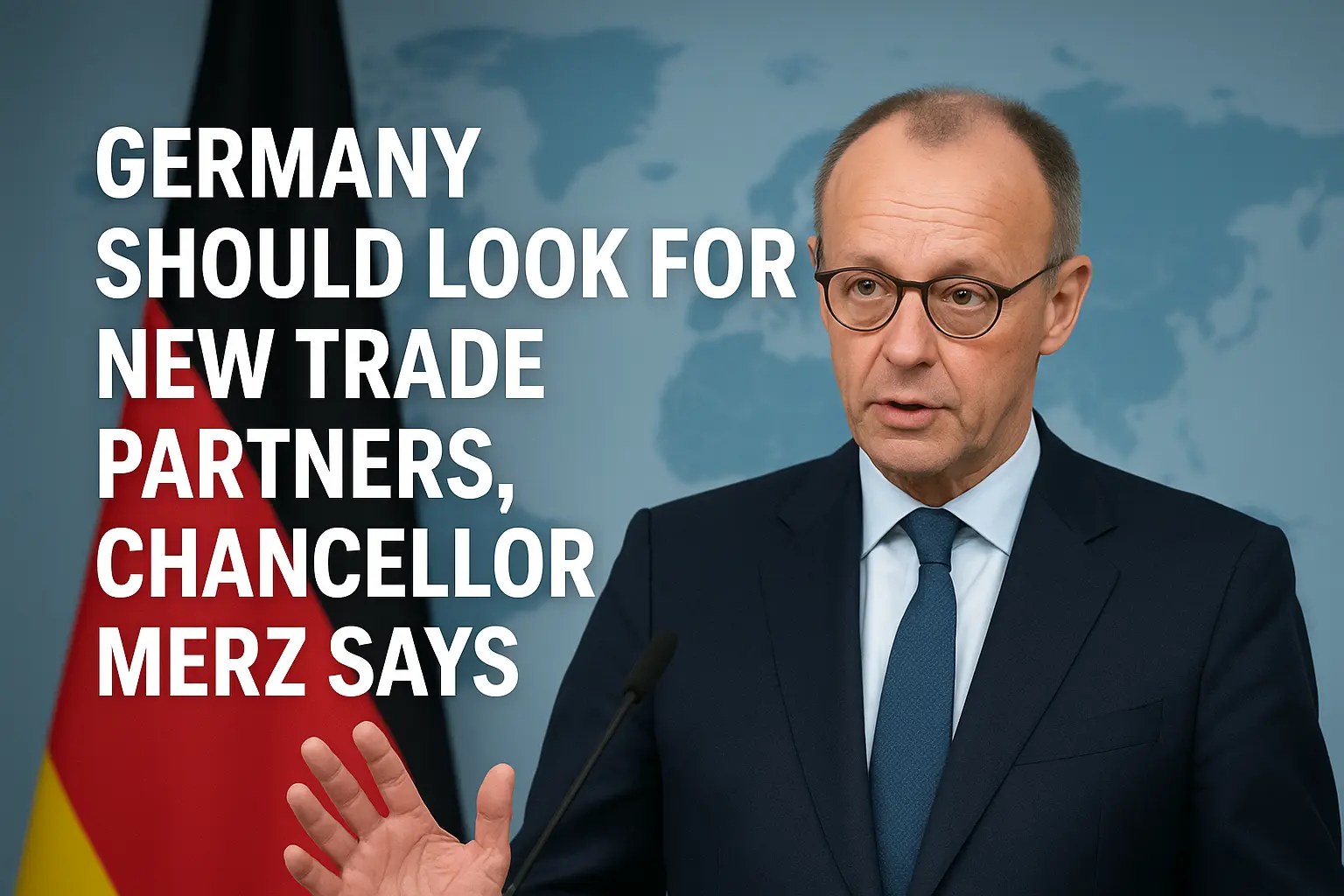
German Chancellor Friedrich Merz has called for a strategic shift in the country’s economic policies, urging Berlin to diversify its global trade relationships. Speaking at a business forum in Berlin on Saturday, Merz stressed that Germany’s heavy dependence on a few major markets—particularly China—has exposed vulnerabilities that must be addressed to secure long-term stability.
According to the Chancellor, Germany’s export-driven economy cannot afford to rely excessively on one or two major partners. “For too long, we have put most of our eggs in the same basket. It is time to broaden our economic horizons and look for new trade partners,” Merz told business leaders. His remarks underline growing concerns that Germany’s economy, Europe’s largest, is facing mounting challenges from geopolitical tensions, slowing demand in key markets, and global supply chain disruptions.
Merz highlighted that the world economy is undergoing rapid changes, with new opportunities emerging across Asia, Africa, and Latin America. He emphasized that Germany should actively seek trade agreements with countries such as India, Brazil, and nations in Southeast Asia. Expanding cooperation with African economies, which are projected to see significant growth in the coming decade, was also mentioned as a priority.
The Chancellor also noted that the European Union must play a leading role in securing diversified trade links. “A strong European strategy is essential. Germany cannot act alone—we need a united European approach to build partnerships that reduce risks and enhance resilience,” Merz said. His call comes amid broader EU efforts to finalize trade deals with Mercosur, Australia, and other regions.
Economic analysts argue that Germany’s long-standing reliance on China as both a supplier and a market has created imbalances. While China remains one of Germany’s largest trading partners, concerns about political tensions, human rights issues, and China’s own slowing growth have triggered debates about reducing exposure. The recent global supply chain crisis, compounded by energy challenges following Russia’s war in Ukraine, has added urgency to these discussions.
German industries, especially the automotive and machinery sectors, have been pushing for new markets to offset declining competitiveness in traditional regions. However, experts caution that expanding into new territories will require time, investment, and diplomatic efforts. Building trust with partners in Africa and Latin America, for example, will not only involve trade deals but also investments in infrastructure and technology transfer.
Famine confirmed in Gaza City is ‘failure of humanity’, UN chief says
Chancellor Merz concluded his remarks by urging German companies to adopt a forward-looking strategy. “Our prosperity depends on our ability to adapt. New trade partners will mean new opportunities, new jobs, and stronger resilience for Germany.”