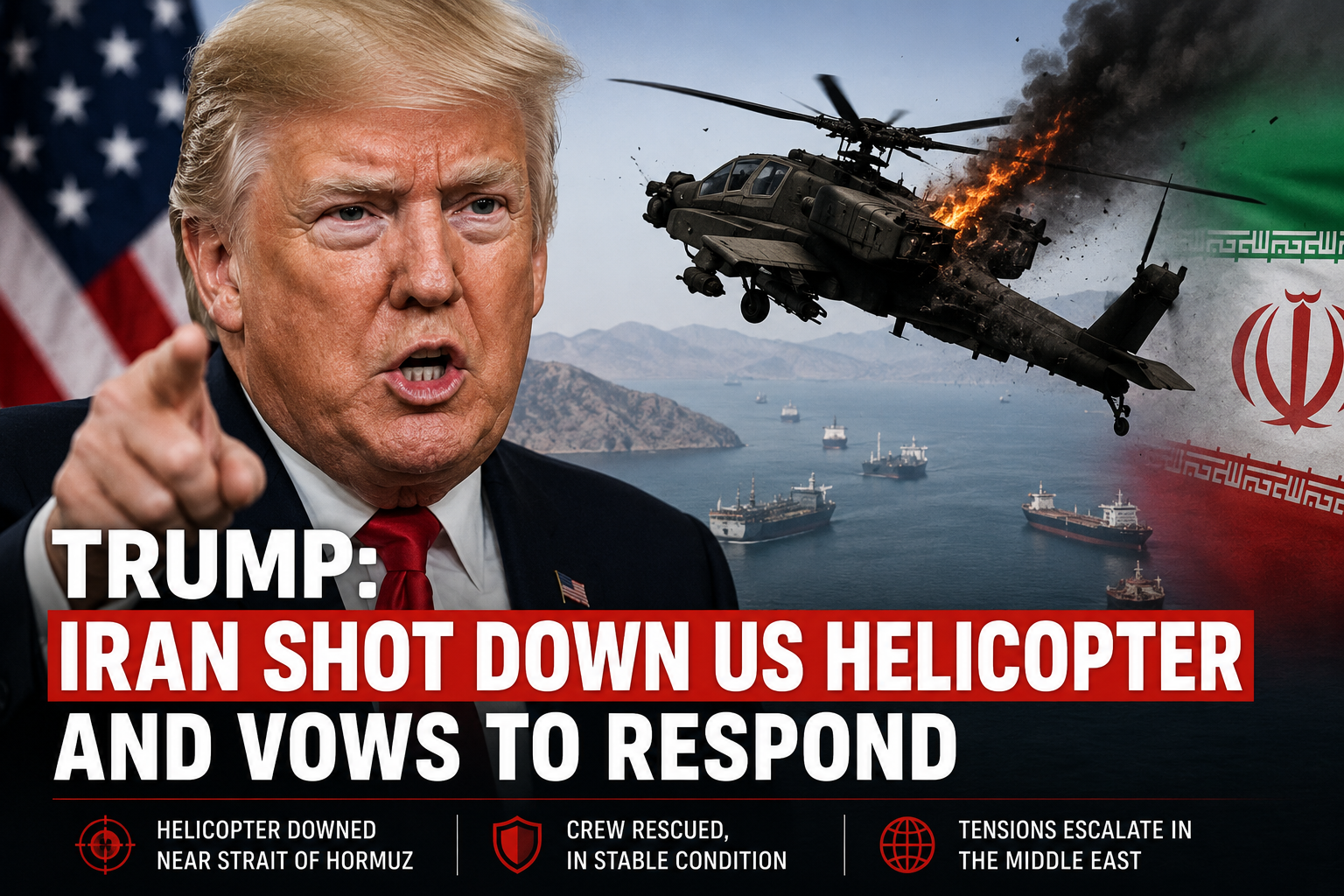
U.S. President Donald Trump has accused Iran of shooting down a U.S. Army Apache helicopter near the Strait of Hormuz and pledged that the United States will respond to what he described as a direct attack. The incident marks a significant escalation in tensions between Washington and Tehran at a time when diplomatic efforts to reduce regional conflict remain fragile.
According to Trump, the helicopter was conducting a patrol mission over the strategically important Strait of Hormuz when it was allegedly targeted by Iranian forces. In a statement posted on social media, Trump said he had been informed by the U.S. military that Iran was responsible for the downing of the aircraft. He added that the United States “must, of necessity, respond to this attack.”
Despite the dramatic claim, details surrounding the incident remain limited. U.S. military officials confirmed that the helicopter went down near the Strait of Hormuz and that both crew members were safely rescued. Reports indicate the pilots are in stable condition and suffered no major injuries.
The event comes amid heightened tensions in the Middle East following recent clashes involving Iran, Israel, and U.S. forces. Analysts warn that any American military response could further destabilize the region and threaten shipping routes through the Strait of Hormuz, one of the world’s most important energy corridors.
Iran has not publicly provided a detailed response to Trump’s accusation, and investigations into the circumstances of the helicopter’s loss are ongoing. Meanwhile, global markets are closely watching developments, with oil prices showing signs of volatility as concerns about regional security grow.
As Washington considers its next steps, the incident has raised fresh questions about the future of U.S.-Iran relations and the possibility of a broader confrontation in the Gulf region.